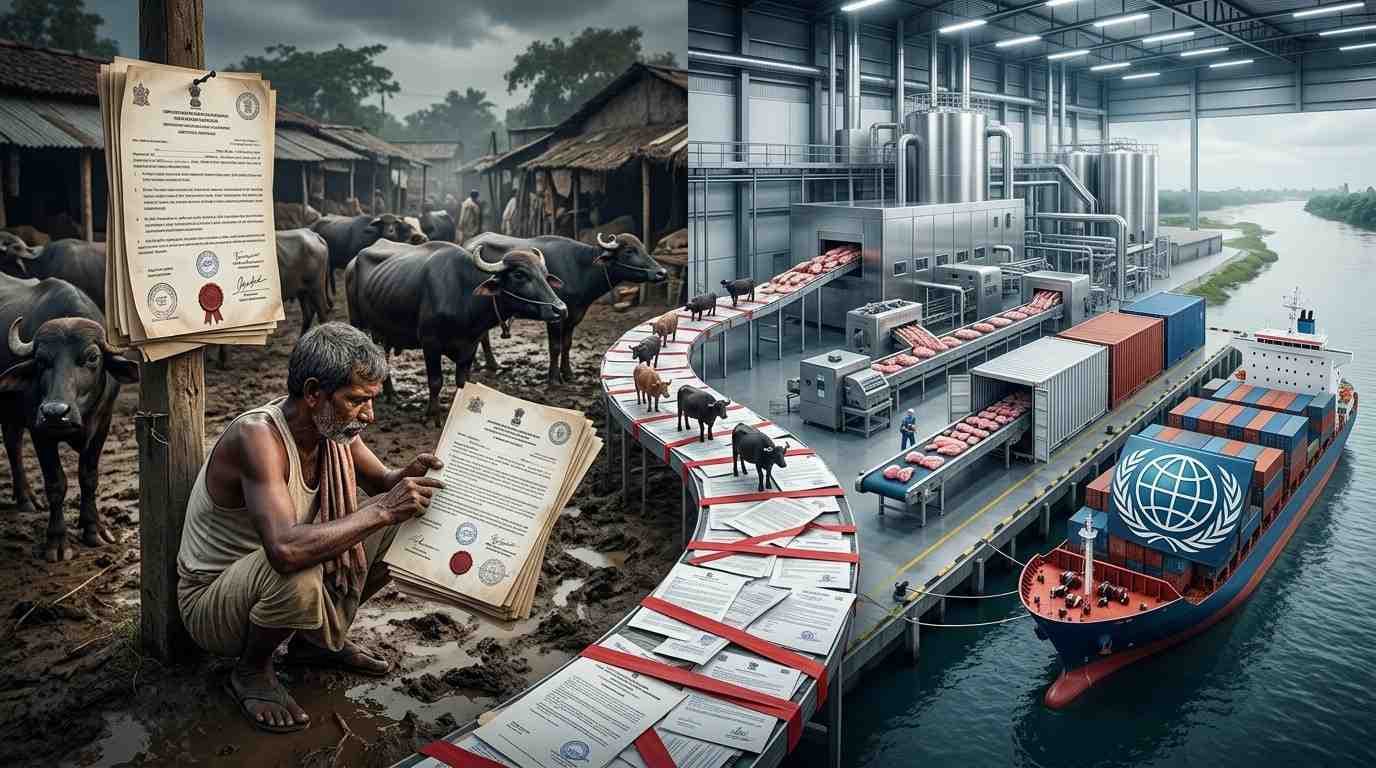
The sudden enforcement of stringent livestock verification rules in West Bengal just before Eid al-Adha has sparked an intense, polarized debate that reaches far beyond religious compliance. While mainstream narratives attribute the policy to a protective stance on cultural and religious sentiments, a parallel economic perspective is gaining traction. Ground-level observers, small-scale farmers, and market analysts are increasingly looking past the socio-religious rhetoric to ask a fundamentally disruptive question: Is this sudden regulatory squeeze truly about respecting communal sentiments, or is it a calculated administrative strategy disguised as a cultural intervention to reshape the livestock market?
To fully understand the skepticism brewing in rural trade hubs, one must look closely at the immediate consequences of the current restrictions. The mandate requiring dual-signed fitness certificates and age verifications for cattle has effectively crippled local transactions, causing an immediate oversupply of livestock. As local buyers back away to avoid legal scrutiny, prices in traditional village markets are plummeting. For small-scale dairy farmers and seasonal breeders who invested their life savings into rearing these animals, this artificial price crash is catastrophic, forcing them into a desperate corner where they must sell at a loss or absorb unsustainable maintenance costs.
This brings us to the core of the economic conspiracy theory circulating among regional farming unions. Critics are questioning who stands to benefit from a market where local livestock prices have hit rock bottom. India is structurally positioned as one of the world's absolute largest exporters of bovine meat—specifically water buffalo meat, commonly traded globally as carabeef—with export valuations comfortably exceeding 5 billion dollars. When local religious and festive demands are abruptly suppressed by policy, a massive, cheap surplus of livestock is instantly created, perfectly primed to feed into highly organized, industrial supply chains.
The central point of contention lies in the mechanism of this alleged supply shift. Skeptics argue that by implementing rules that make local, decentralized slaughter nearly impossible for the average citizen, the government forces the flow of livestock away from traditional neighborhood markets and directly toward massive, state-licensed processing facilities and corporate abattoirs. These commercial entities, equipped with the administrative resources to easily navigate complex veterinary certifications, are the only buyers left with any real purchasing power. By acquiring livestock at heavily depressed rates, these large-scale operations can drastically maximize their profit margins on the international market.
However, viewing this entire policy purely through a lens of economic opportunism risks oversimplifying a deeply embedded cultural reality. For millions of Hindus across India, the cow is not an agrarian asset, but a profound symbol of sanctity, non-violence, and maternal divinity. From this viewpoint, state interventions to control and limit slaughter are seen as a necessary and long-overdue alignment of public policy with deeply held community values. Supporters of the government's measures argue that maintaining strict oversight during major festivals is a proactive, essential step to prevent communal friction and ensure mutual respect in a shared social space.
This complex intersection leaves Bengal at a fascinating crossroads where faith and high-stakes trade directly collide. If the policy were driven purely by cultural reverence, critics argue, the stringent regulations would be accompanied by robust financial safety nets or state purchase programs to protect vulnerable farmers from economic ruin. The absence of such relief measures is precisely what fuels the narrative that the state is leveraging sensitive cultural themes as a convenient political shield, using it to quietly restructure a traditional agrarian ecosystem into a highly streamlined, export-driven corporate industry.
Ultimately, the true intent behind West Bengal’s livestock policy likely exists in the gray area where political theater, economic ambition, and genuine cultural pressure overlap. Whether the primary goal is the preservation of social harmony or the strategic dominance of a lucrative global trade, the immediate reality remains unchanged for the people on the ground. As small farmers watch their livelihoods hang in the balance, the ongoing shift highlights a modern political truth: in the arena of state policy, the line between protecting sacred traditions and capitalising on market forces is becoming increasingly invisible.