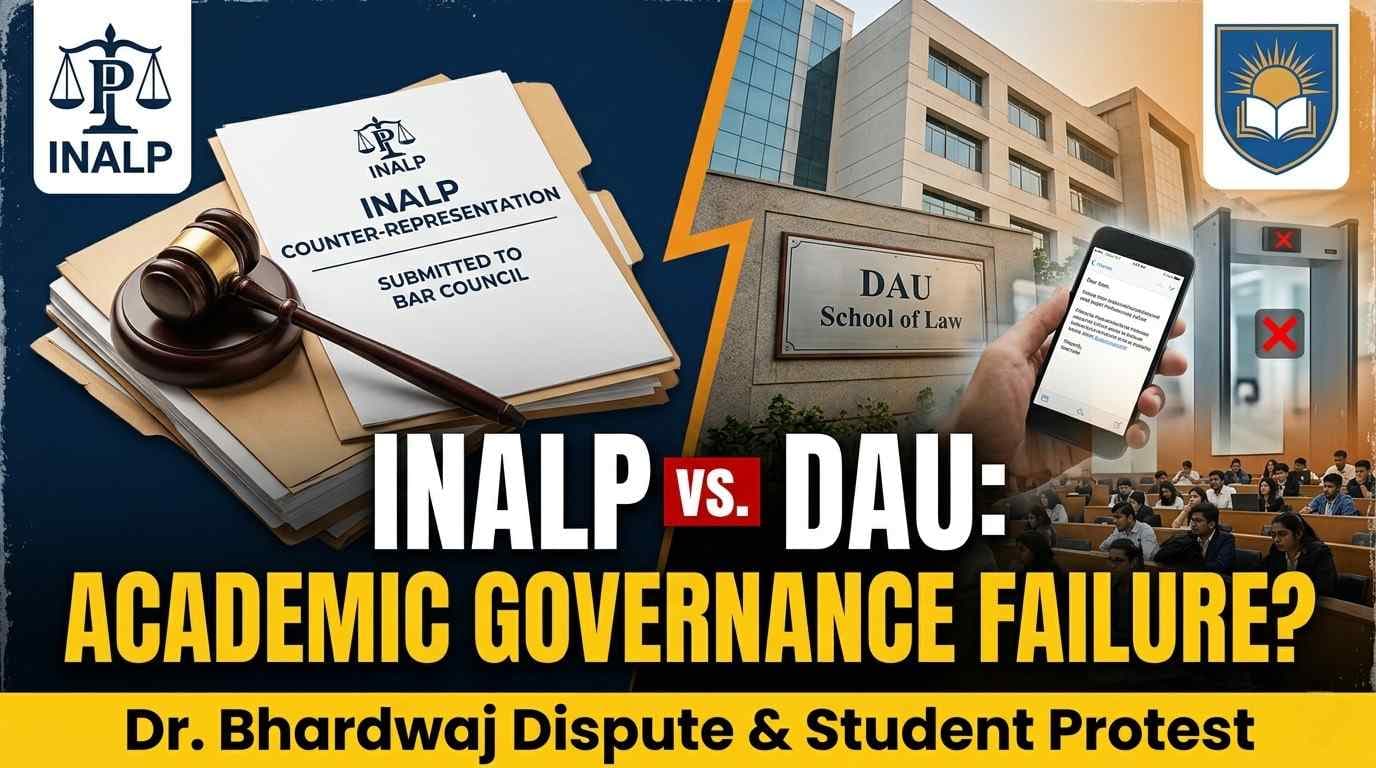
The Indian National Association of Legal Professionals (INALP) has formally challenged Dhirubhai Ambani University (DAU) School of Law through a detailed counter-representation. This move comes in defense of Dr. Manuj Bhardwaj, the INALP Executive Secretary, following a public statement issued by the university. The dispute highlights a growing friction between professional legal bodies and academic institutions over administrative conduct and faculty relations.
At the heart of INALP’s argument is a significant factual contradiction regarding the university's internal communications. The organization points to records from early April 2026 where the Law School’s Director proposed re-engaging Dr. Bhardwaj as visiting faculty. INALP contends that if there were genuine concerns regarding his performance or conduct, the university would not have initiated such a re-engagement process just days before issuing negative public statements.
The counter-representation also brings to light the voices of the student body, specifically those in the ESG, Carbon Markets, and Sustainability LL.M. batch. These students reportedly submitted signed representations expressing concern over Dr. Bhardwaj being pressured to resign. They warned that his departure would cause significant disruption to their specialized academic programme, suggesting a strong level of support for the faculty member.
A particularly contentious point in the document involves an incident on 8 April 2026, when Dr. Bhardwaj was allegedly invited to campus for discussions. INALP states he was stopped at the gate by security, an event they describe as "professionally humiliating". Although the university later expressed regret for the incident, INALP views this sequence as evidence of institutional inconsistency and poor governance.
Beyond personal reputation, the dispute touches on broader regulatory compliance within legal education. INALP alleges that a portion of the breakdown in negotiations stemmed from expectations for Dr. Bhardwaj to conduct classes online. The organization argues that this model potentially conflicts with Bar Council norms governing legal education, turning a contract dispute into a question of academic integrity.
The association has made it clear that they stand fully behind Dr. Bhardwaj and view the university’s allegations as defamatory. By placing this counter-representation before the Bar Council of India, INALP is escalating the matter to the national regulatory level. This ensures that the documentation becomes part of a formal record that could influence future disciplinary or legal proceedings.
This ongoing conflict serves as a reminder of the complex relationship between faculty, university administration, and the regulatory bodies that oversee them. As both parties stand their ground, the legal community watches closely to see how these allegations of professional misconduct and institutional inconsistency will be resolved. The outcome could set a precedent for how visiting faculty and professional associations interact with private law schools in India.
Ultimately, the INALP counter-representation is not just a defense of an individual, but an assertion of legal rights and remedies. With scanned student representations and email records attached as evidence, the document presents a robust challenge to the university's public position. The focus now shifts to whether a resolution can be found or if the matter will move further into the halls of the judiciary.
PDF Public Statement: https://l1nq.com/k4gvw32 (Source: Linkdin)