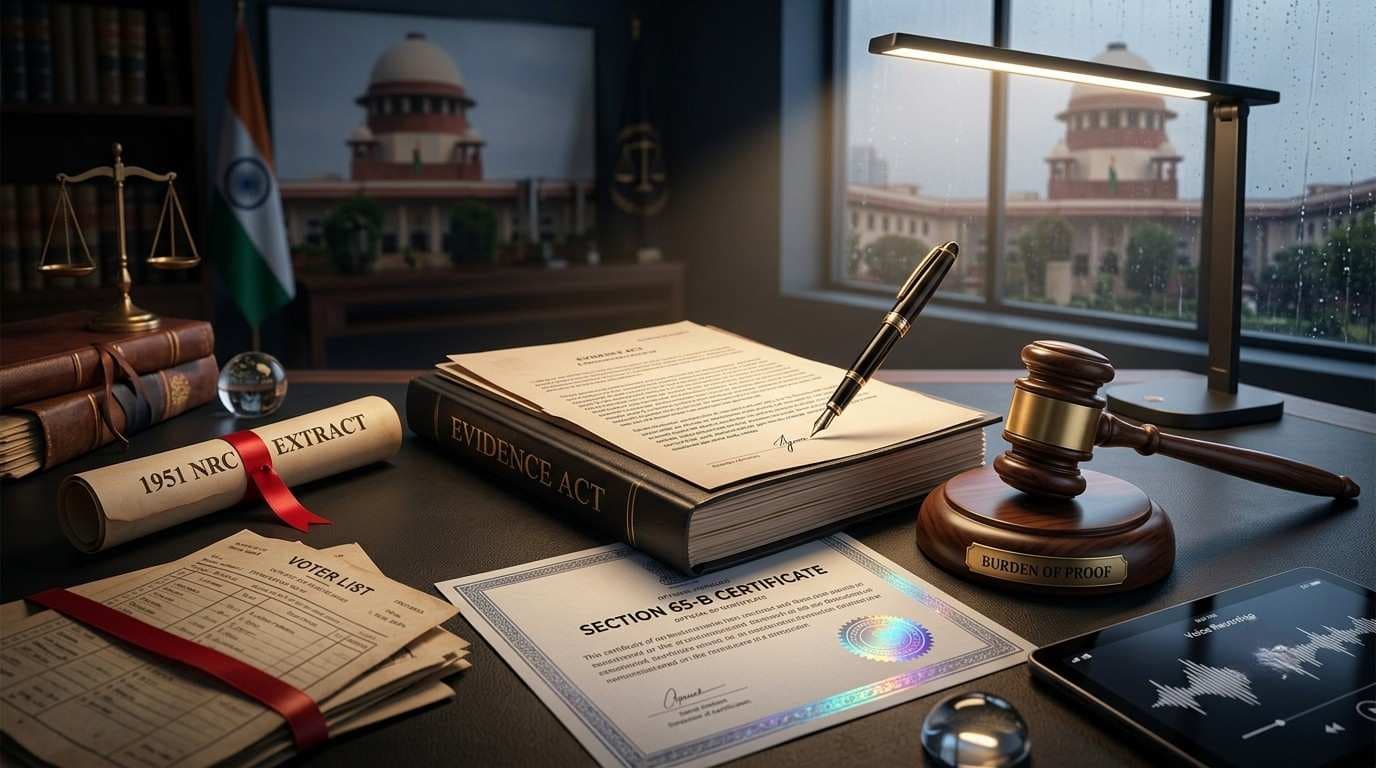
The jurisprudence surrounding citizenship determination in Assam remains one of the most complex and strictly enforced legal frameworks in India. In a notable decision, the Gauhati High Court recently dismissed a writ petition filed by Aminul Hoque, upholding a Foreigners Tribunal order that declared him a foreigner. The ruling serves as a stark reminder of the rigorous evidentiary standards mandated under Section 9 of the Foreigners Act, 1964, which places the absolute burden of proving citizenship squarely on the individual rather than the State.
The petitioner had approached the High Court to challenge an opinion dated February 28, 2019, passed by the Foreigners Tribunal. Before the Tribunal, Hoque had submitted fifteen separate documents—ranging from a computerized 1951 National Register of Citizens (NRC) extract to voter lists and personal identification cards—aiming to establish his ancestral lineage. However, the Tribunal concluded that these documents failed to create a seamless, verifiable link of Indian citizenship, thereby failing to discharge the heavy statutory burden imposed on him.
A Division Bench comprising Justice Kalyan Rai Surana and Justice Shamima Jahan meticulously evaluated the lower tribunal's record. The Bench observed that mere volume does not equate to legally sustainable evidence in citizenship disputes. Even though fifteen documents were formally exhibited, the court noted that they collectively lacked the legal weight and cross-verifiable continuity required to satisfy Section 9. Consequently, the High Court affirmed that the Tribunal committed no error in rejecting the documentation package.
The petitioner’s legal counsel vigorously argued that minor discrepancies in the names of Hoque's father and grandfather across different decades should be overlooked. Relying on the Supreme Court’s precedent in Sirajul Hoque v. State of Assam & Ors (2019), the counsel insisted that name variations are common in rural records and that the oral deposition of the petitioner's father confirming their relationship should have been decisive. Furthermore, the defense cited Shital Krushna Dhake v. Krushna Dagdu Dhak (2018) to argue that computer-generated printouts from official government websites should be directly admissible.
The High Court, however, categorically rejected the defense's reliance on Shital Krushna Dhake. The Bench clarified that the 2018 decision was strictly confined to its unique facts and did not grant a blanket waiver of admissibility for internet printouts. Crucially, the court emphasized that any electronic record must strictly comply with the procedural mandate of Section 65-B of the Indian Evidence Act, 1872. Without the required statutory certification, digital downloads cannot be accepted as valid legal evidence.
Turning to the computerized 1951 NRC extract, the Bench delivered a significant clarification based on the landmark case Abdul Mojid @ Mojid Ali v. Union of India. The court explained that the 1951 NRC was compiled under the umbrella of the Census Act, 1948. Because Section 15 of the Census Act expressly bars census records from public inspection and renders them inadmissible in judicial proceedings, an unverified 1951 NRC extract cannot be weaponized to prove domicile or citizenship.
The court also exposed critical gaps in the petitioner's reliance on historical voter lists from 1966 onwards. While names like "Pasan Ali" (alleged to be the petitioner's father) appeared in certain fragments, the defense could not show a continuous, unbroken presence of the family unit across the three villages mentioned (Dobakura, Ghugudoba, and Hashdoba). The Bench remarked that the defense's theory of routine family migration between these villages remained a mere pleading on paper, entirely unsupported by any land, tenancy, or administrative records.