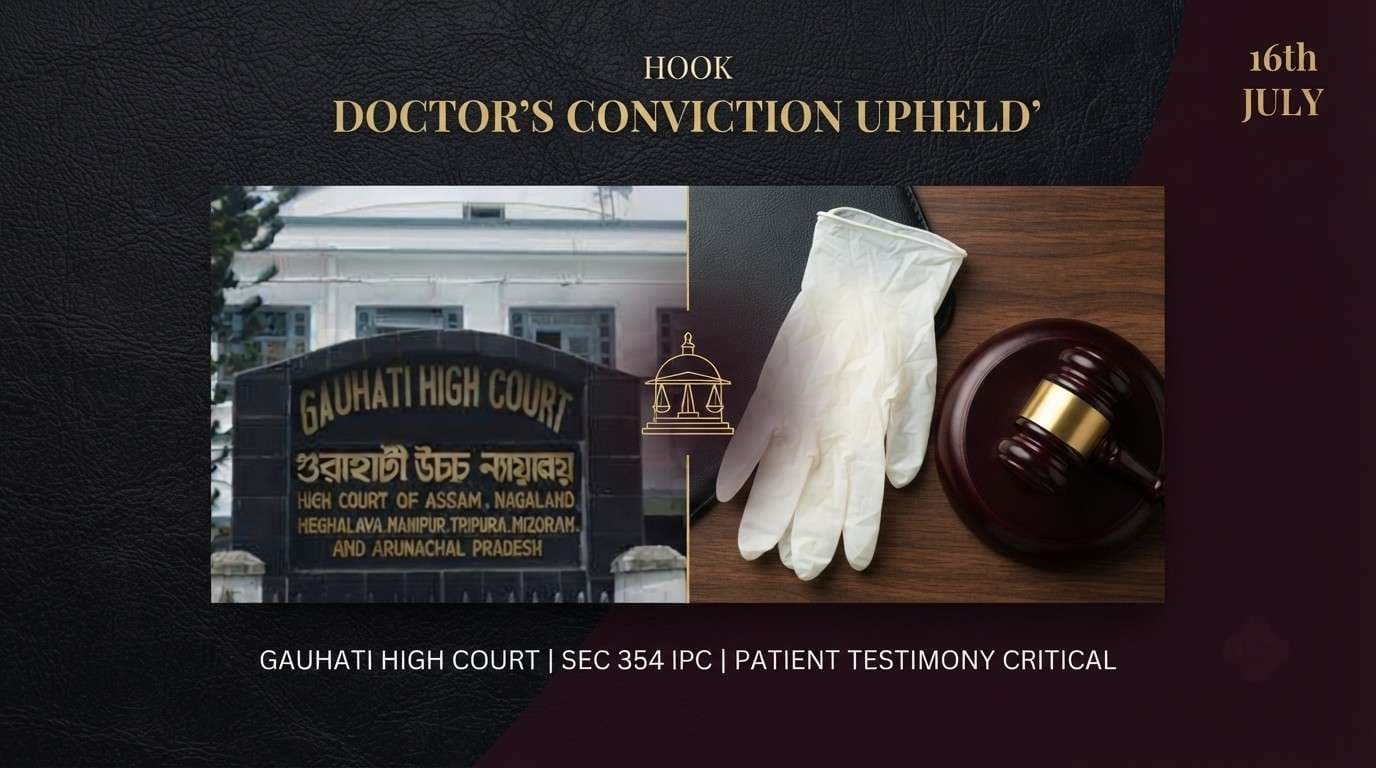
The Gauhati High Court, through a judgment delivered by Justice Susmita Phukan Khaund, has upheld the conviction of a doctor charged under Section 354 of the Indian Penal Code for outraging the modesty of a female patient. The patient had approached the doctor complaining of irregular menstrual periods. According to the prosecution case, during the examination the doctor unbuttoned the patient’s blouse, pressed and squeezed her breasts, touched her private parts and bit her lips, while telling her that such contact was part of a routine check‑up.
The trial court had found the doctor guilty in 2013 and sentenced him to undergo simple imprisonment for two years together with a fine of ten thousand rupees. The Sessions Court affirmed the conviction in 2014. The doctor then preferred an appeal before the Gauhati High Court.
In its order the High Court observed that the victim’s statement was reliable and sufficient to sustain the charge. The Court noted that minor inconsistencies in the evidence did not weaken the prosecution’s case, especially in matters concerning outrage of modesty where eyewitnesses are often unavailable. The judgment quoted the trial court’s finding that the modesty of an adult woman is inherent and can be outraged irrespective of age, intellect or state of consciousness.
Justice Phukan Khaund emphasized that the culpable intention of the accused is the crux of the offence under Section 354 IPC. The Court found that the doctor’s acts—groping the breasts despite the victim’s protests, inserting his hand into her mekhala (lower skirt), biting her lips and touching her private parts—demonstrated a clear sexual motive and could not be characterised as a legitimate medical examination.
The Court rejected the doctor’s defence that the contact was part of a routine gynaecological examination for menstrual problems or a pregnancy test. It held that a doctor may examine the abdomen or tummy in such cases but is not required to squeeze or press the breasts. The judgment described the doctor’s contention that he was conducting a routine examination as absurd, especially since the patient had stated she sought treatment for irregular periods, not for a pregnancy test.
The High Court further noted that the victim’s testimony under Section 164 of the Code of Criminal Procedure remained consistent and was not shaken by cross‑examination. There was no evidence of false implication or any motive on the part of the victim to fabricate the allegations. The Court also observed that although the patient did not suffer any physical injury, her psychological well‑being was adversely affected by the doctor’s conduct.
Ultimately, the Gauhati High Court dismissed the appeal and affirmed the conviction and sentence imposed by the lower courts. The judgment reinforces the principle that a victim’s statement, when credible, can alone establish guilt in cases of outrage of modesty, and that medical professionals must confine their examinations to what is clinically necessary, avoiding any act that could be construed as sexual harassment.