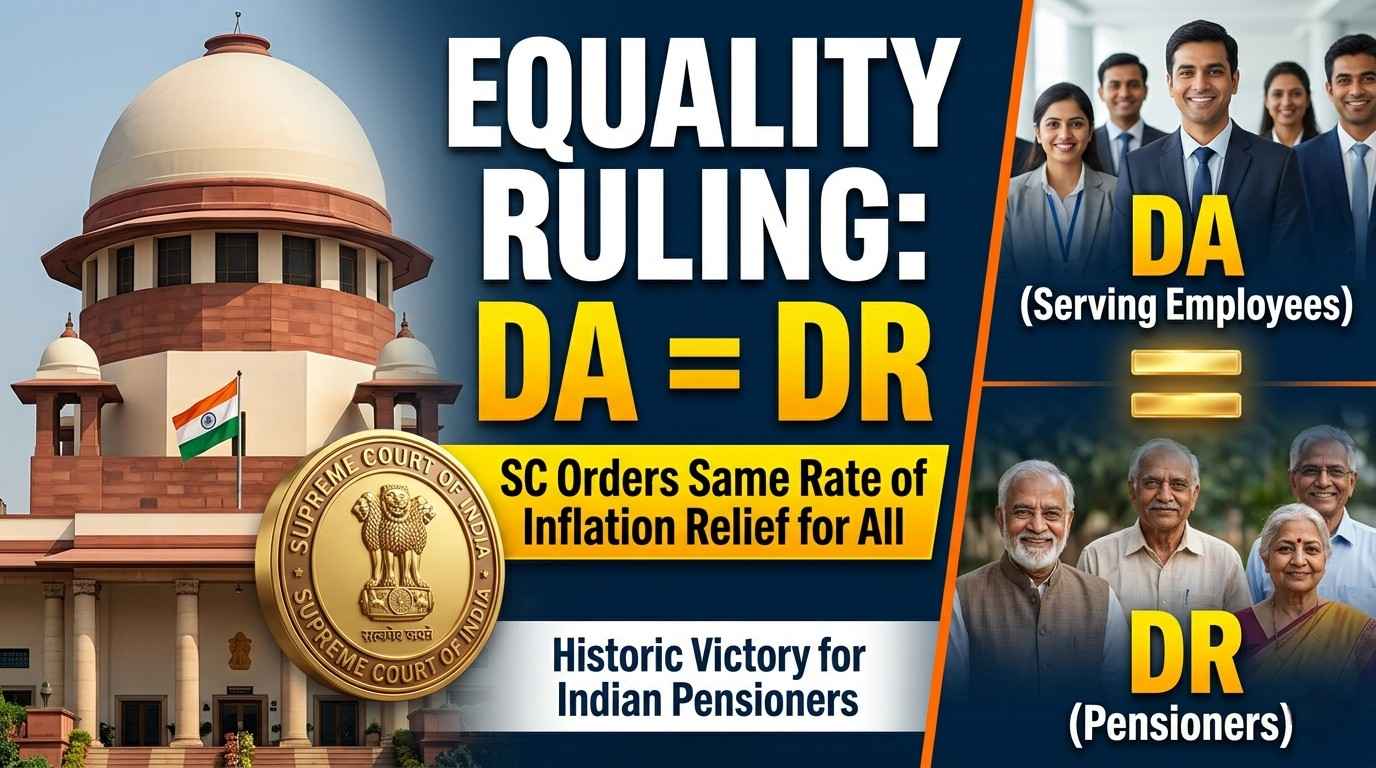
The Supreme Court of India has ruled that the State cannot grant pensioners a lower rate of Dearness Relief (DR) than the Dearness Allowance (DA) provided to serving employees. A Bench comprising Justices Manoj Misra and Prasanna B. Varale held that such a distinction is arbitrary and violates Article 14 of the Constitution, as both benefits share the singular objective of neutralizing the impact of inflation. The Court emphasized that inflation is an economic reality that "hits both serving and retired employees with equal force," leaving no rational basis for discriminating between the two groups.
The case, State of Kerala v. M Vijayakumar & Ors, arose from a 2021 Kerala government order concerning the Kerala State Road Transport Corporation (KSRTC). Under this order, serving employees were granted a 14% increase in DA, while pensioners received only an 11% increase in DR. The Kerala High Court had previously struck down this disparity as discriminatory, a decision that the state government challenged before the apex court by arguing that employees and pensioners constitute two separate legal classes.
In its detailed judgment, the Supreme Court rejected the state’s classification argument. Justice Misra noted that while serving and retired employees might be different for certain administrative purposes, they are identical in the context of inflation-linked relief. The Court clarified that since both DA and DR are pegged to the same price index and serve to mitigate the cost-of-living crisis, applying different rates of increase has "no rational nexus to the object sought to be achieved."
The KSRTC had also pleaded financial constraints as a justification for the lower payout to pensioners. While the Court acknowledged that a "financial crunch" could be a valid reason to defer the disbursement of benefits or set different implementation dates, it cannot be used to justify a lower rate of benefit once the decision to provide relief has been made. The bench made it clear that economic hardship does not grant the State the license to act arbitrarily or unfairly toward those who are no longer in active service.
This ruling is a significant victory for pensioners across India, as it solidifies the principle of parity between DA and DR. The Court’s observation that "inequality rooted in arbitrariness cannot stand the test of fairness" serves as a reminder to state governments that retired individuals are entitled to the same economic safeguards as their working counterparts. The judgment ensures that pensioners, who are often more vulnerable to rising prices, are not left behind during periods of high inflation.
Ultimately, the Supreme Court dismissed the appeals filed by the State of Kerala and KSRTC, affirming that the right to equal treatment under the law extends to the calculation of inflation-linked allowances. This decision reinforces the judiciary’s role in protecting the financial dignity of retirees and ensures that state policies regarding dearness benefits remain grounded in constitutional equity rather than administrative convenience