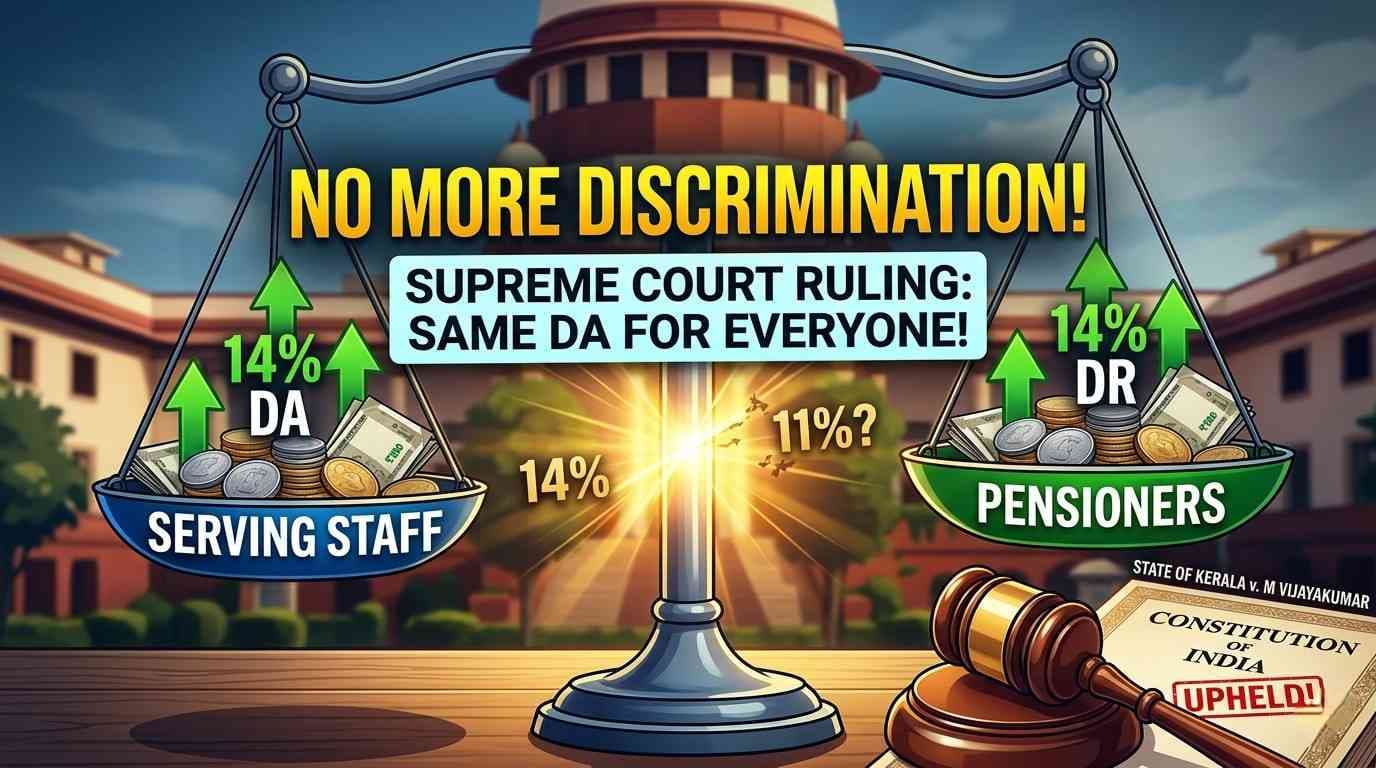
The Supreme Court of India has delivered a significant verdict upholding the principle of economic parity, ruling that the State cannot discriminate between serving employees and pensioners when it comes to the rate of Dearness Allowance (DA) and Dearness Relief (DR). A Bench comprising Justices Manoj Misra and Prasanna B. Varale held that inflation is an "all-encompassing economic reality" that does not differentiate between those in active service and those who have retired. Consequently, any attempt to provide a lower rate of relief to pensioners is arbitrary and violates the right to equality under Article 14 of the Constitution.
The ruling came in the case of State of Kerala v. M Vijayakumar & Ors, which challenged a Kerala government decision regarding the Kerala State Road Transport Corporation (KSRTC). In 2021, the state had sanctioned a 14% DA increase for active employees but restricted the DR for pensioners to only 11%. The Supreme Court dismissed the state’s appeal against a High Court order that had struck down this disparity. The Bench clarified that while employees and pensioners may form different classes for some administrative purposes, they are "similarly situated" regarding the need for protection against the rising cost of living.
The Court further addressed the common plea of "financial crunch" raised by state authorities. It ruled that while a lack of funds might justify a delay or deferment in paying out these benefits, it cannot serve as a legal basis for creating a permanent disparity in the percentage of relief granted. The judgment emphasizes that DA and DR are both pegged to the Consumer Price Index (CPI), and since the objective of both is to neutralize the erosion of purchasing power, they must remain synchronized.
Beyond the immediate financial implications for KSRTC, the judgment sets a nationwide precedent for public sector undertakings and state governments. It reinforces the idea that pension is not a "bounty" or an act of charity, but a hard-earned right that carries with it the right to maintain a dignified standard of living. By ensuring that pensioners receive the same 14% increment as serving staff, the Court has provided a vital safety net for senior citizens who are often the hardest hit by fluctuating market prices.
The decision is also expected to reduce future litigation in various High Courts where similar disparities in DA/DR implementation are being challenged. Legal experts suggest that this ruling forces state governments to be more disciplined in their fiscal planning, as they can no longer treat the "pensioner's share" as a flexible variable to balance budgets. The Supreme Court has effectively signaled that the dignity of the retired workforce is a non-negotiable constitutional mandate that takes precedence over administrative convenience.
Ultimately, this verdict serves as a cornerstone for social security jurisprudence in India. It bridges the gap between the working and the retired, ensuring that the "inflation-neutralizing" mechanism of the State functions as a unified shield. For thousands of retirees, this means a more predictable and equitable financial future, grounded in the Supreme Court’s affirmation that the "bite of inflation" is felt by all, regardless of whether they are at the office or at home.