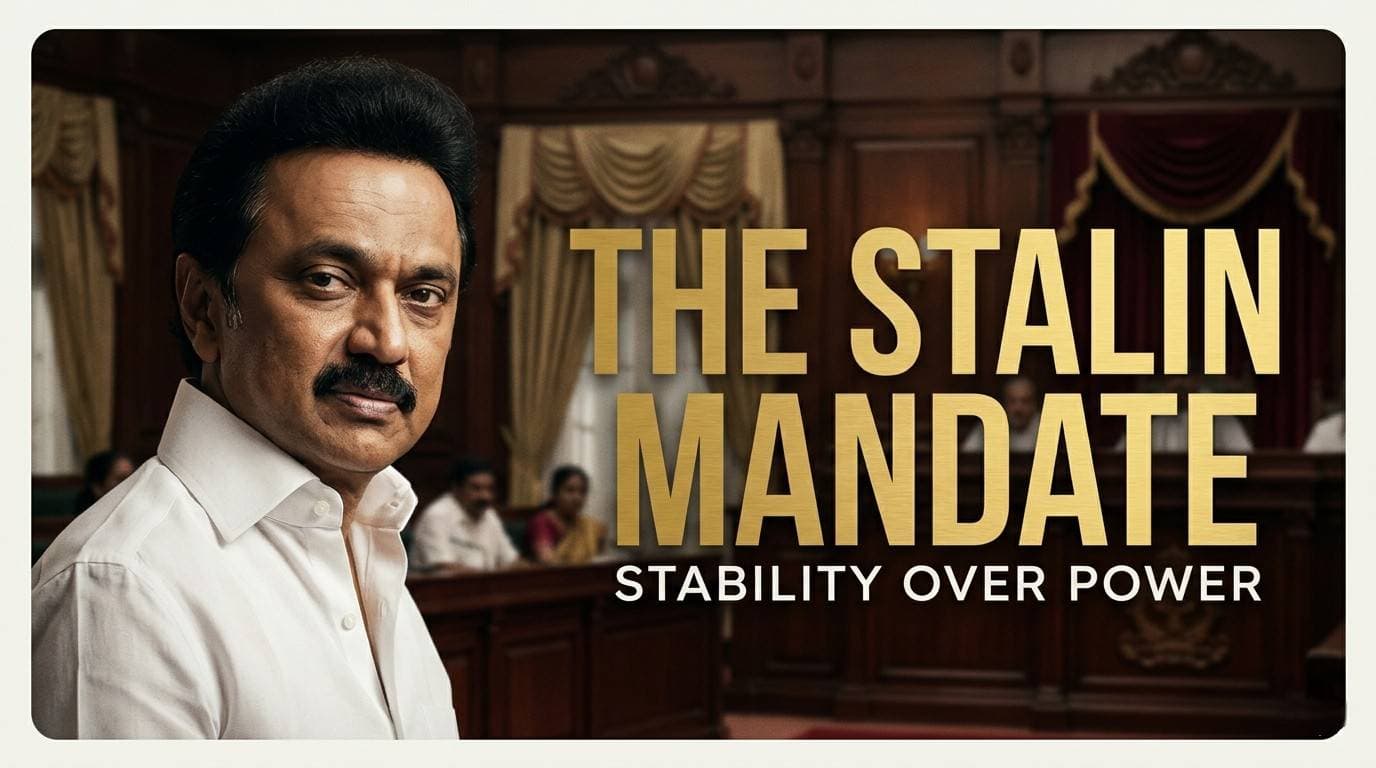
In a political landscape often defined by ruthless power plays and the desperate cling to authority, M.K. Stalin has chosen a path of constitutional sobriety. Following the recent 2026 Tamil Nadu Assembly elections, which shifted the state’s political axis, the outgoing Chief Minister has made it clear that the DMK will not "disturb" the formation of a new government or precipitate a constitutional crisis. This is a significant pivot—a moment where the heat of the campaign trail cools into the cold, hard reality of the democratic mandate, signaling a maturity that places the stability of the state above partisan maneuvering.
Stalin’s declaration is more than a mere admission of defeat; it is a calculated effort to safeguard the institutional integrity of Tamil Nadu. By stating that the DMK respects the people's mandate for a new party to assume power, he has effectively neutralized rumors of "backdoor entries" or unstable coalition attempts. In a system where hung assemblies can often lead to horse-trading and administrative paralysis, his commitment to a smooth transition acts as a stabilizing force, ensuring that the wheels of governance do not grind to a halt amidst political ego.
The refusal to "disturb" the incoming administration also serves as a sharp rejection of the "feelers" reportedly sent by rival factions. Stalin has been explicit in dismissing rumors of a potential alliance with the AIADMK to thwart a third-party emergence. This ideological rigidity reinforces the DMK’s identity as a distinct political movement, unwilling to compromise its core tenets even for the sake of power. It is a strategic retreat, allowing the party to consolidate its base and reflect on its performance without the burden of a fractured governance model.
However, "not disturbing" the new government does not equate to political silence. Stalin has redefined the DMK's immediate future as that of an "effective and efficient Opposition." This role is crucial in a democracy; it ensures that the new treasury benches are held accountable and that the interests of the Tamil people remain shielded from arbitrary policy shifts. By stepping into the opposition benches with grace, Stalin is positioning the DMK not as a fallen giant, but as a watchful guardian of the state’s welfare, ready to challenge the government on issues ranging from delimitation to fiscal autonomy.
The broader implications for the Union-State dynamic are also clear. While Stalin has signaled a cessation of electoral hostilities at the state level, his stance on central issues—particularly the 2026 Delimitation Bill—remains as fierce as ever. By avoiding a local constitutional crisis, he preserves his political capital to lead a broader regional resistance against central policies that he perceives as detrimental to the southern states. It is a dual-track strategy: peace within the state, but continued ideological warfare against the perceived "bulldozing" of federalism by New Delhi.
For the citizenry of Tamil Nadu, this stance offers a much-needed respite from the anxiety of post-poll violence or administrative uncertainty. Stalin’s emphasis on "respecting the mandate" is an appeal to his cadre to maintain peace and focus on the long-term democratic process. It reframes the election result not as a dead end, but as a new chapter where the DMK will use the "power of the pen" and the "voice of the floor" to influence the state's trajectory from a different vantage point.
In the final analysis, M.K. Stalin’s decision to act as a responsible opposition leader is a masterclass in political optics. It allows the DMK to exit the executive office with its head held high, while simultaneously placing the burden of performance squarely on the shoulders of the new administration. As the new government takes its oath, the shadow of a formidable and disciplined opposition will loom large—a reminder that in Tamil Nadu, power is never absolute, and the mandate of the people is the only true sovereign.