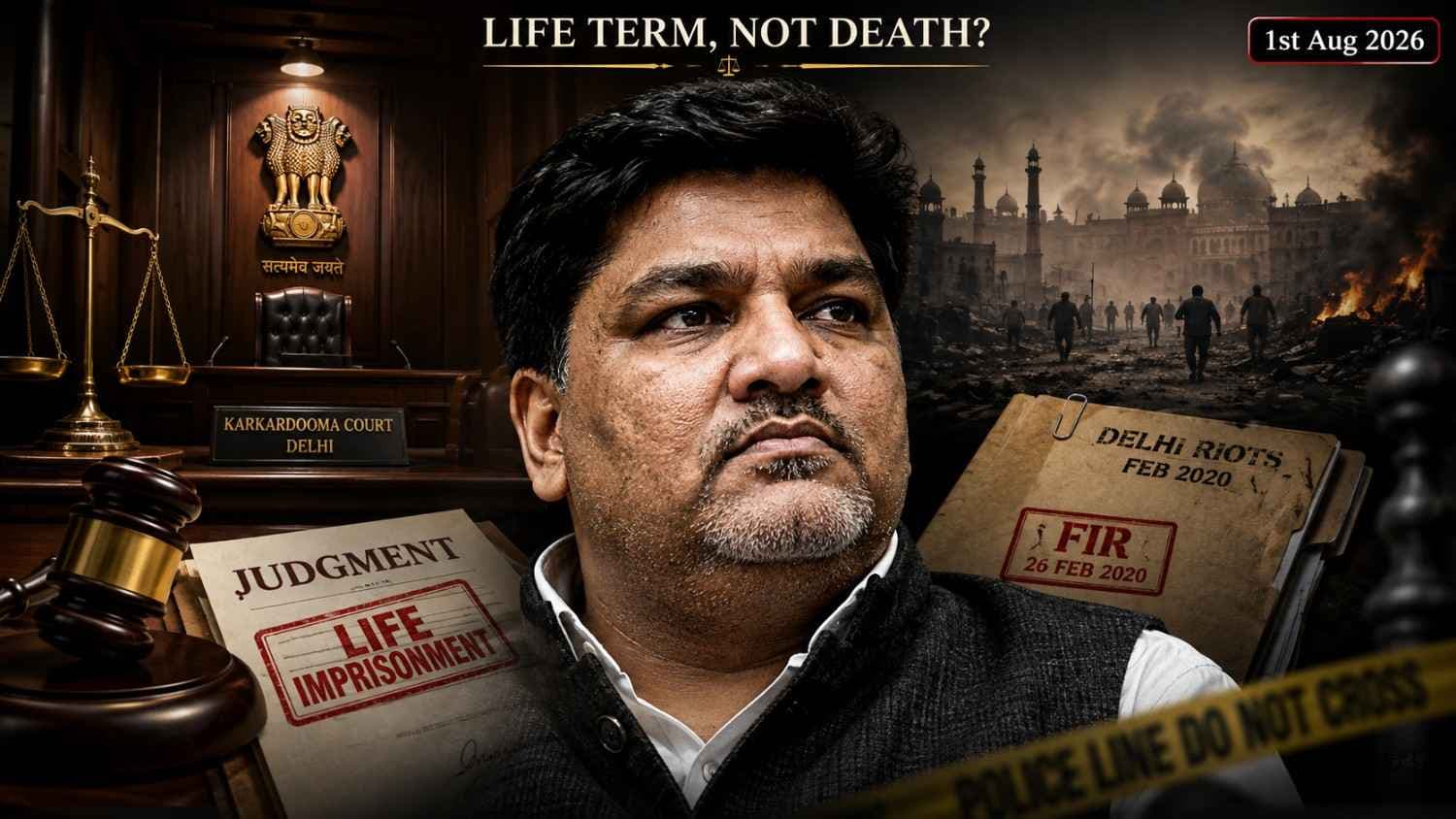
The Additional Sessions Judge (ASJ) Parveen Singh of the Karkardooma Court delivered judgment on Friday in the case relating to the killing of Intelligence Bureau officer Ankit Sharma during the communal violence that erupted in Delhi in February 2020. The court convicted Tahir Hussain, a former Aam Aadmi Party councillor, together with Nazir, Asim, Javed and Anas, for offences under Sections 188, 153A, 147, 148, 149, 365 and 302 of the Indian Penal Code. The conviction was based on the charge that the accused participated in an unlawful assembly that resulted in the murder of Sharma.
The prosecution had urged the court to impose the death penalty, describing the killing as cold‑blooded and exceptionally brutal. Counsel for the Delhi Police submitted that the crime warranted the rarest of rare category because the victim was dragged, his body was strapped like an animal and then thrown into a drain, acts that demonstrated a level of savagery that shocked the conscience of society.
In response, the defence argued that the death penalty could be imposed only when the offence falls within the rarest of rare category and that the prosecution had failed to establish any prior violent disposition or any direct role of the accused in the fatal assault. Counsel for Tahir Hussain and the other accused contended that mere membership of an unlawful assembly, even when liability is attracted under Section 149 IPC, is insufficient to attract capital punishment unless something more than passive participation is proved.
The court acknowledged the gravity of the act. ASJ Parveen Singh observed that the barbarity of the crime was “nauseating and sickening” and that the manner in which Sharma’s body was treated after the killing reflected extreme brutality. The judge noted that the offence was committed against the backdrop of widespread communal riots, which heightened the aggravating circumstances.
Despite this, the court held that the prosecution had not satisfied the threshold for imposing the death penalty. The judge reasoned that there was no evidence showing that any of the convicts had a history of violent behaviour or that they had previously been involved in any criminal activity involving violence. The conduct of the accused while in judicial custody, apart from minor infractions, was described as entirely satisfactory, indicating that they were capable of following rules and could be reformed.
The court further held that the prosecution had failed to prove that Tahir Hussain had aided, abetted, instigated or led the unlawful assembly. It emphasized that the allegation that Hussain used his residence as a launchpad for the riots was neither framed as a charge nor supported by any evidence presented during the trial. Consequently, the court found that the prosecution could not establish the requisite element of direct or vicarious participation that would justify a death sentence under the rarest of rare doctrine.
Applying the principles laid down in Bachan Singh v. State of Punjab and subsequent judgments, the court concluded that while the crime test tilted towards the rarest of rare category, the mitigating factors—lack of prior violent conduct, satisfactory behaviour in custody and the possibility of reformation—outweighed the aggravating circumstances. Accordingly, ASJ Parveen Singh sentenced Tahir Hussain, Nazir, Asim, Javed and Anas to life imprisonment, meaning imprisonment for the remainder of their natural lives, and refused the prosecution’s plea for capital punishment.
The First Information Report (FIR) that initiated the proceedings was lodged on 26 February 2020 on a complaint filed by Ravinder Kumar, the father of Ankit Sharma. The FIR alleged that demonstrations by both anti‑CAA and pro‑CAA groups continued for two to three days at Chand Bagh Pulia and Main Road, during which the victim was abducted and killed.
The judgment underscores the judicial approach that even in cases of extreme brutality, the death penalty will not be imposed unless the prosecution proves both the heinous nature of the act and the personal culpability of the accused beyond mere membership in an unlawful assembly. The decision may influence future proceedings involving riot‑related offences where the prosecution seeks capital punishment based on vicarious liability under Section 149 IPC.