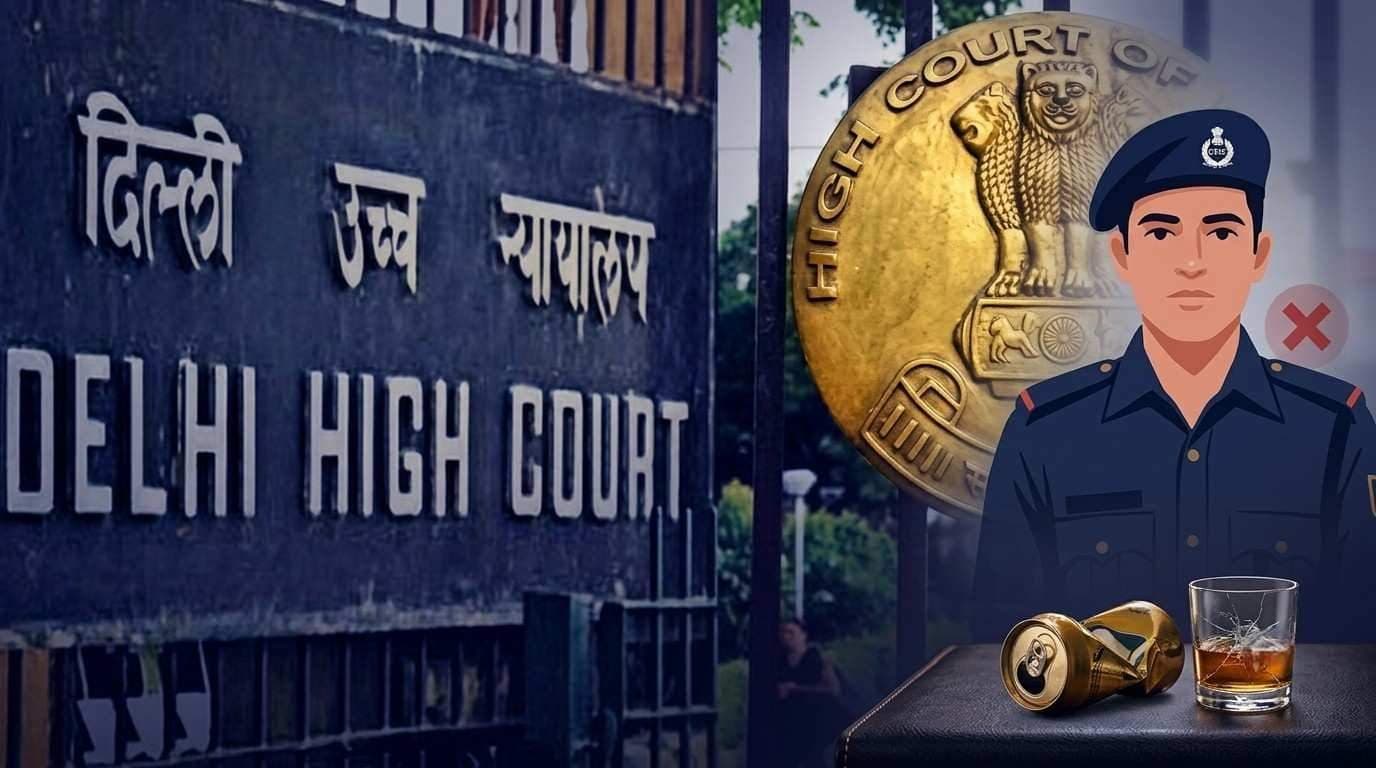
The petitioner, a constable in the Central Industrial Security Force (CISF), proceeded on sanctioned leave in January 2018. During the leave period he allegedly consumed liquor along with friends at Dhom Dam in Maharashtra and became involved in a scuffle that resulted in the death of an Indian Army personnel identified as Ganesh. An FIR was registered against him under Sections 302 and 34 of the Indian Penal Code, while the CISF simultaneously initiated departmental proceedings charging him with consuming liquor in a public place, participating in the violent altercation and bringing disrepute to the force.
Following a departmental inquiry, the charges were held to be proved and the constable was dismissed from service. His appeal and review petitions were rejected by the competent authority. Although a Sessions Court later acquitted him after key prosecution witnesses turned hostile, the departmental authorities maintained that the misconduct stood established on the standard of preponderance of probabilities.
Petitioner’s Contentions Before the High Court
Before the Delhi High Court the petitioner challenged the dismissal on two principal grounds. First, he argued that once he had been acquitted in the criminal trial the departmental punishment could not survive. Second, he contended that there was no medical evidence proving alcohol consumption and that there were no eyewitnesses implicating him directly in the death of the army personnel.
Court’s Examination of the Evidence
The Division Bench comprising Justices Anil Kshetrapal and Amit Mahajan examined the record and noted that the petitioner’s own statement admitted his participation in the liquor gathering and the subsequent altercation. The Bench observed that the departmental authorities had relied on this admission together with other corroborative material to prove the charges.
The Court emphasized that the petitioner, as a member of a disciplined armed force entrusted with duties that demand high standards of conduct, restraint and the preservation of public confidence, is held to a stricter behavioural norm than a private citizen. It stated that the proved misconduct extended beyond private consumption of alcohol to include consumption of liquor at a public place, participation in a violent altercation, involvement in an occurrence that culminated in the death of Ganesh who was enrolled with the Indian Army, and conduct that brought disrepute to the force.
Legal Reasoning on the Quantum of Punishment
The Bench held that once charges which strike at the core of integrity have been partly admitted by the petitioner and there is evidence supporting the same, the quantum of punishment imposed lies primarily within the domain of the Competent Authority. It further observed that the penalty of dismissal does not shock the conscience of the Court in the circumstances presented.
The Court rejected the petitioner’s reliance on his criminal acquittal, clarifying that departmental proceedings operate on a different standard of proof and are not automatically nullified by a criminal verdict. It reiterated that the departmental authorities had correctly applied the preponderance of probabilities standard and that the findings of misconduct were sustainable on the record.
Disposition
Accordingly, the Delhi High Court dismissed the petition and upheld the order of dismissal passed by the CISF authorities. The judgment reinforces the principle that personnel of disciplined forces are expected to maintain exemplary conduct even during periods of leave, and that departmental authorities retain discretion to impose appropriate sanctions where such standards are breached.