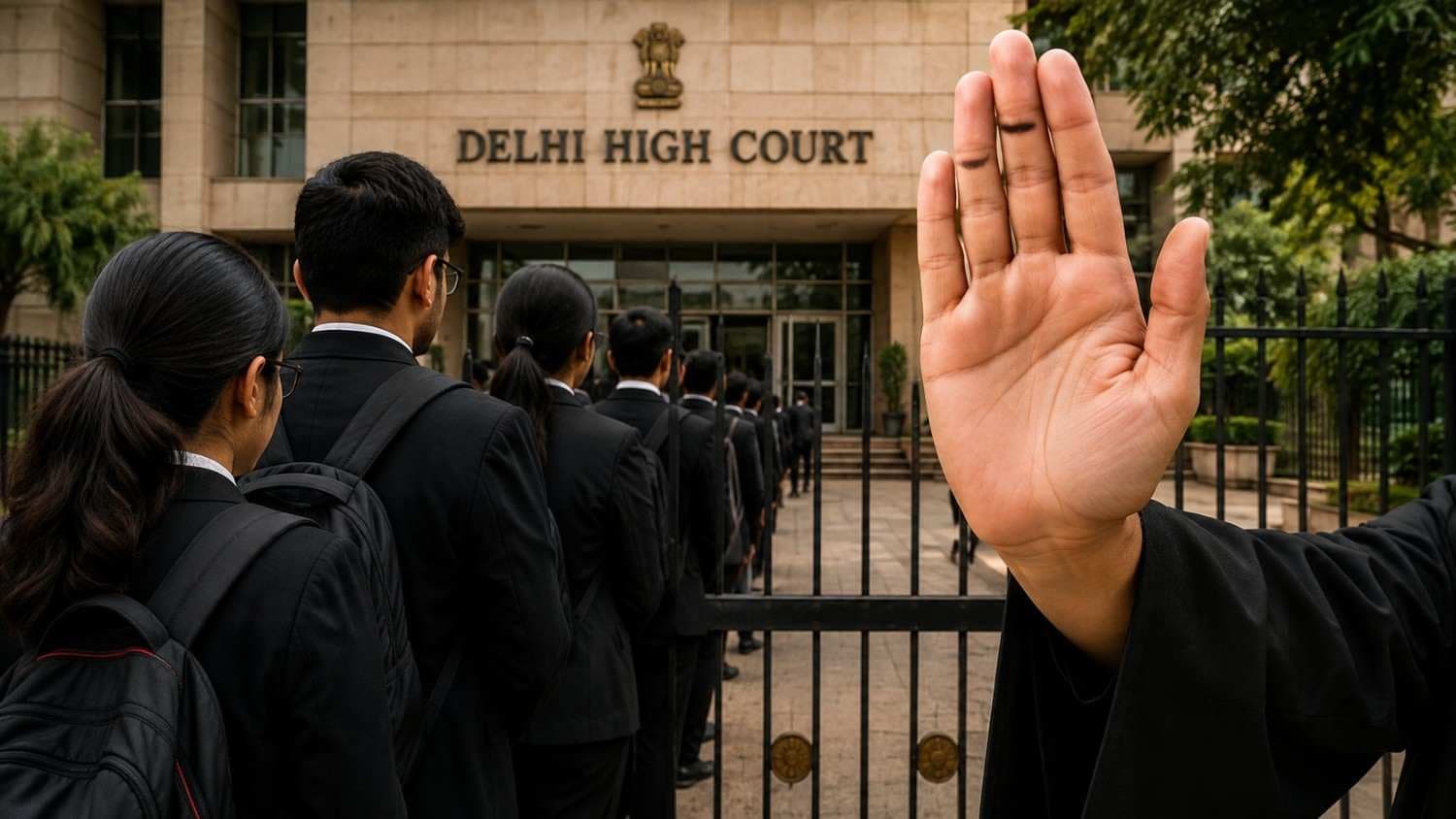
The Delhi High Court has revised its policy governing the issuance of entry passes and identification cards to law students seeking to intern with advocates practising before the Court. According to a circular issued by the Court on August 24, 2026, access to court premises for internship purposes will henceforth be restricted to specific categories of law students.
Only students in their final year of the three-year LLB programme and those in the fourth and fifth years of the five-year integrated LLB course will be eligible to receive entry passes and ID cards. The Court has explicitly stated that entry passes will be issued only to these students going forward.
To obtain an ID card, law students must submit a set of prescribed documents. These include a recommendation letter from the advocate with whom they intend to intern, accompanied by the advocate’s enrolment number. Additionally, applicants must furnish a photocopy of the advocate’s Bar ID card, a photocopy of their own Aadhaar card, a photocopy of their college ID card, and two stamp-size photographs.
The circular does not specify the rationale behind the restriction, nor does it indicate whether the change applies retrospectively or prospectively to existing interns. It also does not mention any consultation with law colleges, bar associations, or student representatives prior to its issuance. The Court has not clarified whether the policy aims to address concerns related to court security, administrative efficiency, or the supervision of interns.
The restriction effectively excludes first, second, and third-year students of the five-year integrated LLB programme, as well as first and second-year students of the three-year LLB course, from accessing court premises for internship purposes under the revised scheme. Students in these earlier academic years will no longer be eligible for entry passes issued by the Delhi High Court for internship advocacy.
The Court has not announced any review mechanism or timeline for reassessing the policy. Similarly, no details have been provided regarding the duration of validity for the entry passes issued under the new criteria or the process for renewal, if applicable. The circular remains silent on whether exceptions may be considered for special circumstances, such as academic projects or moot court affiliations requiring court access.
Legal education institutions and student bodies have not yet issued public responses to the circular as of the date of this report. The Bar Council of Delhi has also not commented on the implications of the restriction for internship opportunities or vocational training for law students.
The Delhi High Court’s decision marks a notable shift in its long-standing practice of facilitating court exposure for law students across various stages of their academic programmes. By limiting access to senior-year students only, the Court has narrowed the pool of eligible interns, potentially affecting early exposure to court proceedings and advocacy observation for junior law students.