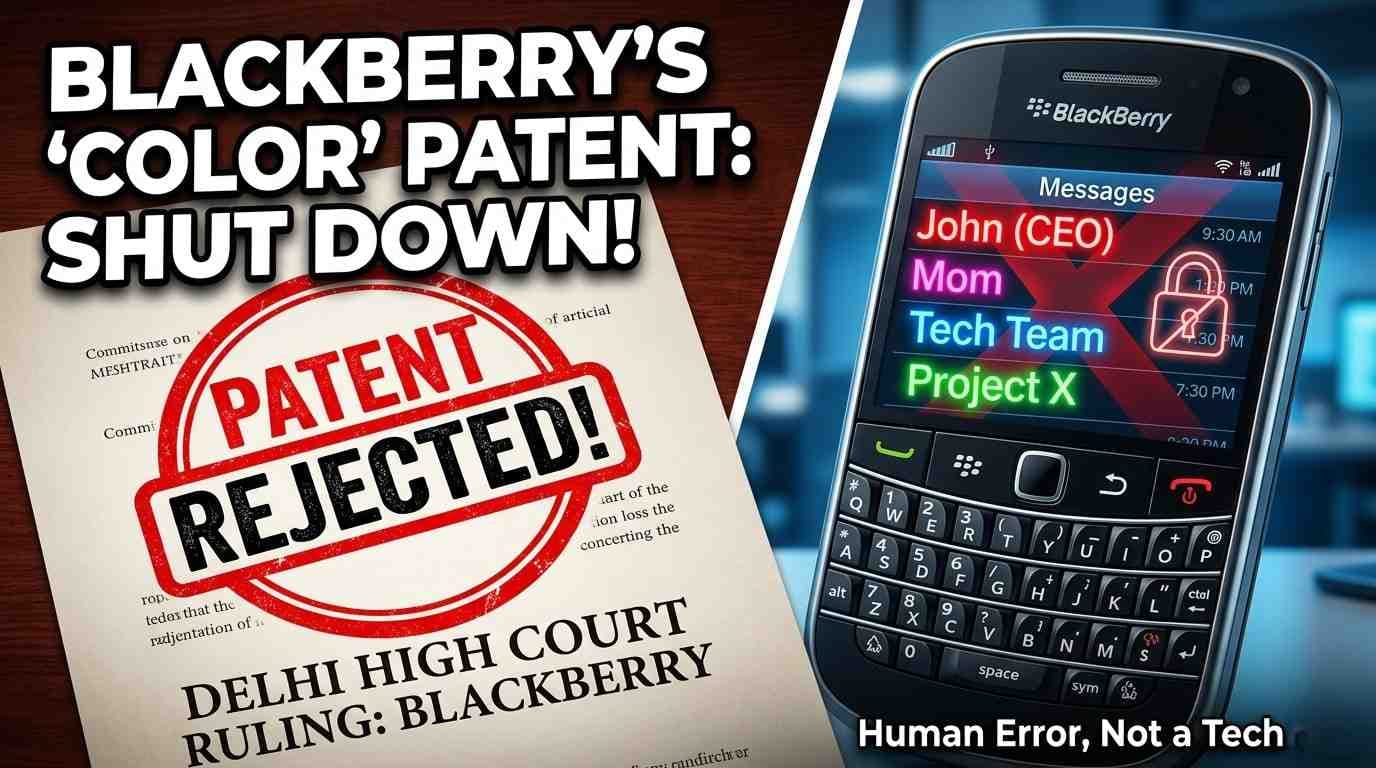
In a significant decision for the technology and intellectual property sectors, the Delhi High Court has rejected a patent claim by BlackBerry Limited regarding its "colour-coded messaging" feature. On Thursday, April 30, 2026, Justice Tejas Karia dismissed BlackBerry’s appeal against the Controller of Patents, ruling that the feature fails the essential tests of patentability under Indian law.
The patent application, which dates back to 2008, described a method for assigning specific colours to message recipients on mobile devices. The intent was to help users visually identify recipients and avoid errors before hitting send. However, the Court held that this feature lacked a crucial "inventive step," categorizing it as an obvious extension of existing technologies.
A central pillar of the ruling was Section 3(k) of the Indian Patents Act, which excludes computer programs per se or mathematical methods from being patented. Justice Karia observed that the colour-coding feature was essentially a software-based method of presenting information. Crucially, it did not improve the underlying hardware or the system performance of the device itself.
The Court’s detailed examination of "prior art"—existing technologies at the time of the application—revealed that systems already existed for grouping messages by category and providing recipient alerts. Justice Karia noted that combining these known concepts with visual colour differentiation did not constitute a unique technical breakthrough.
Addressing BlackBerry’s argument that the invention solved the "technical problem" of incorrect message addressing, the Court provided a sharp rebuttal. It clarified that choosing the wrong recipient is a "human error," not a technical flaw in the device. The judgment pointed out that even with the invention, a user with multiple contacts of the same name would still need to memorize various colours, meaning the potential for human error remains.
"Even after the present invention is implemented, the sender still may commit an error," the Court remarked, adding that computer-related inventions must demonstrate a "clear technical effect" to qualify for protection—a standard this application failed to meet.
This ruling reinforces the high bar set by Indian courts for software-related patents. It underscores the principle that mere improvements in user interface or aesthetic convenience do not equate to patentable technical innovations. For tech companies operating in India, the judgment serves as a reminder that patents are reserved for inventions that advance the functional or systemic capabilities of hardware, rather than those that simply refine how information is displayed to the user.
As BlackBerry’s long-standing pursuit for this specific patent ends, the decision provides valuable clarity on the boundaries of Section 3(k) and the definition of an "inventive step" in the digital age.