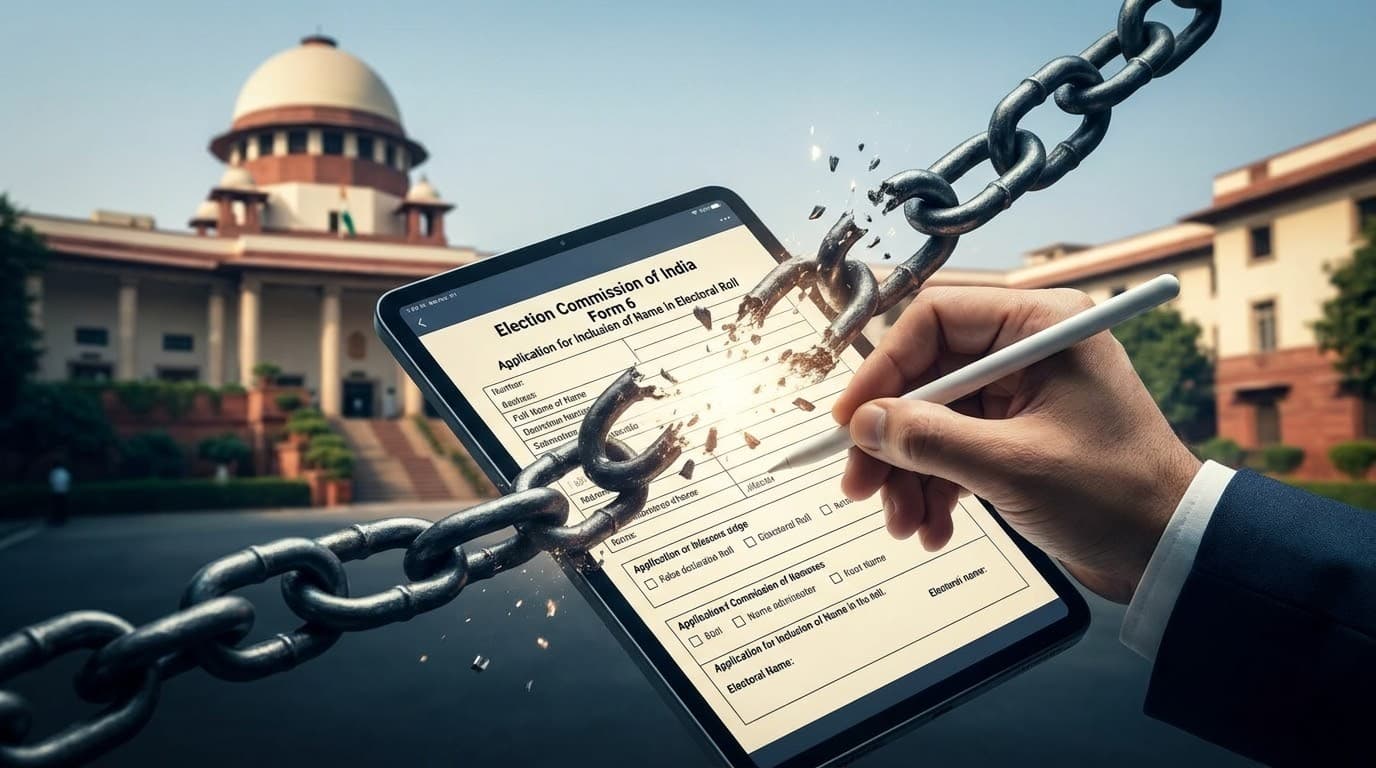
The Delhi High Court recently observed that the apprehension of an elector that he would be accused of furnishing a false declaration by submitting Form 6 to restore his name to the electoral roll is misplaced. A Division Bench comprising Justices Dinesh Mehta and Aditi Choudhary made this observation while disposing of a petition filed by Nilotpal Datta and another petitioner. The petitioners had challenged the deletion of their names from the electoral roll following their inability to complete the enumeration process during the Special Intensive Revision (SIR) of electoral rolls in Delhi after a change of residence.
The petitioners contended that the Election Commission of India’s direction requiring existing electors who could not be enumerated during the SIR to seek fresh inclusion through Form 6, rather than correcting or shifting their existing entries through Form 8, was legally untenable. They sought the restoration of their names in the electoral roll and permission to transpose their entries to the constituency corresponding to their present place of ordinary residence.
During the proceedings, Standing Counsel Sanjay Vashishtha, appearing for the Election Commission of India, submitted that the petitioners’ grievance could be redressed if they furnished Form 6 under the Registration of Electors Rules, 1960. He informed the court that the Electoral Registration Officer had offered assistance in filling out the form during the previous hearing. However, petitioner Nilotpal Datta, who appeared in person, opposed the suggestion, stating that furnishing Form 6 would amount to making a false declaration.
The Court, after hearing learned counsel for the parties, expressed its considered opinion that when the suggestion to submit Form 6 comes from the learned standing counsel appearing for the Election Commission of India, and that too as per the instructions of the Electoral Registration Officer, the petitioner’s apprehension of being accused of furnishing a false declaration is misplaced. The Bench, comprising Justices Dinesh Mehta and Aditi Choudhary, emphasized that the origin of the suggestion from the ECI’s representative, acting on the ERO’s instructions, negated any basis for the fear of legal repercussions on grounds of false declaration.
The Court clarified that its observation was made in the context of closing the petition. It noted that the petitioners had appeared before it seeking relief against the deletion of their names from the electoral roll consequent to the SIR process. The ECI was represented by Standing Counsel Sanjay Vashishtha, along with advocates Siddhartha Goswami, Ashish Shukla, and Aditya Sachedeva. Advocate Farman Ali appeared for the Union of India.
The Delhi High Court’s observation underscores that procedural guidance issued by the Election Commission of India, conveyed through its authorized counsel and grounded in the instructions of the Electoral Registration Officer, does not expose electors to the risk of being charged with making a false declaration when they comply with such guidance by submitting Form 6 for re-inclusion in the electoral roll.
The judgment reaffirms the principle that electors acting on official directions from the Election Commission’s functionaries, particularly when such directions are relayed through standing counsel in court on the basis of Electoral Registration Officer instructions, cannot reasonably be said to incur liability for false declaration under electoral laws. The Court’s reasoning rests squarely on the attribution of the suggestion to the ECI’s representative and the ERO’s instructional role, which together dispelled the petitioner’s apprehension as unfounded.
The outcome of the petition, as reflected in the Court’s observation, is that the fear of legal consequences for submitting Form 6 under the stated circumstances is without foundation. The Court did not pass any substantive order on the merits of the petition beyond this observation, as the matter was closed following the clarification offered to the petitioner.
This observation by the Delhi High Court contributes to judicial clarity on the interplay between electoral roll revision procedures, the remedial forms available to electors, and the protection against spurious allegations of false declaration when electors act on official guidance. It reinforces the elector’s confidence in availing the mechanisms prescribed by the Election Commission of India for correcting or restoring their electoral entries without fear of legal reprisal, provided the suggestion emanates from the Commission’s authorized functionaries.
The Court’s reasoning is confined to the factual matrix presented: the deletion of names post-SIR, the ECI’s direction to use Form 6, the standing counsel’s submission based on ERO instructions, and the petitioner’s personal appearance and opposition grounded in fear of false declaration. No external facts or inferences have been introduced. The observation is strictly derived from the proceedings as outlined in the evidence, with attribution maintained to the Court, the judges, the standing counsel, and the Electoral Registration Officer’s role as described.