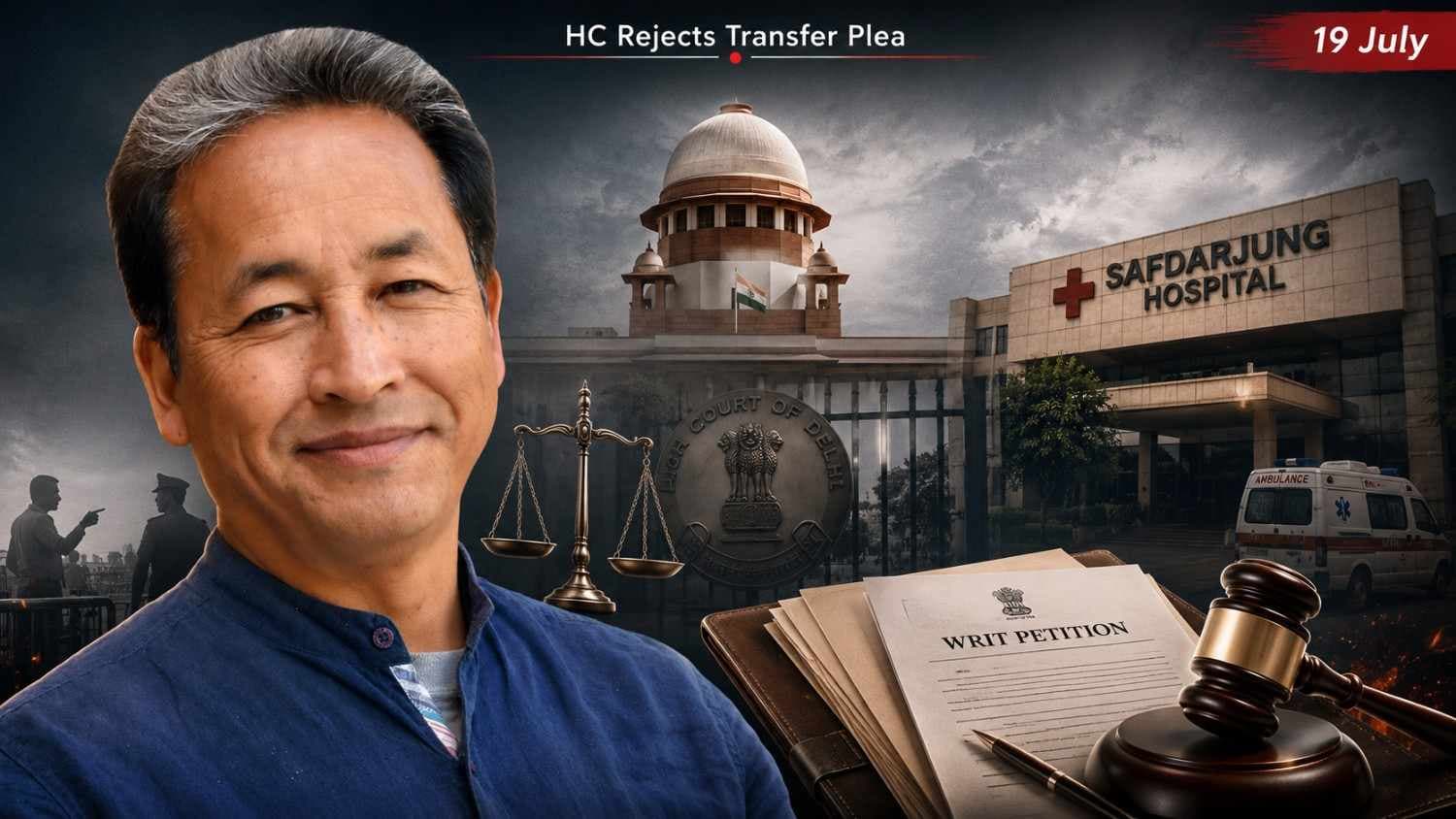
The wife of activist Sonam Wangchuk, Dr Gitanjali Angmo, filed a writ petition seeking an interim order to allow her husband to be transferred to a private hospital of his choice. The petition arose after Wangchuk, who had been on a hunger strike since 28 June at Jantar Mantar, was taken to Safdarjung Government Hospital on 18 July following a deterioration in his health. The petitioner contended that, as Wangchuk was not under detention and no offence was alleged against him, he should be free to select the medical facility where he receives treatment. She also submitted that Medanta Hospital had agreed to admit him and that she would undertake to ensure his admission if the court permitted the transfer.
The Additional Solicitor General, representing the Union of India, opposed the plea. He submitted that Wangchuk’s health had deteriorated after an 18‑day fast, necessitating immediate medical intervention. According to the ASG, apart from the doctors at Safdarjung Hospital, physicians from the All India Institute of Medical Sciences were also monitoring his condition. He emphasized that government doctors enjoy a degree of sanctity and that courts typically rely on their medical assessments in such situations. The ASG further stated that Wangchuk’s wife and brother had been granted access to him and were provided a separate room for visitation.
Justice Mini Pushkarna, presiding over the special Sunday sitting, noted that Wangchuk had not voluntarily presented himself at any hospital despite his declining health. The judge observed that, given this fact, the government’s decision to shift him to a hospital could not be characterised as an arbitrary action. The court recorded that the medical team at Safdarjung had been administering oral rehydration solution without sugar and potassium chloride tablets, and that these interventions had been carried out with Wangchuk’s consent. Consequently, the bench found no indication that force had been used or that his bodily autonomy had been violated.
Senior Advocate Kapil Sibal, appearing for the petitioner, argued that following the July 16 order of the Delhi High Court, Wangchuk had been moved to Safdarjung where he was denied access to his personal doctors and lawyers. He contended that the lack of transparency regarding prescriptions and medical advice warranted judicial intervention. Sibal also urged the court to direct the removal of police personnel from Wangchuk’s room, asserting that their presence was unnecessary in a hospital setting.
The ASG disputed the claim of police presence, maintaining that no law‑enforcement officers were stationed in the activist’s chamber. He further submitted that granting access to lawyers in a hospital environment was inappropriate, describing the request as befuddling. The ASG offered an alternative, stating that if doubts persisted regarding the treating physicians, Wangchuk could be transferred to AIIMS, where he would continue to receive care under government supervision.
During the hearing, the ASG requested that the order include a statement that doctors would have the right to undertake any interventions necessary to save Wangchuk’s life. Justice Pushkarna initially incorporated this observation but, after an objection from Sibal that it could permit forced treatment without consent, she qualified the sentence to read that Wangchuk would cooperate with doctors “if he chooses.” The ASG then warned that such a qualification might create further complications, potentially allowing the activist to refuse even basic sustenance. Consequently, the observation was omitted from the final order.
The Delhi High Court ultimately declined to pass any interim order permitting a transfer to a private hospital. The bench held that, at this stage, no immediate direction was required. However, the court issued notice to the respondents on Angmo’s writ petition and directed the Union of India to file a reply within three days. The order concluded with the statement that “the ultimate decision on any medical condition will be monitored by the medical team which shall decide as per medical protocol.”
Thus, the court affirmed the government’s action in shifting Wangchuk to Safdarjung Hospital, emphasized the importance of consent and medical supervision, and refused to intervene further pending the respondents’ reply.