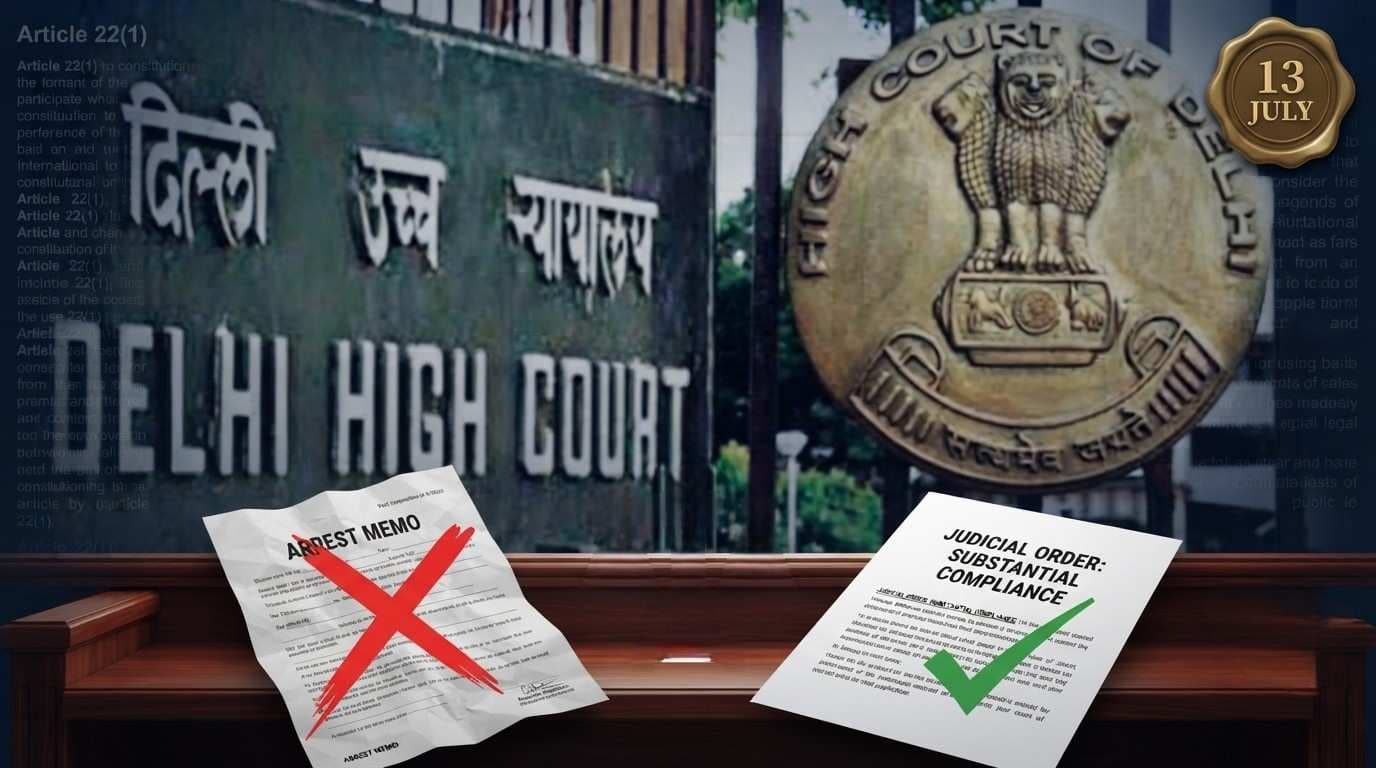
The accused was arrested by the Delhi Police on allegations of possession and trafficking of a prohibited substance, leading to charges under the NDPS Act. Following the arrest, the accused sought bail before the High Court, contending that the arrest memo prepared by the investigating agency did not satisfy the constitutional mandate to inform him of the grounds for his detention. The bail application raised the question whether the written communication of arrest grounds must conform to a particular format or whether a flexible approach, provided the essential information is conveyed, would meet the requirement of Article 22(1) of the Constitution of India.
Court’s Examination of the Arrest Memo
Justice Girish Kathpalia, presiding over the matter, examined the arrest memo drafted by the Delhi Police. The Court noted that the memo contained the essential particulars required to apprise the accused of the basis of his arrest, including the nature of the alleged offence, the date and time of detention, and the authority effecting the arrest. While the memo did not follow any prescribed template, the Court found that it substantially complied with the obligation imposed by Article 22(1) to communicate the grounds of arrest in writing.
The Bench emphasised that the constitutional guarantee under Article 22(1) mandates that a person arrested be informed, as soon as may be, of the grounds for such arrest and be afforded the right to consult and be defended by a legal practitioner of his choice. The Court observed that the purpose of this provision is to ensure transparency and to enable the accused to seek legal remedy without undue delay. In the present case, the Court concluded that the information conveyed in the arrest memo fulfilled this purpose, notwithstanding the absence of a fixed format.
Legal Reasoning on the Absence of a Prescribed Format
The High Court expressly held that neither the legislature nor the judiciary has prescribed a specific format for the written communication of grounds of arrest. The Court reasoned that imposing a rigid format would be unnecessary and could impede the practical functioning of law‑enforcement agencies, provided the substantive requirement of informing the accused is met. The judgment highlighted that the test is one of substantial compliance: whether the written notice adequately conveys the essential facts that constitute the grounds of arrest.
In reaching this conclusion, the Court relied on the principle that constitutional provisions must be interpreted in a manner that balances the protection of individual liberty with the necessities of effective investigation. The Court noted that the NDPS Act, while stringent in its substantive provisions, does not prescribe a particular manner for the communication of arrest grounds, leaving the requirement to be satisfied by the general constitutional mandate.
Outcome and Implications
Having determined that the arrest memo substantially complied with the constitutional requirement, the Delhi High Court refused to grant bail to the accused. The Court held that the custody of the accused was lawful and that there was no ground to interfere with the detention at this stage of the proceedings.
The decision provides clarity to investigating agencies and lower courts on the procedural aspect of communicating arrest grounds. It affirms that police officials are not bound to adhere to a prescriptive format but must ensure that the written notice contains the material facts necessary to inform the accused of the reasons for his detention. The judgment underscores that any deviation from a model format will not, per se, render the arrest invalid if the essential information is conveyed.
By upholding the accused’s custody on the basis of substantial compliance, the Delhi High Court reinforces the flexibility inherent in the procedural safeguards under Article 22(1) while maintaining the core objective of protecting the arrested person’s right to be informed of the grounds of arrest. The ruling is expected to influence future bail applications where the adequacy of arrest memos is contested, guiding courts to focus on the substance of the communication rather than its formal presentation.