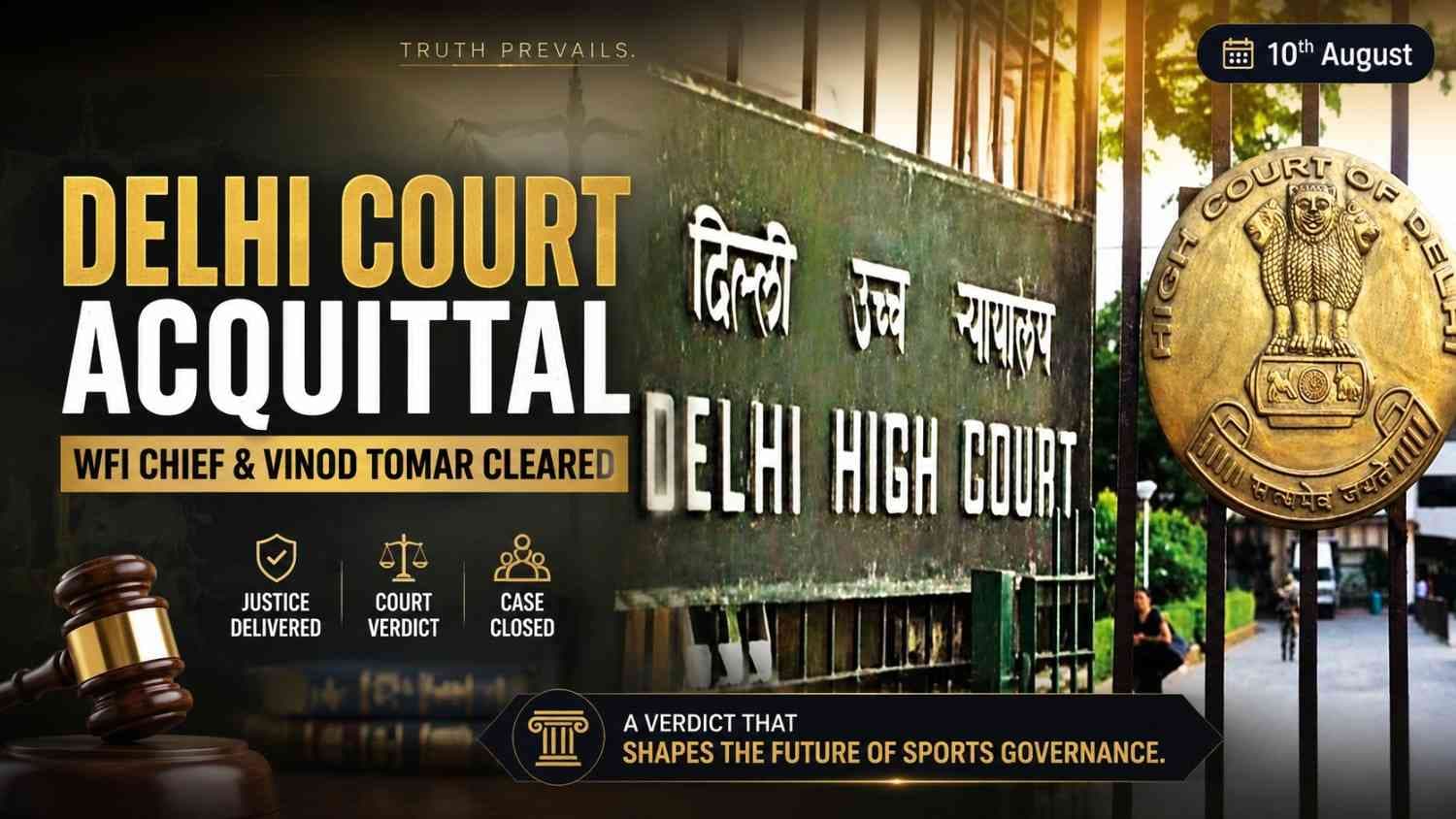
In a major legal development that marks a crucial turning point in one of Indian sports' most high-profile controversies, a Delhi court has acquitted former Wrestling Federation of India (WFI) president Brij Bhushan Sharan Singh in the sexual harassment case filed against him by top women wrestlers. The court also cleared co-accused Vinod Tomar, the former assistant secretary of the federation, of all charges.
The ruling brings an end to a long-drawn legal battle that began when several prominent national and international wrestlers took to the streets, accusing the former WFI chief of sexual harassment, intimidation, and misuse of power. The prolonged protest by top athletes made nationwide headlines and sparked a broader conversation about athlete safety, governance, and accountability within Indian sports federations.
Following the extensive protests and subsequent directions from the Supreme Court, the Delhi Police had registered an official case against the accused. The police subsequently filed a detailed chargesheet framing allegations under various sections of the Indian Penal Code, including outraging the modesty of women, stalking, and criminal intimidation.
Throughout the trial, Brij Bhushan Sharan Singh and Vinod Tomar consistently maintained their innocence, denying all allegations brought against them. The defense team argued that the claims were baseless, politically motivated, and aimed at destabilizing the federation’s management rather than addressing genuine grievances.
After reviewing the evidence, evaluating witness depositions, and hearing extensive arguments from both the prosecution and the defense, the court concluded that the charges could not be proven beyond a reasonable doubt. Consequently, the court ordered the acquittal of both individuals, clearing them of all criminal liability in the matter.
The court’s verdict has drawn swift reactions from various quarters, with supporters hailing the decision as a vindication of truth, while representatives of the protesting wrestlers expressed deep disappointment with the outcome. Legal experts note that the prosecution and the complainants retain the option to challenge the trial court’s acquittal order in a higher court.
This trial and its eventual outcome stand as a defining moment for Indian sports governance. Beyond the immediate legal implications for the parties involved, the case has forever reshaped the public discourse surrounding sports administration, safety mechanisms, and the crucial handling of harassment complaints in national athletic bodies.