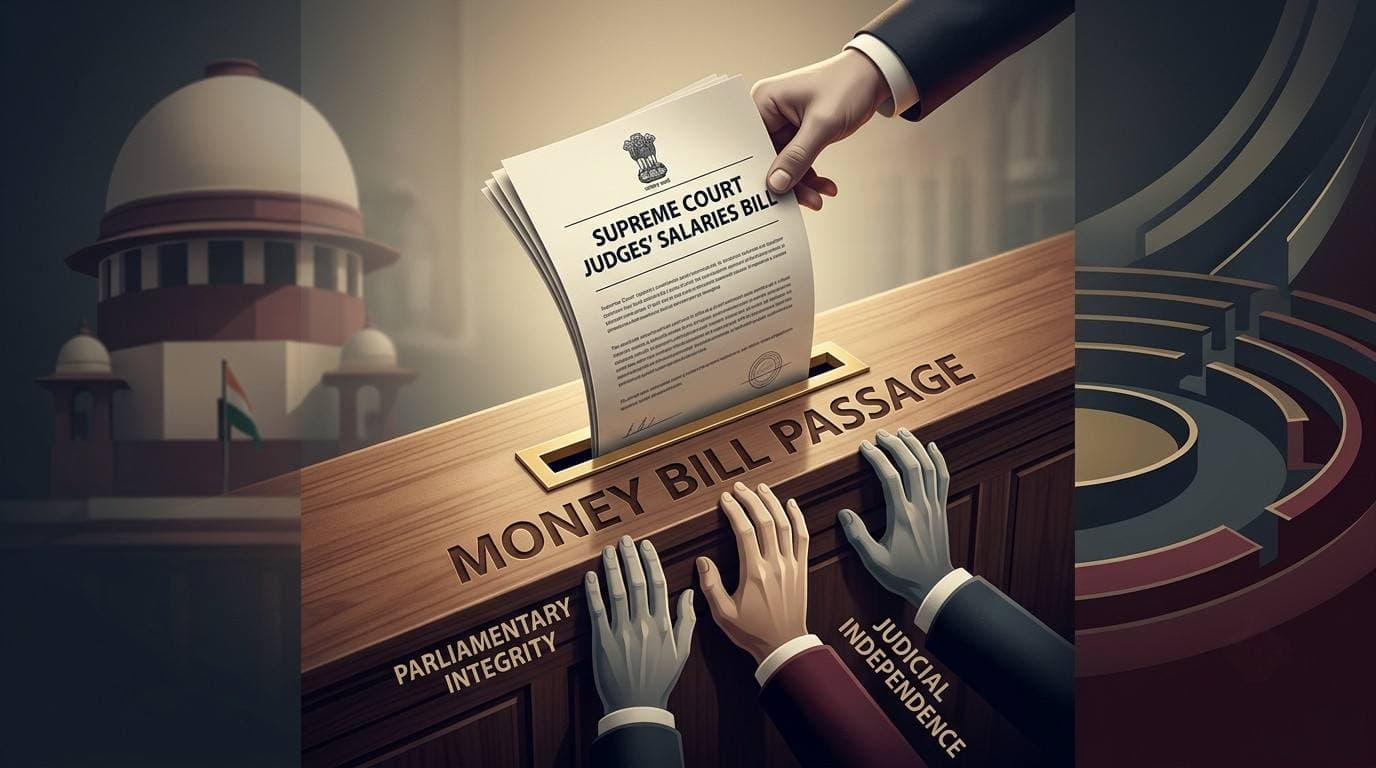
The Supreme Court (Number of Judges) Amendment Bill, 2026, was introduced in Parliament to replace an executive ordinance promulgated on May 16, 2026, following Cabinet approval on May 5, 2026. The Bill seeks to increase the sanctioned strength of Supreme Court judges from 33 to 37, excluding the Chief Justice of India, by amending the Supreme Court (Number of Judges) Act, 1956. This expansion is aimed at addressing the growing backlog of cases and enhancing the Court’s capacity to deliver timely justice.
The government’s decision to proceed with the Bill as a money bill has attracted constitutional scrutiny. Under Article 110 of the Constitution, a bill qualifies as a money bill only if it contains provisions dealing exclusively with matters specified in clauses (a) to (g) of Article 110(1). These include taxation, borrowing, appropriation of funds from the Consolidated Fund of India, and declaring any expenditure to be charged on the Consolidated Fund or increasing the amount of such expenditure. The classification of a bill as a money bill significantly alters the legislative process by limiting the Rajya Sabha’s role to making non-binding recommendations within a 14-day period, which the Lok Sabha may accept or reject.
The government’s position relies on Article 112(3)(d)(i) and Article 146(3) of the Constitution, which treat the salaries, pensions, and administrative expenses of Supreme Court judges as expenditure charged on the Consolidated Fund of India. By admitting that the additional financial burden from increasing judicial strength would be met from the Consolidated Fund, the government argues that the Bill falls under Article 110(1)(e), which covers the declaring of expenditure to be charged on the Consolidated Fund or increasing the amount of such expenditure.
However, critics contend that while the financial implications of increasing judicial strength are real, the core substance of the Bill pertains to altering the composition of the judiciary a matter of structural and institutional reform rather than financial legislation. The constitutional validity of classifying such a Bill as a money bill hinges on whether its provisions are substantially and directly related to the financial matters enumerated in Article 110, or whether the financial aspect is merely incidental or consequential to a non-financial legislative objective.
The Supreme Court has previously held that a bill cannot be classified as a money bill merely because it has financial implications. The determining factor is whether the primary and substantial purpose of the legislation relates to the matters specified in Article 110(1). In this case, the Bill’s principal aim is to amend the law governing the number of judges, which is a structural reform intended to improve judicial efficiency. The financial consequence increased expenditure on salaries and pensions is a necessary outcome of that structural change but not its central focus.
The procedural route adopted also raises questions about the satisfaction of conditions for ordinance-making under Article 123. An ordinance may be promulgated only when both Houses of Parliament are not in session and circumstances exist that require immediate action. The timing of the ordinance issued on May 16, 2026, shortly after Cabinet approval on May 5 has prompted examination of whether the requisite urgency and parliamentary recess conditions were met.
By choosing the money bill route for a legislative proposal that primarily affects judicial strength, the government has initiated a debate on the boundaries of parliamentary procedure and the potential use of financial classification to bypass the Rajya Sabha’s deliberative function. The constitutional question before the courts, if challenged, would centre on whether the Bill’s provisions, when considered as a whole, fall within the narrow and strictly defined scope of a money bill under Article 110, or whether its classification represents an overextension of the money bill mechanism to achieve legislative objectives that would otherwise require bicameral approval.