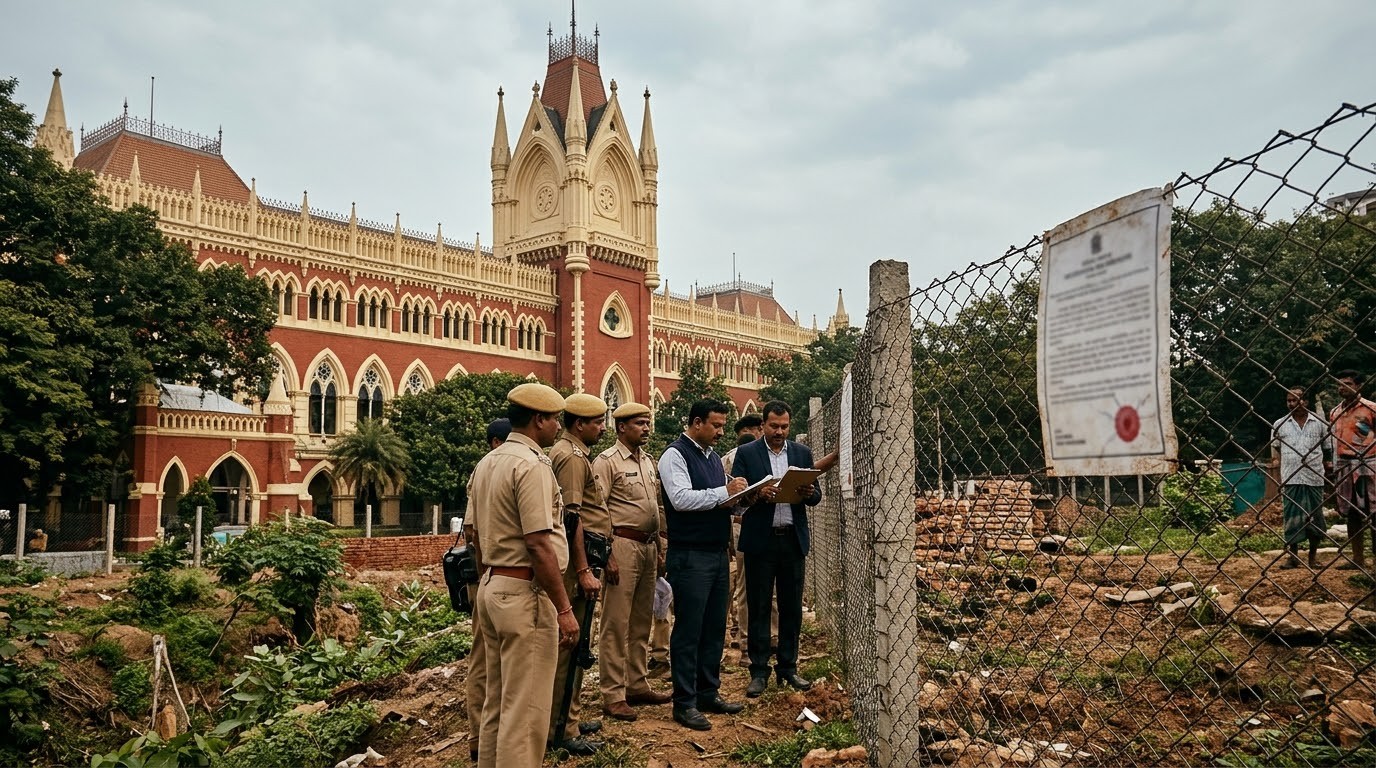
The Calcutta High Court has held that administrative authorities are bound to ensure proper implementation of a subsisting civil court order directing parties to maintain status quo over a disputed property. The direction was issued by Justice Rishad Medora while disposing of a writ petition filed by co-owners of a plot of land in Howrah, who alleged that construction activity continued unabated despite a clear judicial injunction.
Background Of The Dispute
The petitioners, Ruma Chatterjee and others, are co-owners of a property situated in Howrah along with respondents 5 to 32. According to the petitioners, respondent number 29 unilaterally authorised respondent number 33 to develop the property and undertake construction of a building. Aggrieved by this unilateral action, the petitioners instituted a partition suit before the 3rd Civil Judge (Senior Division), Howrah.
On January 28, 2026, the trial court passed an interim order directing all parties to maintain status quo with regard to the nature, character and possession of the suit property. The order remained in force at the time of the High Court proceedings. Despite this injunction, the petitioners alleged that construction activities continued at the site. In support of their contention, they relied on a report dated September 30, 2026, submitted by a court-appointed commissioner before the trial court, which purportedly confirmed ongoing construction.
Trial Court Direction To Police
Confronted with the alleged violation, the petitioners filed an application under Section 151 of the Code of Civil Procedure, 1908, before the civil court seeking enforcement of the status quo order. By an order dated October 6, 2026, the trial court directed the Officer-in-Charge of Sankrail Police Station, Howrah, to ensure that the subsisting status quo order was properly implemented at the suit property in accordance with its true spirit and purport. The court further directed that neither party should be permitted to violate the injunction.
The petitioners contended that even after bringing the October 6 order to the notice of the police authorities, construction work persisted and the police failed to take any coercive or preventive action. This alleged inaction prompted the petitioners to approach the High Court under Article 226 of the Constitution seeking a writ of mandamus or appropriate direction to enforce the trial court's mandate.
State's Defence And Inquiry Report
Opposing the writ petition, the State produced an inquiry report dated October 28, 2026, prepared by the Inspector-in-Charge of Sankrail Police Station. The State submitted that the police authorities were duly complying with the trial court's October 6 direction and denied any inaction or wrongdoing on their part. The State maintained that appropriate steps were being taken to maintain the status quo as directed by the civil court.
High Court's Observations And Disposition
After considering the materials on record and hearing the parties, Justice Rishad Medora disposed of the writ petition. The High Court directed the concerned police authority to ensure that the order dated October 6, 2026, passed by the 3rd Civil Judge (Senior Division), Howrah, was properly implemented in accordance with law. The court emphasised that the subsisting status quo order concerning the nature, character and possession of the property must be given effect to by the executive machinery.
The judgment underscores the obligation of the police to act in aid of civil court processes when specifically directed to enforce interim injunctions. The High Court refrained from commenting on the merits of the underlying partition suit or the allegations of unauthorised construction, limiting its intervention to the enforceability of the trial court's extant order.
What Is The Obligation Of Police When A Civil Court Directs Implementation Of A Status Quo Order ?
The police are bound to enforce a civil court's specific direction to implement a subsisting status quo order. The Calcutta High Court held that authorities must ensure proper implementation of such orders in accordance with their true spirit and purport, preventing any party from violating the injunction regarding the nature, character and possession of disputed property.
Stage | Order / Action | Authority | Date |
|---|---|---|---|
Interim Injunction | Status quo regarding nature, character and possession of suit property | 3rd Civil Judge (Senior Division), Howrah | January 28, 2026 |
Commissioner's Report | Alleged ongoing construction at site | Court-appointed Commissioner | September 30, 2026 |
Enforcement Direction | Directed Officer-in-Charge, Sankrail PS to implement status quo order | 3rd Civil Judge (Senior Division), Howrah | October 6, 2026 |
Police Inquiry Report | Claimed compliance with October 6 order | Inspector-in-Charge, Sankrail PS | October 28, 2026 |
High Court Disposal | Directed police to ensure proper implementation of October 6 order | Justice Rishad Medora, Calcutta HC | WPA 31480 of 2026 |
The case, titled Ruma Chatterjee & Ors. v. State of West Bengal & Ors. (WPA 31480 of 2026), reaffirms the principle that executive authorities cannot remain passive when a civil court has expressly mandated enforcement of its interim orders. The High Court's direction serves as a reminder that the rule of law requires active cooperation between the judiciary and the executive to preserve the subject matter of litigation pending adjudication.