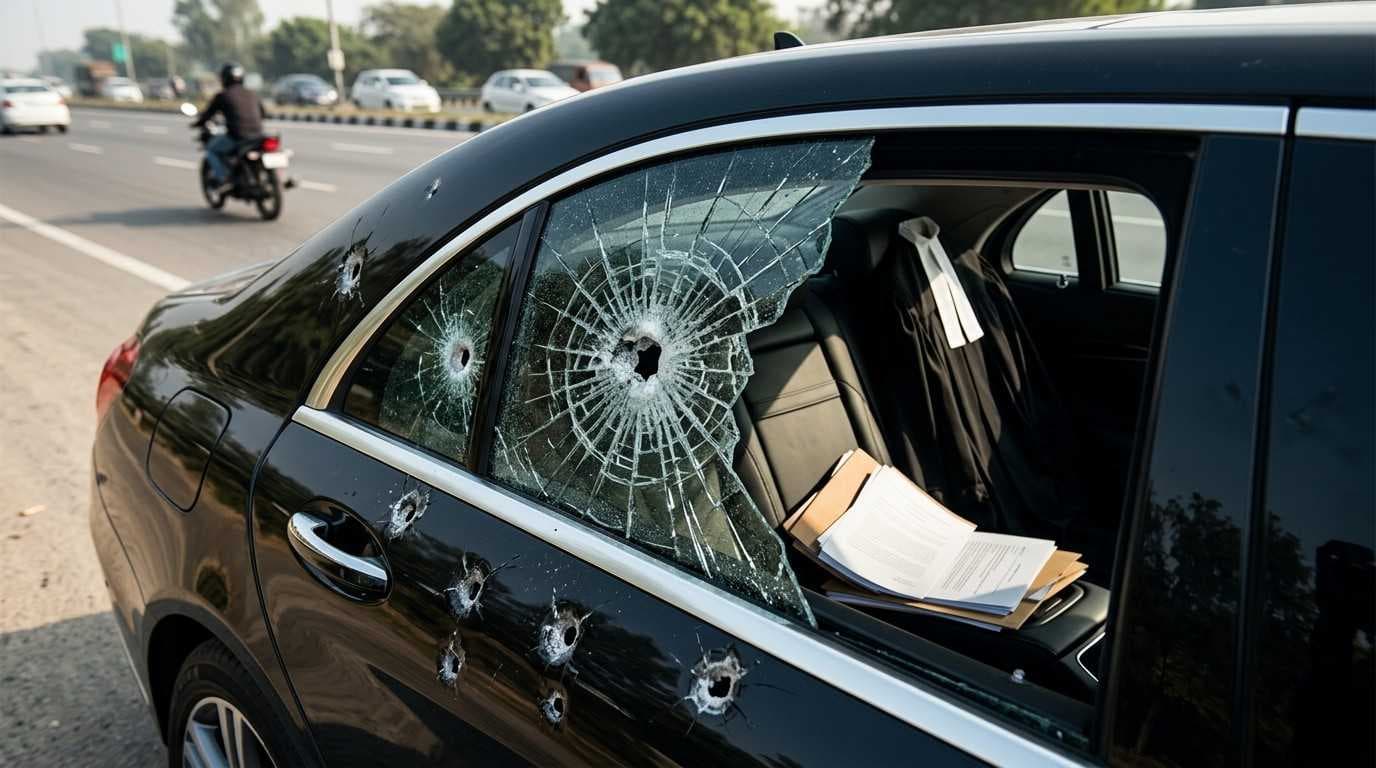
The growing threat of violence targeting legal professionals has hit the upper echelons of the regional bar hierarchy. In a brazen daylight ambush, an unidentified assailant opened fire on a vehicle carrying senior advocate Gagandeep Jammu, the former Honorary Secretary of the Punjab and Haryana High Court Bar Association. While the targeted vehicle sustained visible damage from multiple gunshot impacts, Jammu miraculously escaped the encounter entirely unhurt. The targeted strike has sent shockwaves through the region's legal community, sparking intense demands for immediate structural protection for advocates.
The dangerous encounter unfolded while Jammu—the son of veteran journalist and former Press Council of India member Balwinder Jammu—was traveling through the state near the Kurali region. According to the formal police complaint, a lone assailant riding a motorcycle pulled alongside the advocate’s moving vehicle and discharged a firearm directly at it. The attacker utilized the speed and agility of the two-wheeler to rapidly break away from the scene immediately after firing the shots, leaving behind a heavily damaged vehicle and a highly compromised security environment on a busy transit route.
Following the immediate reporting of the ambush, the Mohali police took swift jurisdictional control of the investigation, deploying forensic teams to analyze the bullet trajectories and impact points on the vehicle. Law enforcement authorities have formally registered a First Information Report under Section 109 of the Bharatiya Nyaya Sanhita, which governs attempts to murder, alongside Section 25 of the Arms Act for the unlawful use of a firearm. Specialized investigative squads have been formed to scan regional closed-circuit television networks along the highway to identify the motorcycle's registration details and trace the suspect's escape route.
The response from the organized Bar was immediate, unified, and unyielding in its condemnation of the violence. In an official briefing, the current Honorary Secretary of the Punjab and Haryana High Court Bar Association, Parampreet Singh Bajwa, characterized the ambush as a cowardly, heinous assassination attempt designed with an explicit intent to kill. The association emphasized that while they are immensely relieved that their former leader survived the attack without physical injury, the psychological and institutional damage of such an act threatens the entire legal framework.
The bar body further articulated that this shooting cannot be viewed as an isolated, private dispute. Instead, organized legal associations across the region are reframing the ambush as a direct structural assault on the independence, dignity, and fearless functioning of the entire legal fraternity. When a prominent legal representative can be targeted in transit, they argue, it creates an environment of intimidation that undermines an advocate’s ability to discharge their professional duties to their clients without the constant fear of physical retaliation.
Consequently, the legal leadership has placed immense pressure on the state administration and top police officials to deliver a swift resolution. The Bar Association has issued a formal ultimatum demanding the immediate identification and apprehension of not only the physical shooter but also any background conspirators who may have masterminded the hit. Furthermore, the body has initiated a parallel demand for a complete overhaul of the security protocols provided to prominent members of the bar who regularly handle high-profile, sensitive, or contentious litigations.
Ultimately, this targeted ambush highlights the increasing vulnerability of officers of the court as they navigate an increasingly volatile professional landscape. The ability of an attorney to argue cases fearlessly is a foundational requirement for the survival of the rule of law. As law enforcement teams expand their search across Punjab to locate the bike-borne gunman, the incident serves as a stark reminder that ensuring public justice requires a parallel commitment to securing the physical safety of the practitioners who stand at the frontlines of the legal system.