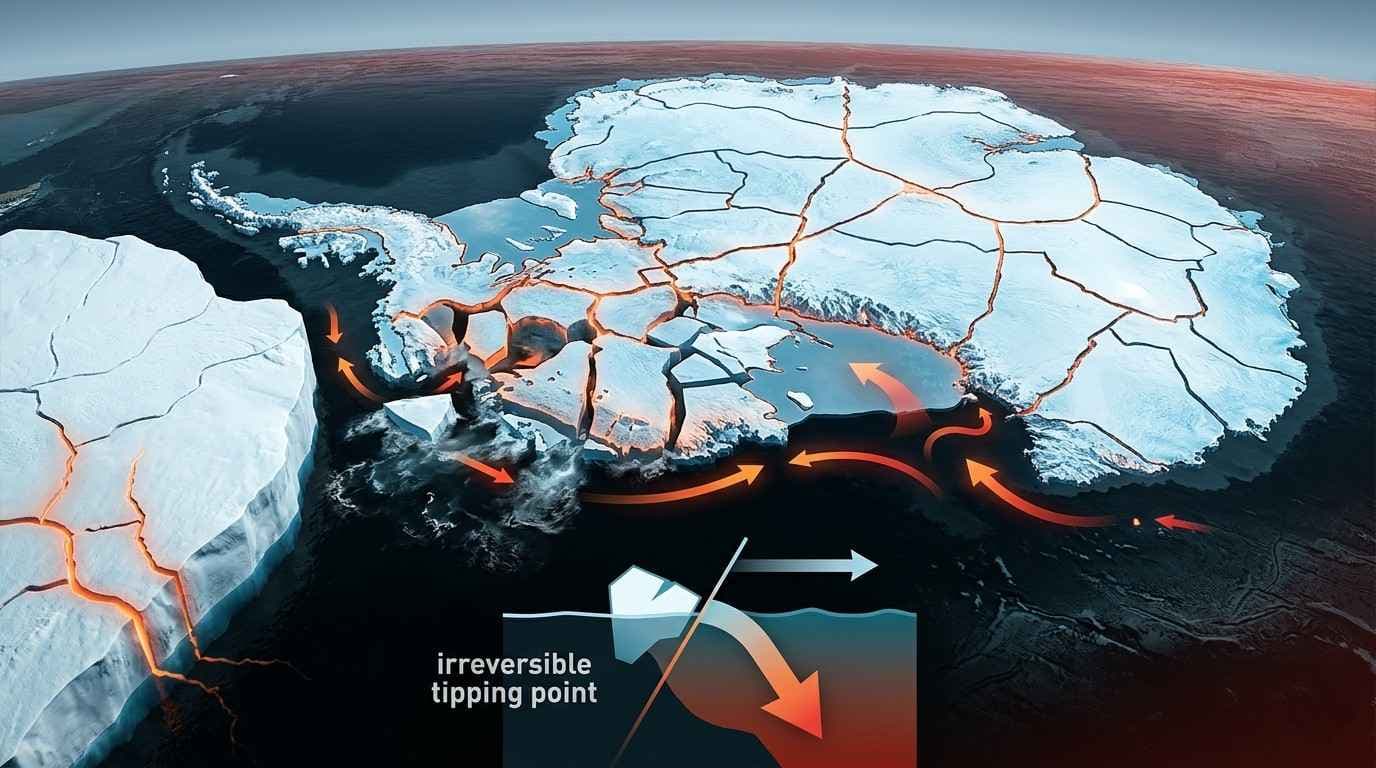
For decades, we have viewed the Antarctic ice sheet as a singular, monolithic giant—a frozen fortress holding back the world's oceans. The prevailing narrative suggested that if global warming pushed temperatures high enough, this massive entity would collectively collapse, triggering catastrophic global sea level rise. However, a groundbreaking study has upended this long-held perspective, revealing that the frozen continent is far more complex, fractured, and vulnerable than previously realized. The ice sheet does not behave as a single tipping element; instead, it operates as an intricate web of interacting basins, each with its own critical threshold.
This shift in understanding changes everything. Rather than waiting for one massive, distant collapse, scientists are realizing that individual regional dominoes are already beginning to wobble. By shifting the focus from a uniform continent to eighteen independent drainage basins, researchers have mapped out a far more nuanced and immediate threat. While some regions are expected to experience a slow, linear decline as temperatures rise, others are hiding sharp, irreversible tipping points. Once these specific regional thresholds are crossed, the subsequent ice loss will accelerate disproportionately, entirely independent of future atmospheric temperatures.
The most alarming revelation centers on West Antarctica. The study indicates that at our current level of global warming, nearly forty percent of the marine-based ice stored in this region may already be locked into long-term, irreversible loss. The Amundsen Sea basin, which anchors the notoriously unstable Thwaites and Pine Island glaciers, appears to have already slipped past its critical threshold. The warming of the surrounding oceans, rather than just the air above, is driving a relentless under-ice melt, destabilizing the grounding lines where the ice meets the bedrock.
As these West Antarctic basins destabilize, they threaten to trigger a cascading effect across the rest of the continent. The loss of ice in one basin alters the mechanical balance of neighboring regions, effectively dragging adjacent ice fields down with it. If global emissions continue on their current trajectory and temperatures rise between two and five degrees Celsius above pre-industrial levels, the massive Wilkes Basin in East Antarctica will also be pushed over the edge. This region alone holds enough vulnerable marine ice to radically redraw global coastlines.
The mechanism behind this acceleration is a compounding feedback loop known as marine ice sheet instability. When warm ocean water seeps beneath the floating ice shelves, it melts the ice from below, pushing the grounding line further inland. Because the bedrock beneath much of West Antarctica slopes downward toward the interior, deeper water allows even more warm ocean currents to rush in. This creates an unbounded process of runaway melting. Once this threshold is crossed, even if global temperatures were magically restored to pre-industrial averages, the physics of the ice flow ensure that the melting will continue for centuries.
The global implications of these localized tipping points are profound. The Antarctic ice sheet contains enough frozen water to raise global sea levels by more than fifty-eight meters if melted entirely. We are no longer talking about a distant, theoretical crisis for future generations. The unlocking of these individual basins means that significant sea level rise is being locked in right now. Coastal infrastructure, low-lying cities, and global economic stability are directly tied to the structural integrity of these remote polar basins.
Ultimately, this research delivers a stark warning wrapped in a call for immediate, decisive action. The frozen giant is not sleeping; it is breaking apart from the inside out, basin by basin. While we may have already set some regions on a path of irreversible decline, the fate of the remaining, massive East Antarctic basins still hangs in the balance. Every fraction of a degree of warming we prevent now determines whether these regional tipping points remain isolated events or cascade into a global environmental rewrite.