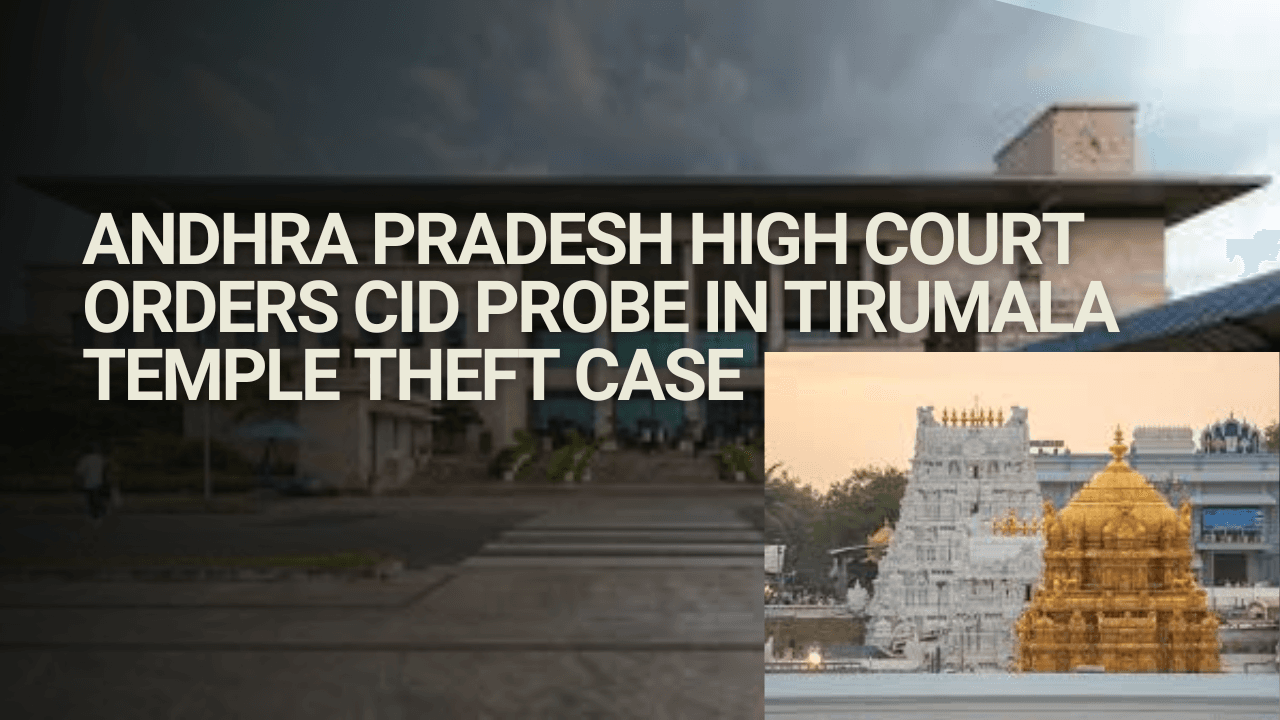
This landmark judicial intervention came in response to a public interest litigation filed in the case of M Sreenivasulu v The State of Andhra Pradesh, highlighting serious lapses in temple security and accountability mechanisms. The Tirumala Temple, one of the richest and most visited Hindu pilgrimage sites globally, attracts millions of devotees annually, making this theft not just a criminal matter but an issue of profound religious and cultural significance.
The High Court's decision to order a CID investigation reflects the gravity of the situation and the need for an impartial, thorough probe into the circumstances surrounding the theft. This case raises critical questions about temple administration, security protocols, custodial responsibility, and the protection of religious endowments under Indian law. The court's intervention demonstrates judicial vigilance in safeguarding public trust and religious institutions from mismanagement and criminal activities.
Background and Case Facts
The Tirumala Venkateswara Temple, located in the Tirupati district of Andhra Pradesh, is administered by the Tirumala Tirupati Devasthanams (TTD), a trust that manages one of India's wealthiest religious institutions. The temple receives enormous donations from devotees in the form of cash, gold, silver, precious stones, and other valuables. These offerings are considered sacred and are held in trust for religious and charitable purposes.
The theft came to light when routine audits and inventory checks revealed significant discrepancies in the temple's treasure records. Several valuable gold ornaments, diamond-studded jewelry pieces, and other precious items that had been donated by devotees over the years were found to be missing from the temple's secure storage facilities. The missing items were estimated to be worth several crores of rupees, though their religious and sentimental value to the devotee community was immeasurable.
Initial investigations by local police authorities failed to make substantial progress in identifying the culprits or recovering the stolen items. This prompted petitioner M Sreenivasulu, a concerned citizen and devotee, to approach the High Court seeking judicial intervention. The petitioner argued that the local investigation was inadequate, potentially compromised, and lacked the expertise required to handle such a sensitive and complex case involving temple administration and organized theft.
The petitioner's PIL highlighted several disturbing aspects: inadequate security measures at the temple's treasure storage facilities, lack of proper documentation and inventory management systems, absence of CCTV surveillance in critical areas, irregular audit procedures, and potential involvement of insiders with access to restricted areas. These allegations pointed toward systemic failures in temple administration and raised serious concerns about accountability and transparency in managing public religious trusts.
Legal Framework and Applicable Laws
The case involves multiple legal dimensions spanning criminal law, administrative law, and religious endowment regulations. The primary legal frameworks applicable include:
Indian Penal Code (IPC): Sections 378 (theft), 380 (theft in dwelling house), 381 (theft by clerk or servant of property in possession of master), 408 (criminal breach of trust by clerk or servant), and 120B (criminal conspiracy) are potentially applicable depending on the investigation findings.
Andhra Pradesh Charitable and Hindu Religious Institutions and Endowments Act, 1987: This legislation governs the administration, management, and protection of Hindu religious institutions and their properties in Andhra Pradesh. It establishes regulatory frameworks for temple administration, audit requirements, and accountability mechanisms.
Constitutional Provisions: Article 226 of the Constitution empowers High Courts to issue writs for enforcement of fundamental rights and for any other purpose, providing the jurisdictional basis for the PIL. Additionally, Article 25 (freedom of religion) and Article 26 (freedom to manage religious affairs) have indirect relevance to temple administration matters.
Court's Observations and Findings
The Andhra Pradesh High Court, after hearing detailed arguments from the petitioner, state government representatives, and TTD authorities, made several critical observations that formed the basis for ordering the CID investigation.
Inadequacy of Initial Investigation: The court noted that the preliminary investigation conducted by local police was superficial and failed to explore crucial aspects of the case. The investigating officers had not properly examined the security breach mechanisms, insider involvement possibilities, or the chain of custody for the stolen items.
Systemic Administrative Failures: The court observed serious deficiencies in the temple's administrative and security systems. The absence of modern inventory management systems, irregular physical verification of valuables, inadequate CCTV coverage, and lax access control protocols indicated systemic negligence that facilitated the theft.
Public Trust and Religious Sentiments: The court emphasized that temples like Tirumala hold a special position in public consciousness and religious life. The theft of donated items constitutes not merely a property crime but a violation of sacred trust placed by millions of devotees. The court recognized that such incidents undermine public confidence in religious institutions and their management.
Need for Specialized Investigation: Given the complexity of the case, potential involvement of organized criminal networks, possibility of insider collusion, and the need for forensic expertise, the court concluded that a specialized investigation by the CID was necessary. The CID's resources, expertise, and independence from local influences made it the appropriate agency for this investigation.
Accountability of Temple Administration: The court indicated that the investigation should also examine the role and responsibility of TTD officials and temple administrators. The court suggested that administrative negligence or complicity, if established, should result in appropriate legal and disciplinary consequences.
Directions Issued by the Court
Based on its findings, the Andhra Pradesh High Court issued comprehensive directions to ensure a thorough and impartial investigation:
CID Investigation: The court directed the Crime Investigation Department to take over the investigation immediately and conduct a comprehensive probe into all aspects of the theft, including identifying perpetrators, tracing stolen items, examining security lapses, and investigating potential insider involvement.
Timeline for Investigation: The court set a reasonable timeline for the CID to complete the investigation and submit a detailed report, ensuring that the matter does not languish indefinitely.
Forensic and Technical Examination: The court directed the use of modern forensic techniques, digital forensics, CCTV footage analysis, and expert examination of security systems to establish how the theft was executed.
Administrative Audit: The court ordered a comprehensive administrative audit of TTD's inventory management, security protocols, and internal control systems to identify systemic weaknesses and recommend corrective measures.
Protection of Evidence: The court directed all concerned authorities to preserve all relevant evidence, documents, and records related to the case and cooperate fully with the CID investigation.
Periodic Reporting: The court required the CID to submit periodic progress reports, ensuring judicial monitoring of the investigation's progress.
Legal Implications and Significance
This judgment has far-reaching implications for temple administration, religious endowment management, and public accountability across India.
Judicial Oversight of Religious Institutions: The case reinforces the principle that while religious institutions enjoy constitutional protection for managing their affairs, they remain subject to judicial oversight when public trust and legal accountability are at stake. Courts can intervene to ensure proper administration and protection of religious endowments.
Enhanced Security Standards: The judgment will likely prompt religious institutions across the country to review and upgrade their security infrastructure, inventory management systems, and internal controls. Modern technology integration, regular audits, and professional security management will become essential.
Administrative Accountability: The case establishes that temple administrators and trust officials can be held legally accountable for negligence or complicity in crimes affecting religious institutions. This creates a deterrent effect and encourages responsible administration.
PIL as Accountability Tool: The successful PIL demonstrates how concerned citizens can use public interest litigation to seek judicial intervention in matters affecting religious institutions and public trusts, promoting transparency and accountability.
Precedent for Similar Cases: This judgment will serve as a precedent for similar cases involving theft, mismanagement, or corruption in religious institutions, providing a legal framework for judicial intervention and investigation.
Challenges in Investigation and Prosecution
The CID investigation faces several challenges that will test its capabilities and resources:
Insider Involvement: If temple staff or administrators were involved, establishing their complicity while overcoming institutional resistance will be challenging. Witnesses may be reluctant to testify against colleagues or superiors.
Recovery of Stolen Items: Precious metals and stones can be easily melted down or recut, making recovery extremely difficult. Tracing items through illegal markets and criminal networks requires specialized intelligence and coordination.
Evidence Collection: Given the time elapsed since the theft and potential evidence tampering, collecting admissible evidence that meets legal standards for prosecution will be challenging.
Jurisdictional Complexities: If the stolen items were transported across state boundaries or involved interstate criminal networks, coordination with multiple law enforcement agencies will be necessary.
Recommendations for Temple Administration Reform
This case highlights the urgent need for comprehensive reforms in temple administration and security:
Technology Integration: Implementation of RFID tagging for valuable items, comprehensive CCTV surveillance, biometric access controls, and digital inventory management systems.
Professional Security Management: Engagement of professional security agencies with expertise in protecting high-value assets, regular security audits, and vulnerability assessments.
Transparent Audit Systems: Regular independent audits, public disclosure of audit findings, and strong internal control mechanisms to prevent misappropriation.
Staff Training and Vetting: Comprehensive background verification of employees, regular training on security protocols, and creation of accountability frameworks.
Legal Compliance Framework: Ensuring full compliance with applicable laws, regulations, and best practices in trust management and religious endowment administration.
Conclusion: Restoring Sacred Trust
The Andhra Pradesh High Court's decision to order a CID investigation in the Tirumala Temple theft case represents a crucial judicial intervention to protect religious institutions, public trust, and devotee sentiments. The case of M Sreenivasulu v The State of Andhra Pradesh demonstrates how courts can effectively balance respect for religious autonomy with the need for accountability and legal compliance.
As the CID investigation proceeds, it will be crucial to maintain judicial oversight, ensure transparency, and implement the court's directions in letter and spirit. The outcome of this case will have lasting implications for how religious endowments are protected and managed in India, potentially setting new standards for accountability, security, and public trust in temple administration.
For millions of devotees who place their faith and offerings in the care of religious institutions, this judgment reaffirms that the law stands as a guardian of their sacred trust, ensuring that those entrusted with managing religious endowments discharge their duties with integrity, transparency, and accountability.