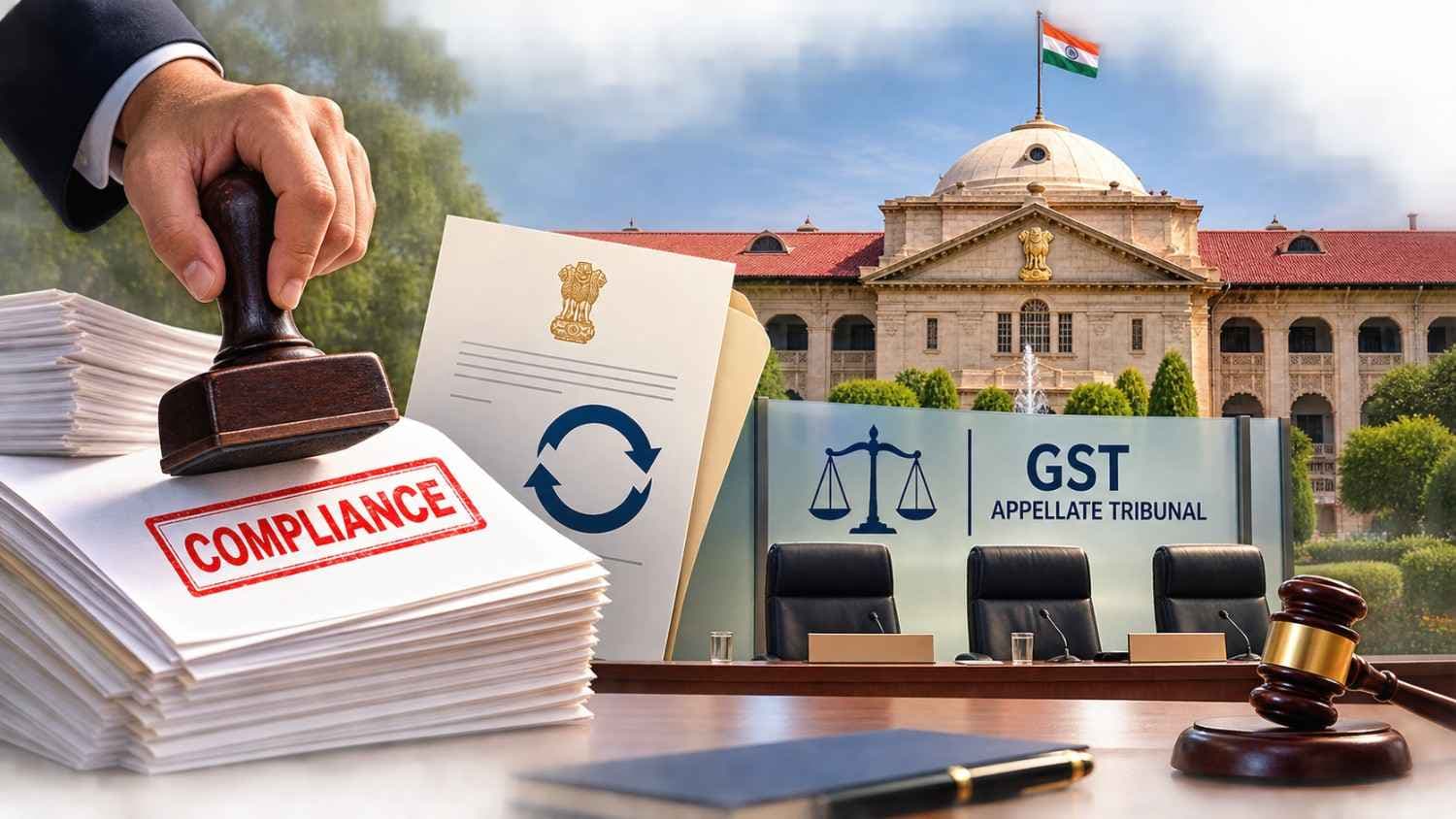
Allahabad High Court Expresses Concern Over GST Appellate Tribunal Vacancies
The Allahabad High Court has highlighted a 'disturbing state of affairs' concerning the substantial vacancies within the Goods and Services Tax (GST) Appellate Tribunal in Uttar Pradesh. The Court observed that out of 92 sanctioned posts, only 29 have been filled, leaving a significant shortfall of 63 positions. Justice Piyush Agrawal, presiding over the matter, underscored that the mere issuance of circulars or advertisements does not constitute adequate compliance with the government's obligation to ensure the statutory appellate forum is fully functional.
Justice Agrawal stated that the very objective of the government to facilitate an effective and hassle-free mechanism through the GST Appellate Tribunal is being undermined by the implementation efforts of officers. The Court noted a 'lack of requisite and effective follow-up' with an intent that appears to 'defeat the very purpose of the Government'. The bench further clarified that it cannot accept a 'formalistic compliance' that consists solely of issuing successive circulars, especially when the statutory appellate mechanism continues to suffer from substantial vacancies. Such an approach, the Court observed, 'defeats the very purpose for which the GST Appellate Tribunal has been constituted and inevitably burdens litigants by depriving them of an effective statutory appellate remedy'.
Discrepancy in Submissions and Affidavit Details
During the proceedings, the Additional Solicitor General of India submitted that the GST Appellate Tribunals in the State were fully functional. However, the Court noted a stark contrast with the affidavit filed by the Joint Secretary, Department of Revenue, Ministry of Finance, Government of India. According to the affidavit, against a total of 92 sanctioned posts at various levels, only 29 posts had been filled, with the process for merely six posts stated to be underway. This left 63 posts vacant, which, as per the affidavit, were yet to be filled.
The affidavit indicated that a circular regarding vacancies was issued on 14th September 2024. However, the Court found that the affidavit failed to disclose any concrete, effective, or time-bound steps taken by the competent authority to fill these vacancies. Specifically, for Uttar Pradesh, the Court noted that only 14 out of 44 posts were filled. The affidavit also did not specify the manner in which notices for filling these vacancies were published. The Court further pointed out that despite a subsequent circular dated 14th January 2026, the affidavit did not reveal what tangible steps followed, how the response was monitored, the number of applications received, the scrutiny undertaken, or the reasons preventing the vacancies from being filled.
Court Directs Comprehensive Affidavit with Time-Bound Schedule
Finding the submitted affidavit unsatisfactory, the Allahabad High Court granted additional time to the Joint Secretary, Department of Revenue, Ministry of Finance, Government of India, to file a fresh and comprehensive affidavit. This new affidavit must provide detailed information, including:
The post-wise and Bench-wise status of all 92 posts.
Identification of posts currently vacant and the exact stage of the process for filling each such post.
A date-wise account of actions taken for filling every vacancy, along with the authority responsible for each action.
Complete details of actions taken pursuant to circulars dated 14th September 2025, 14th August 2025, and 14th January 2026.
The dates and manner in which advertisements or notices were uploaded or circulated on official websites and communicated to relevant authorities.
The number of applications received against each post, the number scrutinised, and the present status of each selection process.
Details of all correspondence exchanged with the Principal Bench, GST Appellate Tribunal, and the respective Benches or authorities concerning the vacancies.
A clear, definite, and time-bound schedule for filling up the remaining vacancies.
The Court has scheduled the next hearing for 9th September 2026, indicating that the adequacy of the fresh affidavit will be closely scrutinised.