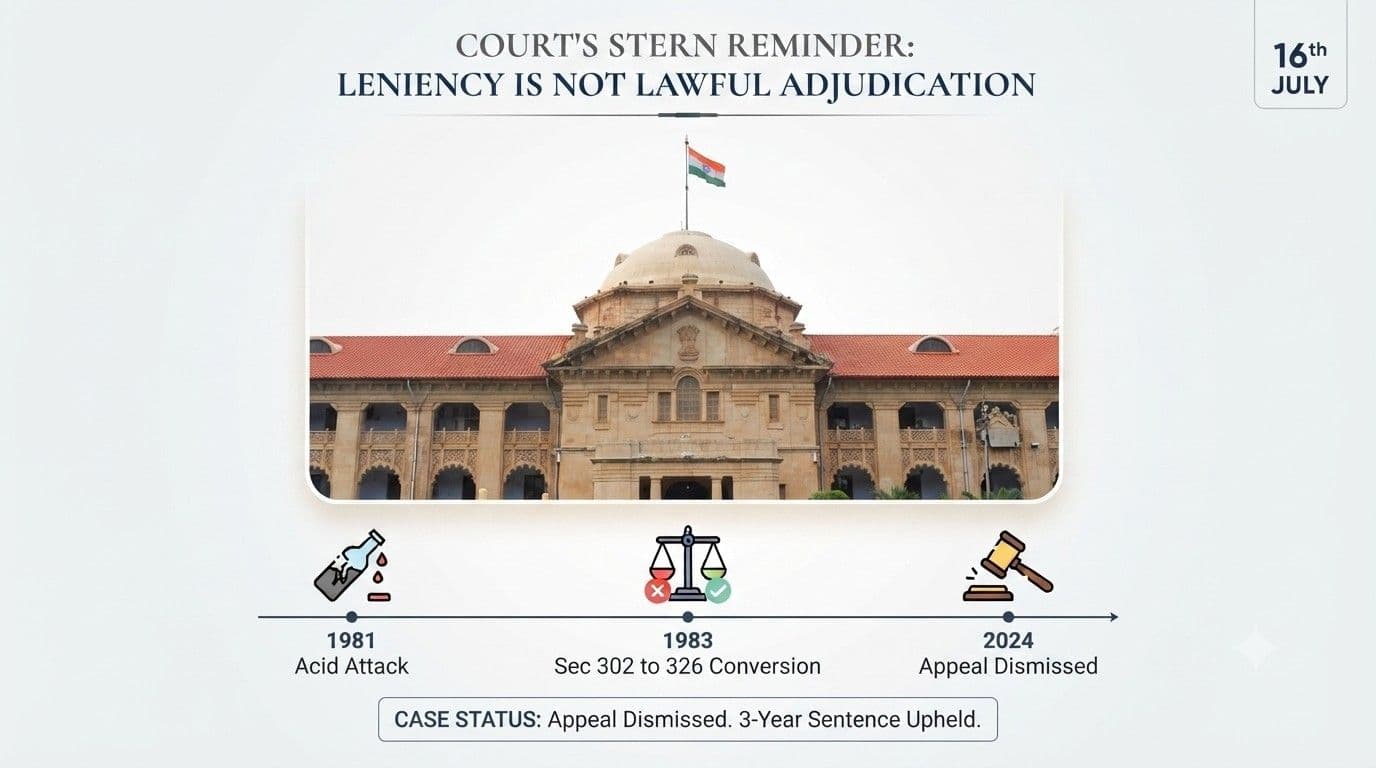
On 5 September 1981 the appellant, Razzak, had a quarrel with his father, Gulam Husain, at their residence in Gorakhpur. He deliberately poured acid on the vital parts of his father’s body. Although he attempted to flee, independent witnesses apprehended him and acid splashes were found on his own hands. The father suffered burn injuries covering approximately sixty percent of his face, neck, chest and upper part of the body. He succumbed to septicaemia about twenty days later while undergoing treatment in a hospital. In his dying declaration, recorded by the investigating officer, the deceased named his son as the perpetrator.
The Sessions Judge in Gorakhpur initially framed charges under Section 302 IPC (murder) in 1983. However, the trial judge ultimately convicted Razzak only under Section 326 IPC (voluntarily causing grievous hurt by dangerous weapons or means) and sentenced him to three years of rigorous imprisonment, without imposing the fine that Section 326 IPC mandates alongside imprisonment.
High Court’s observations on the trial court’s reasoning
A bench comprising Justice Santosh Rai described the trial court’s approach as a “manifest misappreciation of the evidence” and a “complete failure to apply the settled principles governing the offence of murder or culpable homicide”. The bench noted that the trial judge gave no legally sustainable reason for discarding the murder charge or for extending such extraordinary leniency.
The High Court emphasised that acid is a substance whose corrosive and dangerous nature is a matter of common knowledge. Consequently, when a person deliberately pours acid on another individual’s vital parts, it can be presumed that he possessed the knowledge that his act was likely to cause death or such bodily injury as was likely to cause death. This presumption directly contradicted the trial court’s finding that the appellant lacked the requisite knowledge to attract the offence of murder or culpable homicide.
On the basis of the evidence, facts and circumstances available on the record, the bench observed that the appellant was required to be convicted under Section 304 IPC (culpable homicide not amounting to murder) because he had the knowledge that pouring acid over the vital part of his father’s body was likely to cause death. The bench further pointed out that the trial court’s omission to impose the statutory fine prescribed under Section 326 IPC reflected a patent non‑application of mind to the mandatory provisions of law and the settled principles governing sentencing.
Procedural limitation and the final disposition
The bench noted that the State Government had never filed an appeal to enhance the sentence. Consequently, the High Court could not convert the conviction to a higher provision or increase the punishment in an appeal that was preferred solely by the accused. In view of this limitation, the Court dismissed the forty‑three‑year‑old criminal appeal filed by Razzak and directed him to surrender within two weeks to serve the remainder of his three‑year rigorous imprisonment.
Reminder to judicial officers
While acknowledging that the trial judge had likely demitted office, the bench issued a stern reminder to current judicial officers: “Judicial discretion is never synonymous with judicial arbitrariness. Sympathy or misplaced leniency has no place where the statute and the evidence demand a reasoned and lawful adjudication. Such lapses have the potential to erode public confidence in the administration of criminal justice.” The judgment was also stated to serve as a reminder that courts must adhere strictly to the legal principles governing offences involving dangerous substances and must ensure that mandatory sentences, including fines, are not overlooked.