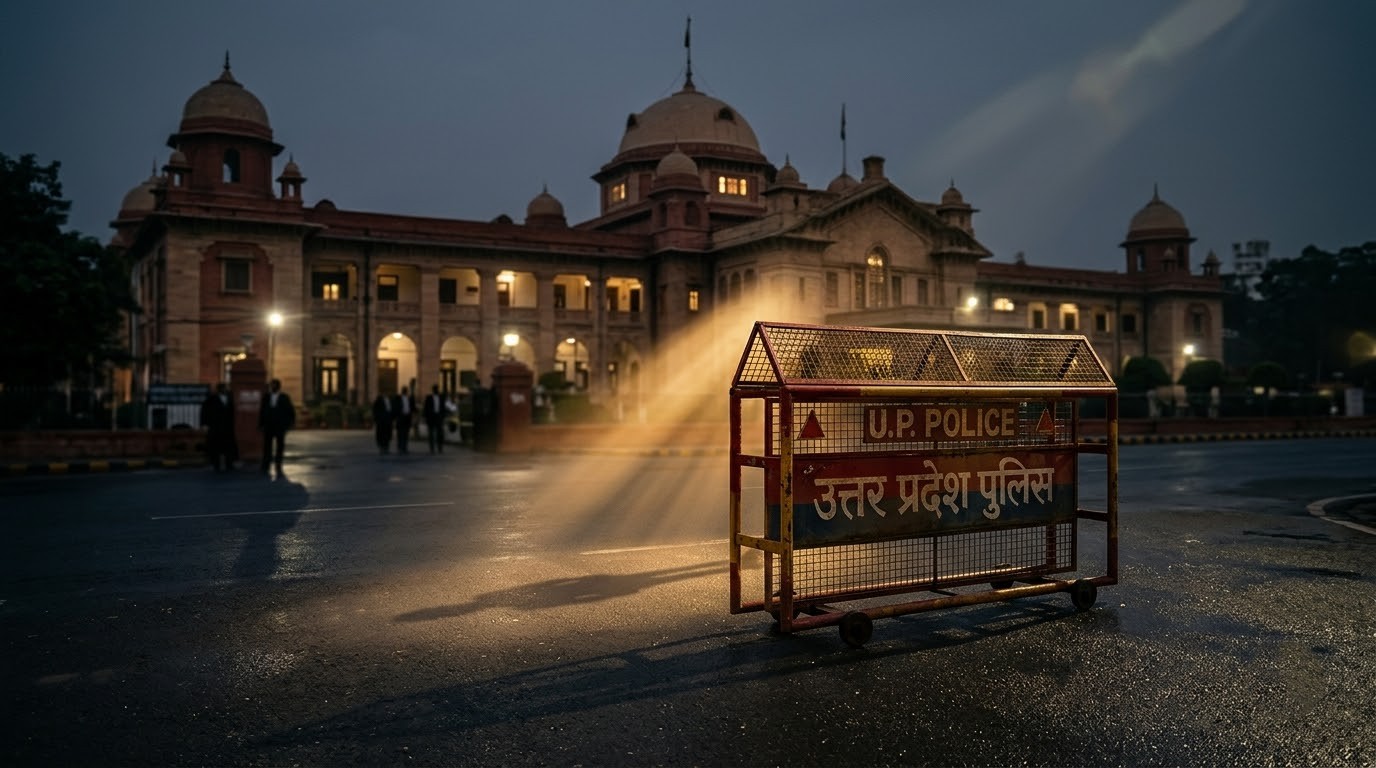
The Allahabad High Court has delivered a scathing indictment of the Uttar Pradesh Police, declaring the situation concerning civil liberties in the state as shameful, to say the least. A Division Bench comprising Justice Atul Sreedharan and Justice Achal Sachdev held that the police appear to have little regard for the fundamental rights and civil liberties of citizens, adding that the infringement of these rights seems to have become a matter of routine for the force.
The observations were made while allowing a habeas corpus petition filed by Afzal Ahmad, who alleged that he was taken into custody by Bijnor Police on September 5, 2026, but his formal arrest was recorded only on September 7, 2026. The petition was filed by Ahmad's daughter, who claimed that police personnel and Special Operations Group (SOG) officials in civil dress forcibly took her father away from outside the police station premises where they had gone after being summoned by the Station House Officer (SHO).
What did the Allahabad High Court rule on CCTV malfunction as an excuse for unlawful detention?
The Court categorically held that the excuse of CCTV malfunctioning is not available to the police in a case of alleged unlawful detention. It ruled that any such explanation would be sufficient for the court to accept the petitioner's contention that the corpus was unlawfully detained and that the footage was deliberately withheld to obfuscate the truth maliciously.
To verify the allegations, the High Court had earlier directed the State to produce CCTV recordings of the police station covering the period from September 5, 2026, at 1:00 pm to September 7, 2026, at 10:00 am. However, the State informed the Court that the footage was unavailable. The State relied on a General Diary entry dated September 5, 2026, stating that a thunderstorm caused water to trickle down the LAN cable into the CCTV system, resulting in a malfunction.
Repeated CCTV Failures and Judicial Displeasure
The Bench took strong exception to this explanation, referring to a recurring pattern where CCTV footage is not made available when summoned by the Court. The judges observed that in case after case, whenever CCTV footage is called for, in a large majority of instances the same report is furnished stating that the footage is unavailable for one reason or another. The Bench noted that the systemic issue concerning the failure of CCTV systems in Uttar Pradesh police stations is being dealt with separately in another matter currently reserved for judgment.
The Court also recorded its displeasure against SHO Annu Kumari, observing that she had deliberately not provided the CCTV footage relevant to deciding the case. This conduct led the Court to presume that the footage was against the interest of the respondent and had been deliberately withheld. The Bench directed that this adverse observation be entered into her service records and suggested that the State should consider her further continuation at the present post.
Operative Orders and Costs
Allowing the habeas corpus petition, the Court directed the immediate release of Afzal Ahmad, provided he is not required in any other case. Furthermore, the State was directed to pay costs of Rs 20,000 to the corpus within seven days.
Aspect | Court's Finding |
|---|---|
Alleged Detention Period | September 5, 2026 (actual) vs September 7, 2026 (formal arrest record) |
State's Explanation for Missing CCTV | Thunderstorm caused water ingress into LAN cable, leading to system malfunction |
Court's Ruling on CCTV Excuse | Not acceptable in unlawful detention cases; raises presumption of deliberate withholding |
Disposition | Petition allowed; immediate release ordered; Rs 20,000 costs imposed |
Action Against SHO | Adverse remarks to be entered in service records; review of posting directed |
The judgment underscores the judiciary's growing intolerance towards procedural lapses that facilitate the erosion of personal liberty. By rejecting the technical plea of equipment failure in the face of serious allegations of illegal confinement, the Court has reinforced the principle that the State cannot evade accountability for the protection of fundamental rights by citing infrastructural deficiencies.