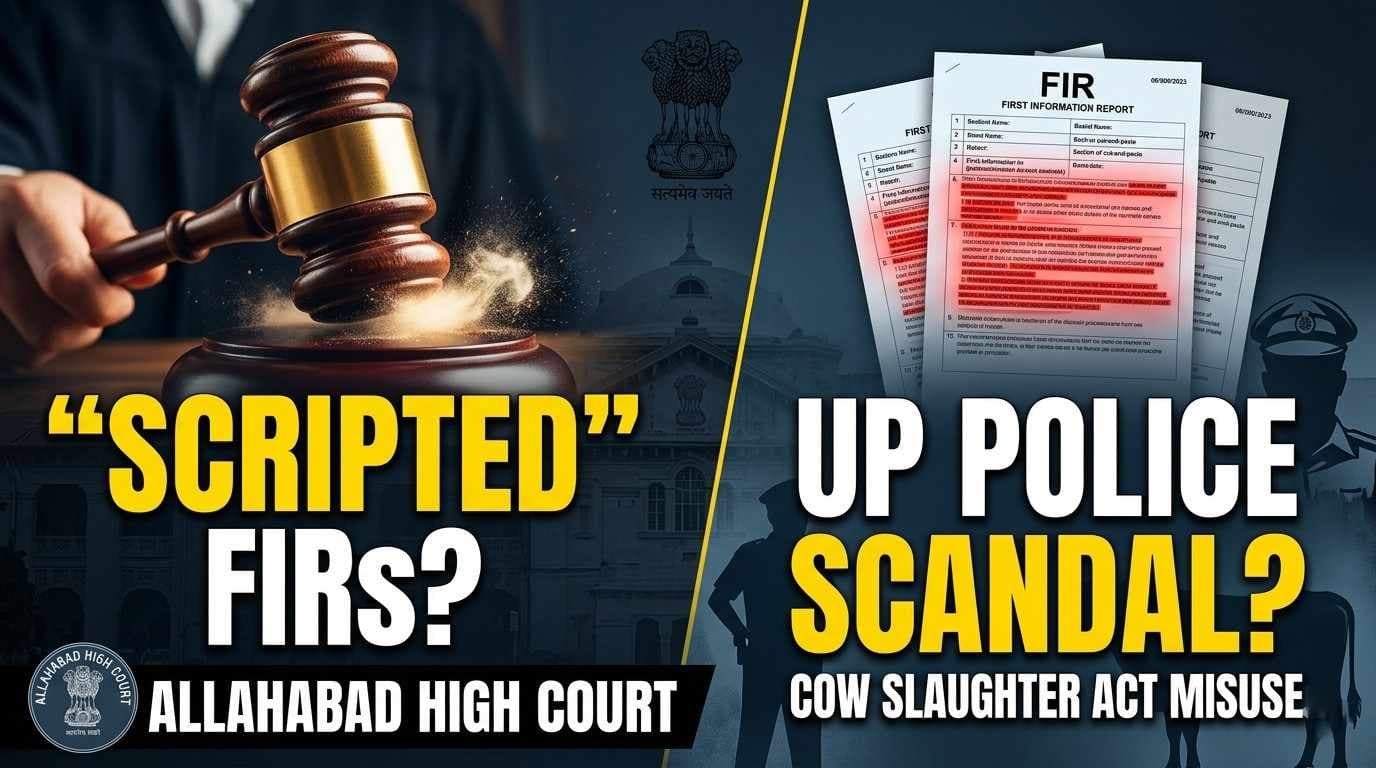
The Allahabad High Court has raised serious concerns over the nature of First Information Reports (FIRs) filed under the Uttar Pradesh Prevention of Cow Slaughter Act, observing that several cases appear to be based on "scripted" or "cut-and-paste" allegations.
A single-judge bench directed the Uttar Pradesh Police to provide an explanation regarding the striking similarities in the narratives of multiple FIRs registered across different districts. The court noted that the language, the sequence of events, and even the descriptions of the alleged recovery of contraband in these cases were virtually identical, suggesting a lack of independent investigation at the ground level.
Key Observations of the Court:
- Mechanical Filing: The court remarked that FIRs should reflect the specific facts of a particular incident. The use of a "standard template" for allegations under the Cow Protection Law undermines the credibility of the prosecution and raises questions about the misuse of the stringent statute.
- Lack of Evidence: In several instances, the court found that the police failed to provide forensic reports or credible witness statements to confirm that the seized meat was indeed beef, yet the accused were kept in prolonged custody based on these standardized FIRs.
- Liberty of Citizens: The bench emphasized that while the law intended to prevent cow slaughter must be enforced, it cannot be used as a tool for arbitrary arrests. The court warned that "scripted" narratives violate the fundamental right to a fair investigation and personal liberty.
- Direction to Senior Officials: The High Court has sought a response from senior police officials, including a report on whether these similarities are a result of a lack of training or a deliberate attempt to circumvent the requirement of detailed investigation.
This intervention by the Allahabad High Court follows a series of bails granted in similar cases where the court found that the evidence did not match the gravity of the charges. The ruling serves as a significant check on the executive's exercise of power under special state laws, reinforcing the necessity for evidentiary rigor in criminal proceedings.