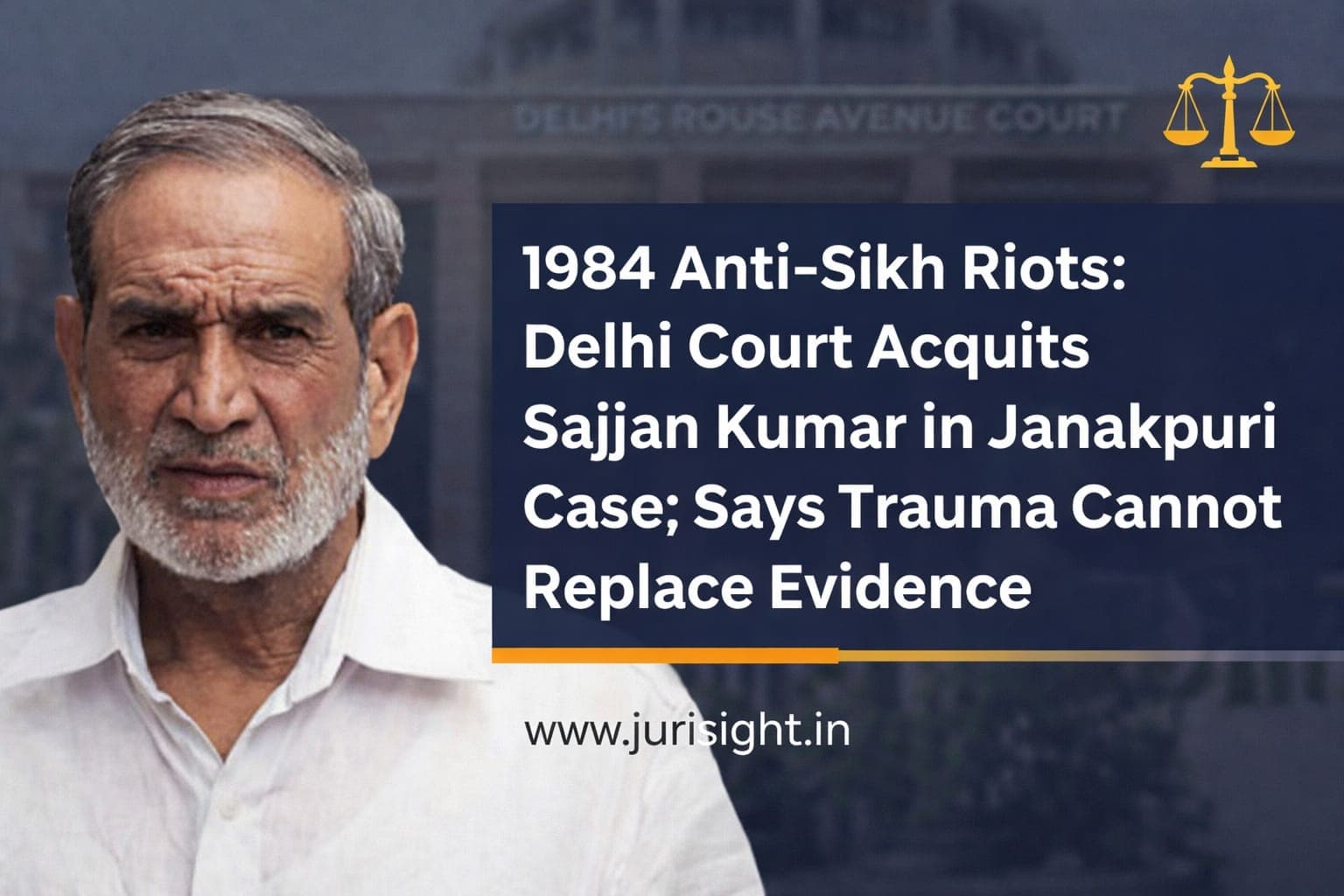
New Delhi: In a significant development concerning the legal aftermath of the 1984 anti-Sikh riots, a Delhi Court on Thursday acquitted former Congress Member of Parliament (MP) Sajjan Kumar in a case involving violence in the Janakpuri and Vikaspuri areas.
The Rouse Avenue Court, presided over by Special Judge Dig Vinay Singh, held that the prosecution failed to prove the charges against Kumar "beyond a reasonable doubt." While acknowledging the immense suffering of the victims, the court emphasized that criminal trials must be decided based on solid evidence rather than emotions or the public profile of the accused.
The case originated from the horrific violence that broke out in West Delhi following the assassination of then-Prime Minister Indira Gandhi on October 31, 1984. The specific allegations against Sajjan Kumar involved leading a violent mob in the Janakpuri area on November 1, 1984.
According to the prosecution, Kumar had allegedly:
- Instigated a mob to commit acts of arson and looting.
- Conspired to incite communal disharmony.
- Been involved in the burning of a local Gurdwara and the destruction of Sikh properties.
- Faced charges of murder (Section 302 IPC), attempted murder (Section 307 IPC), and rioting with deadly weapons.
In a detailed judgment, Special Judge Dig Vinay Singh noted that the prosecution’s case rested largely on testimonies that were either hearsay or recorded several decades after the actual incident.
1. Lack of Reliable Identification The court pointed out that out of the 18 witnesses examined, many named Sajjan Kumar for the first time only after a gap of nearly 30 to 36 years. The judge observed that relying on such delayed identification would be "risky" and could lead to a "travesty of justice."
2. No Proof of Presence at the Scene The judgment stated, "There is no reliable evidence in the present matter that the accused was present at the crime scene for which he has been charged on 01.11.1984, or that he was seen there by anyone." The court found no concrete proof of instigation or a pre-planned conspiracy specifically linked to the Janakpuri incident.
3. The Standard of Law is Uniform The court addressed the fact that Sajjan Kumar is a former influential politician and has been convicted in other riot cases. However, it clarified that past conduct or public status cannot lower the bar for the "standard of proof" required in a specific criminal trial.
"The law remains the same for all criminals, whether they are ordinary men or influential people," the court remarked, reinforcing that every single charge requires its own independent proof.
The court was sensitive to the pain of the families who lost their loved ones and property during the 1984 carnage. However, it made a stern observation on the duty of the judiciary:
"The trauma suffered by the victims and their families is well understood, but that trauma cannot come in the way of this Court’s decision, which has to be sans (without) emotions."
The judge further reasoned that if someone truly saw a perpetrator kill their family member, they would likely name that person at the earliest opportunity rather than waiting for three decades.
The case was part of a fresh look into the 1984 riots. In 2015, a Special Investigation Team (SIT) was formed following the recommendations of the Justice GP Mathur Committee. The SIT’s job was to reopen serious cases that had been closed by the police years ago as "untraced."
The SIT filed a charge sheet against Kumar in 2022 after recording fresh statements. While the court accepted that the SIT’s investigation was legally valid, it ultimately found that the quality of evidence produced in court was not enough to secure a conviction.
Despite this acquittal, Sajjan Kumar will remain in Tihar Jail. He is currently serving two separate life sentences:
- 2018 Conviction: The Delhi High Court sentenced him to life imprisonment for the killing of five Sikhs in the Palam Colony area.
- 2025 Conviction: In February last year, he was handed another life term for the murder of Jaswant Singh and his son Tarundeep Singh in the Saraswati Vihar area.
The acquittal in the Janakpuri case highlights the immense challenge the Indian legal system faces in prosecuting crimes decades after they occur. While the victims' families have expressed their intent to challenge this verdict in higher courts, the trial court’s decision serves as a reminder of the "beyond reasonable doubt" requirement that governs Indian criminal jurisprudence.
- Case Title: State v. Sajjan Kumar
- Court: Rouse Avenue Courts, New Delhi
- Judge: Special Judge Dig Vinay Singh