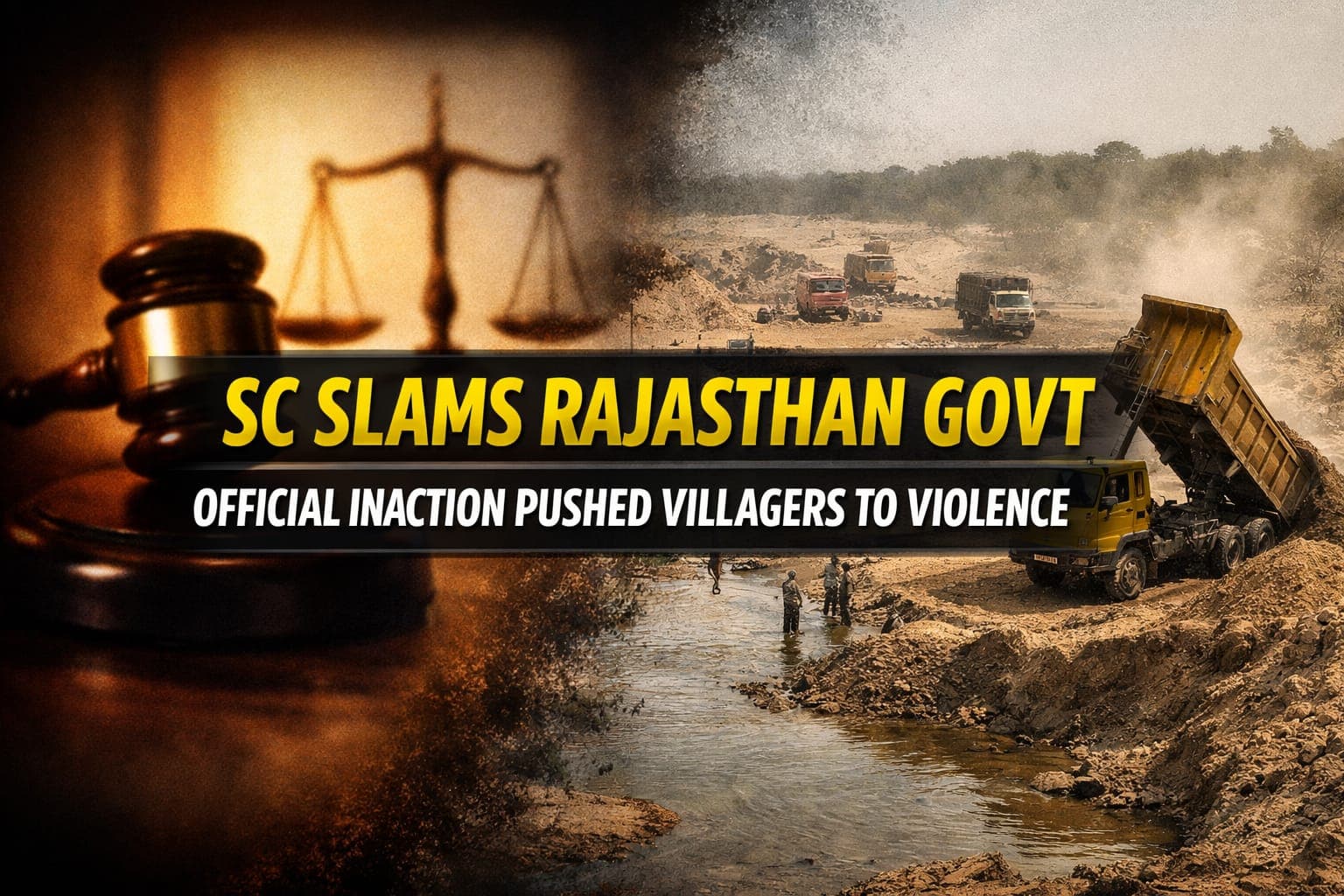
New Delhi: Expressing deep "anguish" over the rampant illegal sand mining in Rajasthan, the Supreme Court has pulled up state authorities for their total failure to act on repeated complaints. A bench of Justices Ahsanuddin Amanullah and R Mahadevan observed that it was the "total inaction" of the officials that pushed local villagers to take the law into their own hands, leading to incidents of violence.
The Court’s remarks came while it was hearing a case involving the conviction of a man sentenced to 10 years of rigorous imprisonment for mob vandalization. The bench noted that the violence was a direct consequence of the authorities ignoring the villagers' pleas against illegal stone crushing and mining units operating in their backyard.
The Supreme Court did not mince words while addressing the state counsel. The bench noted that the villagers had repeatedly approached the concerned authorities to stop illegal mining and stone-crushing units being operated by powerful individuals. However, their pleas fell on deaf ears.
"Clearly the present incident is the direct result of total inaction by the concerned Authorities, who were repeatedly approached to stop/check the illegal mining and Stone crushing units, that too, by the villagers concerned," the Court recorded in its order.
The bench highlighted that when the state fails to perform its duty, the resulting frustration among the public often boils over into unrest. In this specific case, the "official apathy" was seen as the primary catalyst for the mob violence that followed.
Taking the matter a step further, the Supreme Court made it clear that this was "not an isolated incident" in Rajasthan. To ensure accountability, the bench has directed the State of Rajasthan to furnish a detailed list containing the names and designations of all officers who were stationed in the area at the time of the incident.
The Court wants to identify the specific individuals whose negligence allowed the illegal activities to flourish despite public outcry. By seeking these names, the apex court has signaled that "bureaucratic silence" will no longer be tolerated in matters of environmental degradation and public safety.
While addressing the larger issue of mining, the Court also looked into the merits of the criminal case. It granted bail to the petitioner, who had already served a significant portion of his sentence. The bench observed that the underlying cause of the unrest—the illegal mining—needed to be addressed with the same rigor as the resulting violence.
Illegal sand mining (often called 'Bajri' mining) has been a thorn in the side of Rajasthan’s administration for years. Despite various bans and regulatory frameworks, the "sand mafia" continues to operate with alleged local connivance.
Recent reports have shown that this is not just an environmental issue but a severe law-and-order challenge. Only recently, a forest guard was allegedly run over by a tractor-trolley in Dholpur while trying to stop illegal transportation. The Supreme Court’s latest observation validates the fears of many activists: that the line between administrative failure and public violence is thinning.
This observation by the Supreme Court is a landmark moment for "Environmental Justice." It acknowledges that:
- State Inaction is a Trigger: When officials ignore legal complaints, they are indirectly responsible for the chaos that follows.
- Individual Accountability: By asking for names of officers, the Court is moving toward holding bureaucrats personally liable for their "look-the-other-way" approach.
- The Human Cost: Mining isn't just about rocks and sand; it’s about the safety and peace of the villagers living near these sites.
The State of Rajasthan is now expected to submit the list of officers and a report on the actions taken against illegal units. The legal fraternity and environmentalists are closely watching, as this could set a precedent for how courts handle "official negligence" in mining cases across India.