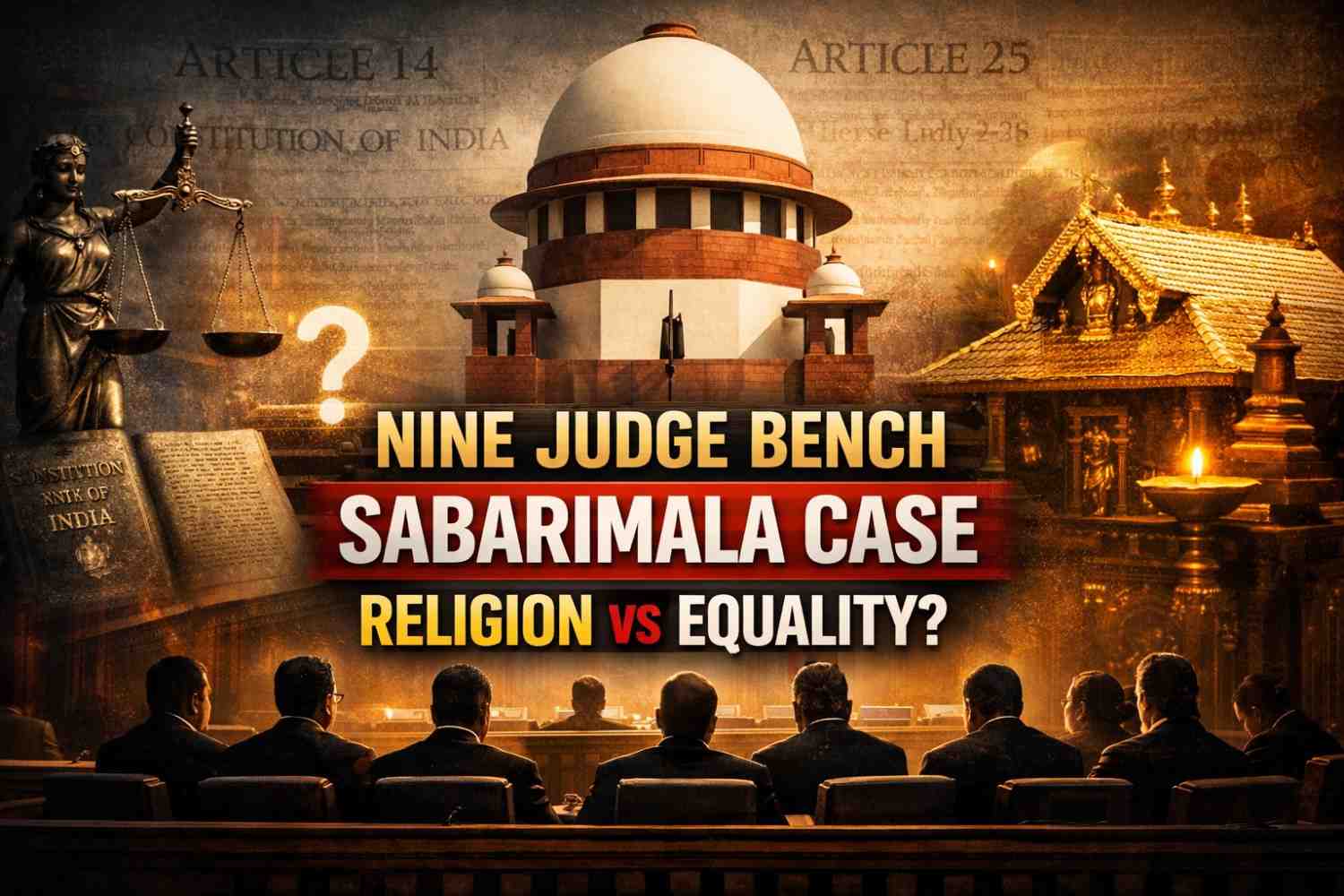
The SUPREME COURT OF INDIA has initiated a historic hearing through a NINE JUDGE CONSTITUTION BENCH to address a series of contentious legal questions stemming from the SABARIMALA TEMPLE case. Presided over by CHIEF JUSTICE OF INDIA SA Bobde, the bench is tasked with examining the interplay between constitutional morality, essential religious practices, and the fundamental right to equality under ARTICLE 14 and ARTICLE 25 of the CONSTITUTION OF INDIA.
The proceedings center on a wider reference that asks whether the top court has the jurisdiction to interfere with religious practices that are considered integral to a specific faith. While the original SABARIMALA judgment permitted the entry of women of all ages into the temple, the current bench is revisiting the scope of JUDICIAL REVIEW regarding religious matters. The court is specifically looking at whether the court should intervene in matters where the devotees claim the practice is an ESSENTIAL RELIGIOUS PRACTICE protected by the constitution.
During the opening arguments, SOLICITOR GENERAL TUSHAR MEHTA representing the state of KERALA maintained that the government supports the implementation of the original ruling. However, various senior advocates representing religious trusts and petitioners have argued that the court must exercise restraint. They contend that the internal management and rituals of a religious institution should be free from judicial interference unless there is a clear violation of public order or health.
A critical point of discussion has been the interpretation of ARTICLE 25. The judges have queried whether the right to profess, practice, and propagate religion is an individual right or if it can be overridden by the competing right of equality. The bench noted that it needs to define the parameters of religious freedom more clearly to prevent arbitrary interference while ensuring that the constitutional values of equality are not sacrificed at the altar of dogma.
As the proceedings continue, the court is expected to deliberate on several interconnected issues. These include the meaning of religious denominations under ARTICLE 26 and the extent to which secular courts can decide what constitutes a core religious practice. Legal experts suggest that the outcome of this NINE JUDGE BENCH will have a far reaching impact on how the judiciary handles religious disputes across the country. It could potentially set a new benchmark for the BALANCE between individual rights and group rights in a secular democracy.
The courtroom atmosphere remains intense as senior lawyers debate the historical context of the temple and the significance of the specific deity, LORD AYYAPPA. The petitioners challenging the previous order emphasize that the exclusionary practice is not a form of discrimination but a matter of strict adherence to the tradition of the deity, who is considered a CELIBATE BRAHMACHARI. On the other side, advocates for the original petitioners argue that tradition cannot be a shield for gender-based discrimination and that the constitution must remain supreme.
As of this week, the bench has not yet indicated a timeline for the final verdict, but it has signaled that the scope of the inquiry will be comprehensive. The court intends to examine whether this case could provide a definitive framework for adjudicating similar religious issues in the future. As the legal community watches closely, the SUPREME COURT continues its quest to reconcile ancient traditions with modern constitutional aspirations.