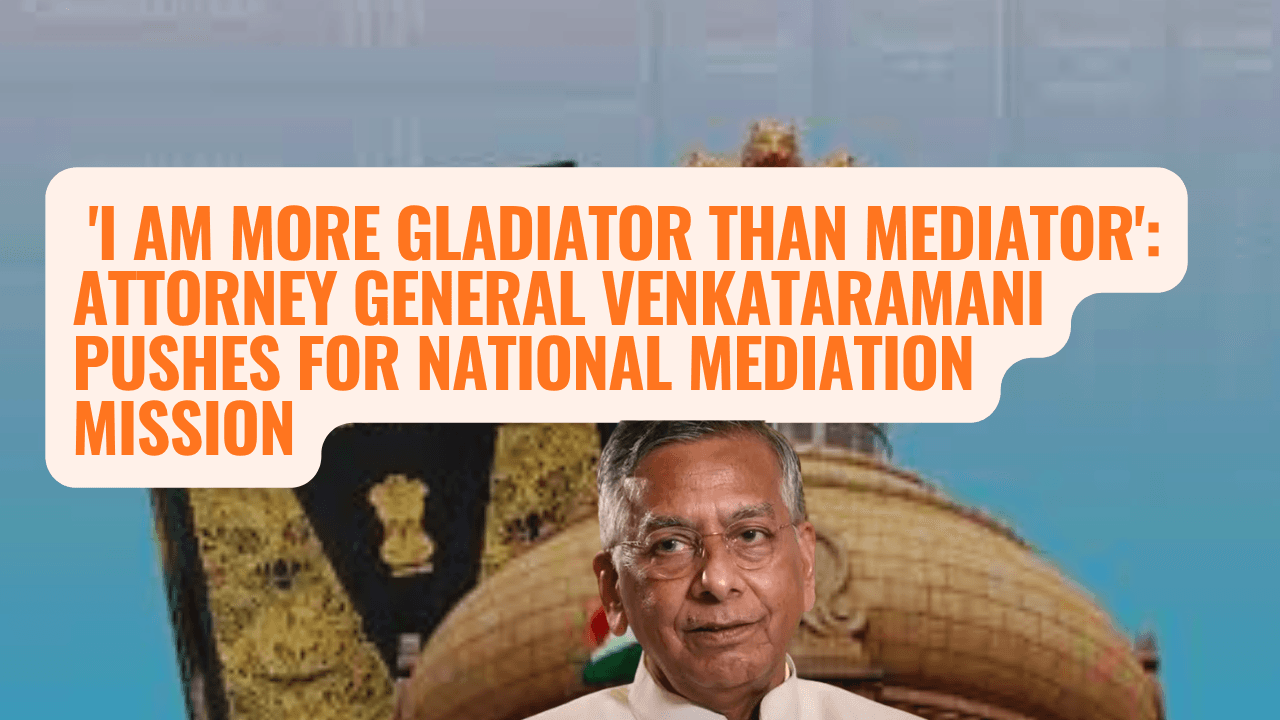
In a candid and refreshingly honest speech at the Mission Mediation Conclave 2025, Attorney
General R. Venkataramani described himself as "more a gladiator than a mediator" while making a passionate case for mediation as a national priority. Despite his constitutional role as the government's chief legal advocate—typically an adversarial position—the AG revealed he has attempted to mediate between government and courts, "sometimes successfully, sometimes with a lot of dissatisfaction." He called for India to establish itself as the global headquarters of mediation and disclosed that Prime Minister Modi "quietly nodded" when the idea was floated.
The Gladiator Who Champions Mediation
The Attorney General's self-description as a "gladiator" captures the traditional role of his office—fighting legal battles on behalf of the government in India's highest courts. The adversarial nature of litigation means taking strong positions, arguing vigorously, and seeking to win cases. Yet here was India's top law officer acknowledging the limitations of this approach and advocating for an alternative.
His candid admission that he has tried to mediate disputes between government and courts, with mixed success, reveals a pragmatic recognition that not every legal conflict needs to become a protracted battle. Even someone whose professional identity is built around litigation can see the value of finding common ground and resolving disputes without judicial pronouncements.
The Adversarial System Must "Slowly Yield"
In a significant statement, the Attorney General said that the adversarial legal system "must slowly yield" for India to advance. This is a remarkable position coming from someone whose entire professional life has been spent in adversarial litigation. He recognizes that while litigation has its place, an overreliance on courts to resolve every dispute creates massive backlogs, delays justice, and often leaves both parties dissatisfied.
Mediation offers a different path. Instead of a winner-take-all approach where one party prevails and the other loses, mediation seeks mutually acceptable solutions. It's faster, less expensive, less formal, and can preserve relationships that litigation often destroys. For commercial disputes, family matters, and many other conflicts, mediation can provide better outcomes than years of courtroom battles.
India as Global Mediation Headquarters
The Attorney General's most ambitious proposal was that India should position itself as the global headquarters of mediation. This vision goes beyond simply promoting mediation domestically—it suggests India could become the preferred destination for resolving international commercial disputes, much as Singapore and London currently serve as arbitration hubs.
India has several advantages for this role: a sophisticated legal system, English-speaking professionals, time zone accessibility for both Asian and European parties, and relatively lower costs compared to Western venues. With proper infrastructure, trained mediators, and supportive legal frameworks, India could attract international parties seeking neutral ground to resolve their disputes.
The AG's disclosure that Prime Minister Modi "quietly nodded" when this idea was presented suggests potential government support for such an initiative. If this vision materializes, it could position India as a leader in alternative dispute resolution and create economic opportunities in the legal services sector.
From Gladiator to Bridge-Builder
The Attorney General's speech at the Mission Mediation Conclave represents an important moment in India's legal evolution. When the nation's top litigator acknowledges that he is "more gladiator than mediator" but still champions mediation as essential for progress, it signals a broader cultural shift in how India approaches dispute resolution.
His honesty about the mixed results of his own mediation attempts makes his advocacy more credible, not less. Mediation is not a magic solution that always works—but even a gladiator can recognize that not every dispute requires going to battle. Sometimes, the real victory lies in finding a path forward that both parties can accept.
As India's courts groan under the weight of millions of pending cases, the Attorney
Meta Description: Supreme Court issues notice to cricketer Mohammed Shami over wife's ₹10 lakh monthly maintenance demand, questioning adequacy given celebrity status while examining balance between earning capacity and reasonable maintenance obligations.
General's call for a mediation mission becomes not just aspirational but essential. The question now is whether India can transform this vision into reality—building the infrastructure, training the professionals, and creating the culture needed to make mediation a viable alternative to endless litigation.