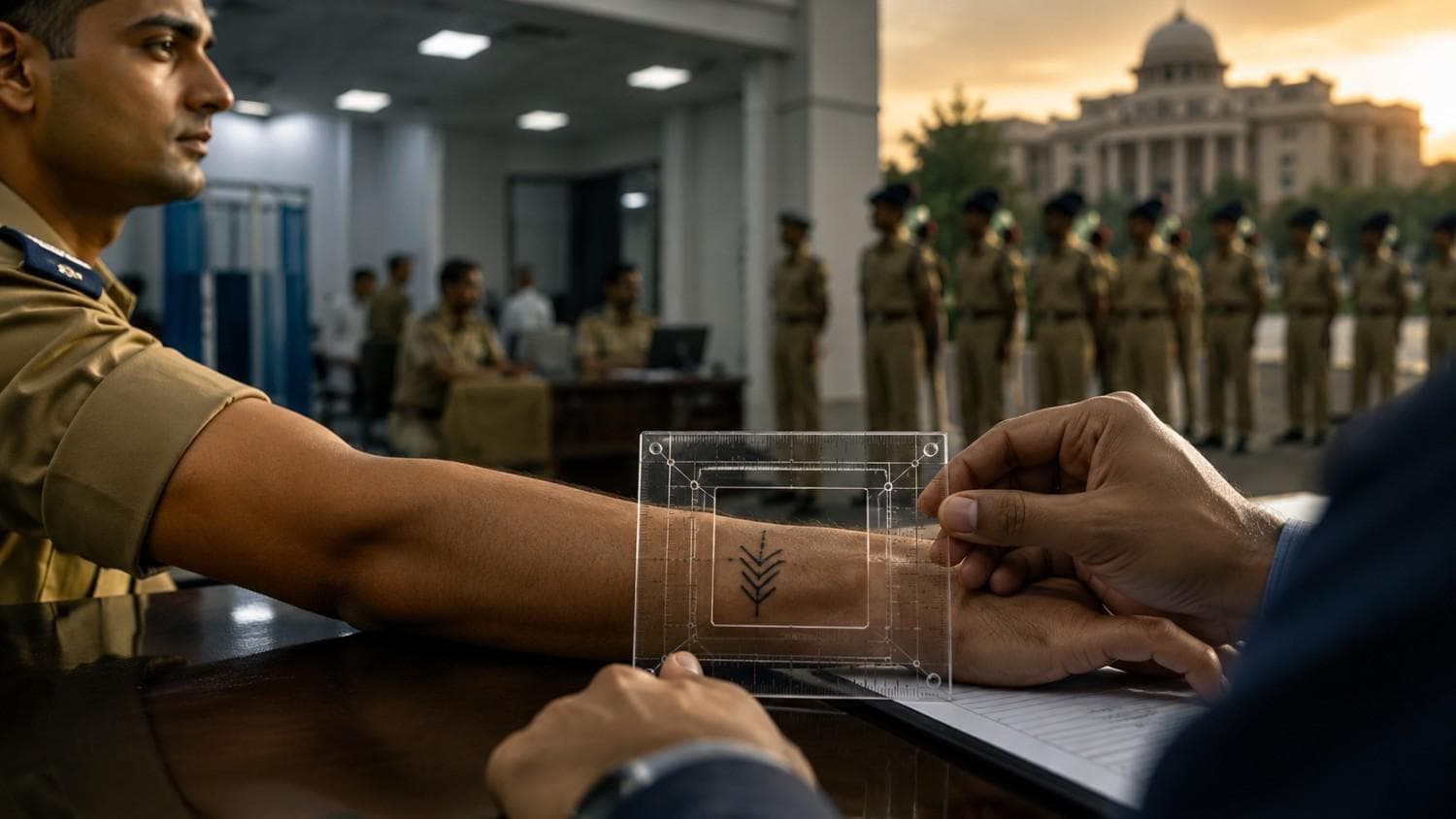
The matter arose from a petition filed by an applicant who claimed that his selection for a post in the Central Armed Police Forces (CAPFs) was rejected solely on the basis of a tattoo he bore. The petitioner contended that the denial amounted to a violation of his right to equality under Article 14 of the Constitution and his right to equal opportunity in public employment under Article 16. He argued that the imposition of a blanket ban on tattoos was arbitrary and lacked a rational nexus with the requirements of the service.
A Division Bench comprising Justice Anil Kshetarpal and Justice Amit Mahajan examined the rival submissions. The Bench observed that the rules governing the recruitment of personnel in the CAPFs do not contain an absolute bar on tattoos. Instead, the regulations prescribe specific standards that a tattoo must satisfy in respect of its content, its anatomical location and its size. The Bench made this observation while dismissing the petition, indicating that the impugned restriction was not a total prohibition but a conditional requirement.
The Bench held that the restriction imposed by the recruiting authority was not arbitrary. It noted that the authority is empowered to lay down norms that promote uniformity, discipline and a professional appearance among the personnel of the forces. The Bench emphasized that such norms serve a legitimate aim connected to the operational effectiveness and internal cohesion of the CAPFs. The Court further observed that the petitioner had not demonstrated that the prescribed standards were unreasonable, discriminatory or lacking in any rational basis. Consequently, the Court concluded that the impugned order did not infringe any fundamental right.
The judgment clarifies that aspirants to the CAPFs may retain tattoos provided they conform to the stipulated guidelines concerning content, location and size. Any tattoo that falls outside these parameters may lead to disqualification. The decision places an onus on the recruiting authorities to apply the prescribed standards objectively and without bias. It also signals that any future modification of the tattoo norms would be subject to judicial review to ensure that the restrictions remain reasonable and proportionate to the goals of uniformity and discipline.
The Delhi High Court’s observation settles the controversy surrounding tattoos in the armed police forces by confirming that the bar is not absolute but conditional. The ruling reinforces the principle that reasonable restrictions on personal appearance are permissible when they are directly linked to the functional requirements of the service, and that such restrictions must be grounded in clear, objective criteria.