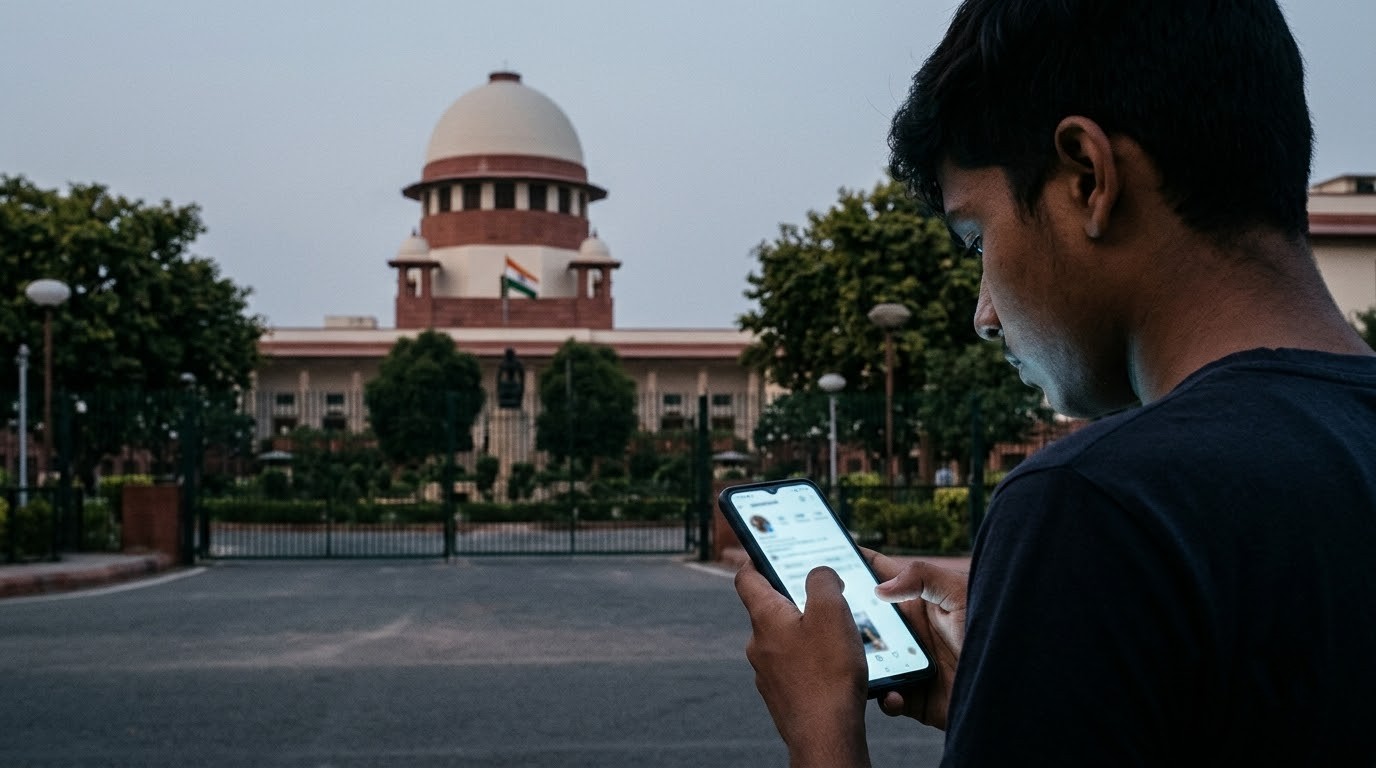
The Supreme Court on Wednesday issued notice to the Union of India and Meta Platforms Inc. on a Public Interest Litigation (PIL) seeking a comprehensive national framework to regulate algorithmic recommendations, compulsive-use features, and data profiling on platforms such as Facebook, Instagram, and WhatsApp. The Bench, comprising Chief Justice of India Surya Kant, Justice Joymalya Bagchi, and Justice V. Mohana, directed the respondents to file their replies in the matter Sreerupa Chowdhury v. Union of India & Ors.
The petitioner, Sreerupa Chowdhury, contended that major social media platforms deliberately deploy compulsive-use mechanics, commonly referred to as dark patterns, to maximise user engagement. Specific features cited in the plea include infinite scrolling, auto-playing video reels, push notifications, and variable reward systems. It was argued that these designs are engineered to trigger dopamine loops, resulting in severe paediatric addiction, cognitive impairment, sleep deprivation, anxiety, depression, and self-harm ideation among adolescents.
What are the specific 'dark patterns' alleged to cause addiction in children?
The petition identifies infinite scrolling, auto-playing video reels, push notifications, and variable reward systems as deliberate design choices—termed 'dark patterns'—that exploit psychological vulnerabilities to create dopamine-driven compulsive use among children.
The PIL further highlighted the inadequacy of existing age-verification mechanisms, submitting that children below the age of 13 access these platforms without effective checks. The petitioner alleged that this regulatory gap has fostered a permissive environment for online grooming and the circulation of Child Sexual Abuse Material (CSAM), constituting violations of the Information Technology Act, 2000, and the Protection of Children from Sexual Offences (POCSO) Act, 2012.
A key contention raised was the disparity in safety standards applied by Meta across jurisdictions. The plea submitted that while the platform has agreed to implement safety-by-design safeguards in Western jurisdictions under regulatory pressure, it has failed to deploy comparable protections for users in India. Consequently, the petition sought directions to the government and regulatory authorities to mandate independent audits of the platforms' algorithmic systems, enforce effective age-verification protocols, and introduce statutory safeguards against compulsive-use features and exposure to harmful content.
Senior Advocate Geeta Luthra appeared for the petitioner, assisted by a team of advocates including Shambo Nandy, Daksh Sharma, Shivani Luthra, Manas Agrawal, Adarsh Kothari, Pranjal Pandey, Rishabh Dahiya, Varnika Bhardwaj, Parth Tanwar, Devansh Tiwari, and Prachi Sharma.
Parallel Proceedings on Child Safety
The instant petition follows a similar intervention by the Supreme Court last month, where notice was issued on a plea filed by Indore-based Emerald Heights International School and its Director, Siddharth Singh. That petition sought directions to the Centre and the National Commission for Protection of Child Rights (NCPCR) to formulate a regulatory framework restricting children's access to social media to shield them from cyberbullying, sexual exploitation, and compulsive digital dependency.
Petition | Petitioner | Core Relief Sought | Respondents Notified |
|---|---|---|---|
Sreerupa Chowdhury v. Union of India & Ors. | Sreerupa Chowdhury | National framework for algorithmic audit, age-verification, safeguards against dark patterns | Centre, Meta Platforms Inc. |
Emerald Heights International School & Anr. v. Union of India & Ors. | Emerald Heights International School, Siddharth Singh | Regulatory framework restricting children's access; directions to Centre and NCPCR | Centre, NCPCR |
The issuance of notice in the Chowdhury petition signals the Court's prima facie recognition of the potential harms posed by unregulated algorithmic architectures on minors. The matter is expected to proceed alongside the earlier pending petition, potentially consolidating the judicial scrutiny of Big Tech's accountability regarding child safety in the Indian digital ecosystem.