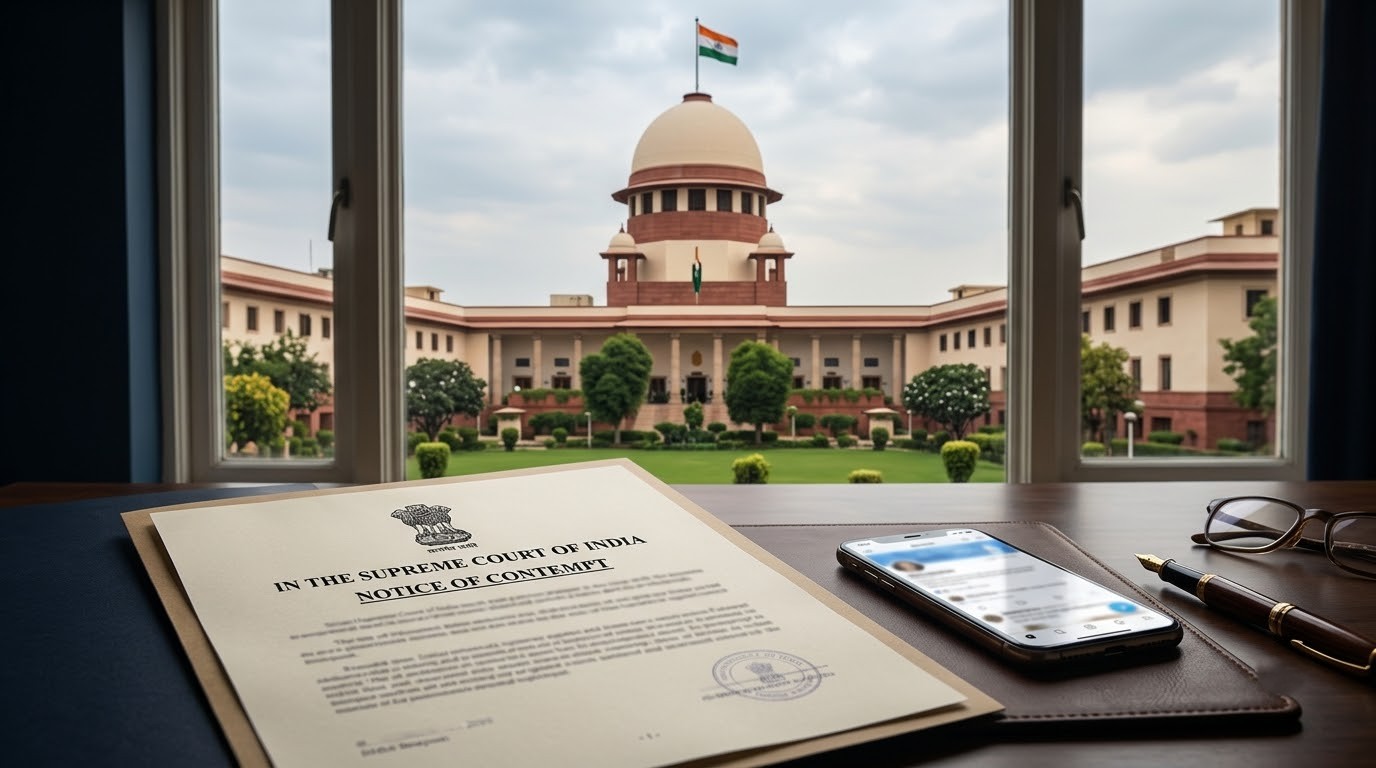
The Supreme Court has initiated contempt proceedings by issuing formal notices to office-bearers of the Kerala Pradesh Congress Committee, including its President and Secretary. The bench comprising Justice Aravind Kumar and Justice Vipul M. Pancholi heard a writ petition filed by Advocate Vineet Jindal, which sought suo motu action regarding a contentious social media post published on the official platform account of the Indian National Congress Kerala unit. The post in question appeared on October 12, 2026, and directed remarks at Chief Justice of India Surya Kant, suggesting resignation over law and order matters. Although the political organization subsequently deleted the content and tendered an unconditional apology, the bench determined that formal scrutiny was warranted.
What are the legal implications of social media posts targeting the judiciary under the Contempt of Courts Act?
Under the Contempt of Courts Act, 1971, and Article 129 of the Constitution, publications or statements that interfere with or tend to obstruct the administration of justice constitute criminal contempt. The Supreme Court held that while judicial decisions remain open to rigorous criticism, freedom of expression cannot serve as a shield for intimidation or interference with judicial functioning.
During the proceedings, counsel representing the Kerala Congress committee argued that the material had been uploaded without the explicit approval of the senior office-bearers. The defense submitted that the responsible party worker was stripped of organizational responsibilities immediately after the incident, and an unconditional apology was issued to address the grievance. Addressing these submissions, Justice Aravind Kumar remarked that the court would examine whether the apology originated from the pen or the heart. The bench emphasized that the Constitution remains supreme and that no individual or political entity stands above it. Furthermore, the court observed that judicial independence is a fundamental constitutional guarantee owed to the public rather than a matter of political convenience.
Legal Parameter | Details Under Supreme Court Proceedings |
|---|---|
Statutory Provision | Contempt of Courts Act, 1971 and Article 129 of the Constitution |
Respondents | Office-bearers of the Kerala Pradesh Congress Committee, including President and Secretary |
Contentious Material | Social media post published on October 12, 2026, targeting the Chief Justice of India |
Defense Raised | Unauthorized post by a party worker, immediate deletion, and unconditional apology |
Judicial Stance | Examination of apology genuineness, strict handling of attempts to undermine judicial authority |
The bench observed that judicial restraint must never be mistaken for institutional weakness. It reiterated that the authority of the court rests entirely on the rule of law and does not require political endorsement or approval. Any attempt to undermine this authority must be met with an iron hand to ensure that the stream of justice remains unpolluted, regardless of the identity of the interferer. The court directed the office-bearers to show cause why contempt proceedings should not be finalized against them, while exempting them from personal appearance at this preliminary stage.
Additionally, the bench indicated that it might appoint Senior Advocates Arvind Datar and Siddharth Agarwal to assist the court as amicus curiae, and requested assistance from the Attorney General of India. The court clarified that it had not yet expressed any final opinion on the merits of the matter, leaving the substantive evaluation for subsequent hearings.