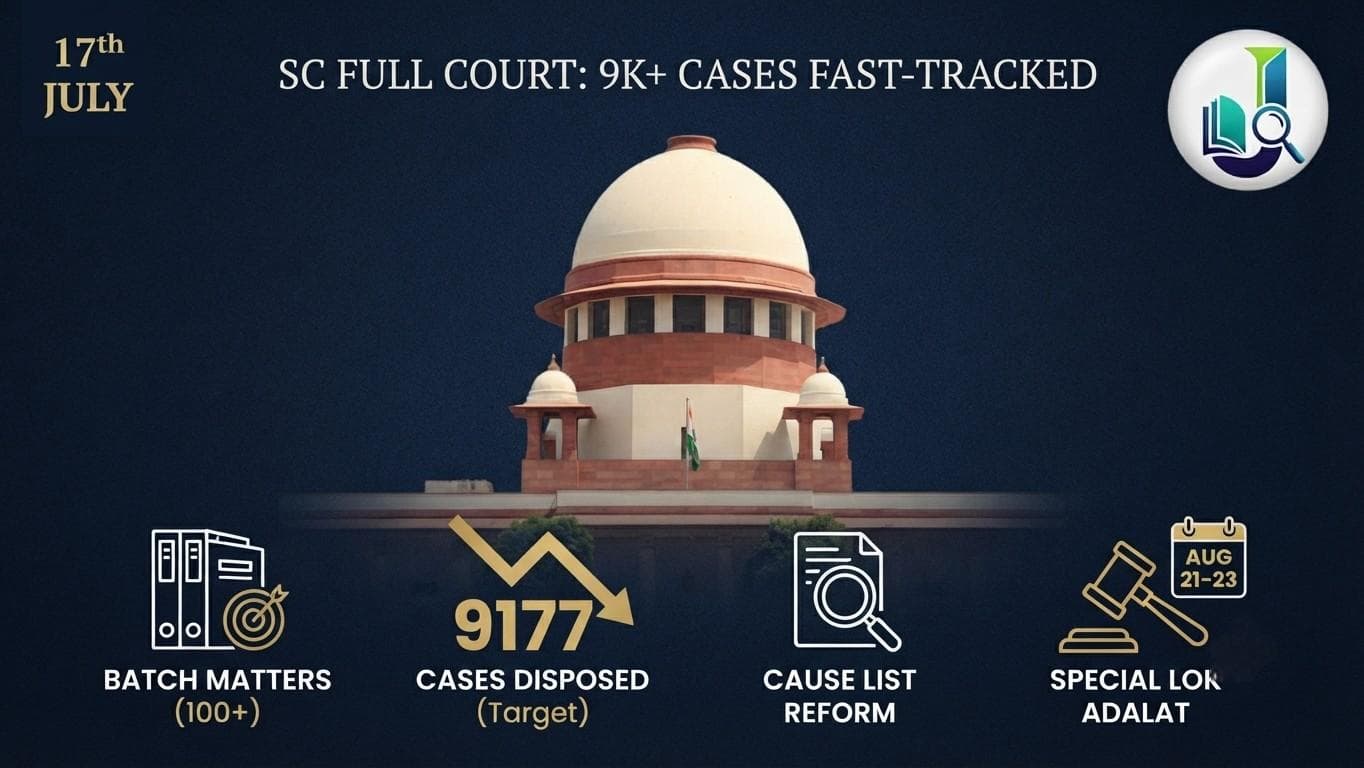
The full court of the Supreme Court, comprising all thirty‑five judges of the apex court, convened on July 15 and adopted a resolution concerning the hearing of batch matters and related case‑management procedures. The resolution was passed in the context of the ongoing Samadhan Samaroh organised by the Court, which is scheduled to culminate in a Special Lok Adalat on August 21, 22 and 23.
The full court resolved that at least one hundred batch matters, which are ready for final hearing, shall be taken up for disposal. These matters are to be listed before the appropriate benches for out‑of‑turn hearing. According to the resolution, the hearing of these batch matters is expected to lead to the disposal of about nine thousand one hundred and seventy‑seven cases.
After the disposal of the aforementioned batch matters, the full court directed that the oldest cases, after notice has been issued, shall be taken up for hearing on Tuesdays, Wednesdays and Thursdays. This sequencing is intended to ensure that matters which have been pending for the longest period are addressed in a regular weekly pattern.
In addition to the scheduling directions, the full court ordered that necessary steps be taken for the simplification of the cause list and to bring uniformity in the manner in which cases are taken up seriatim in the daily cause list. To examine. A committee of judges shall be constituted to examine these issues and to make recommendations on further improvements in cause list management.
The resolution also places an obligation on arguing counsel. When a matter is taken up for final hearing, counsel will be required to furnish timelines for their oral submissions. This requirement is intended to assist the bench in allocating time efficiently and to ensure that hearings proceed within the allotted schedule.
Furthermore, the full court addressed the mode of appearance for parties‑in‑person during interactions with the Registrar under Order IV Rule 1(c) of the Supreme Court Rules, 2013. Parties‑in‑person will be given the option to appear through virtual mode. Those who insist on appearing physically will be permitted to do so, provided that no live‑streaming or video‑recording of the proceedings takes place.
The full court’s resolution reflects a concerted effort to manage the existing caseload by prioritising batch matters that are ripe for final disposition, while simultaneously instituting measures to regulate the daily cause list and to accommodate the preferences of litigants regarding their mode of appearance. The constitution of a judicial committee to study cause‑list simplification indicates that the Court intends to monitor the effectiveness of these measures and to consider further reforms if warranted.
The Special Lok Adalat scheduled for late August will serve as the culmination of the Samadhan Samaroh initiative, during which the outcomes of the batch‑matter hearings and the Lok Adalat proceedings are expected to contribute to a reduction in the pendency of cases before the Supreme Court.