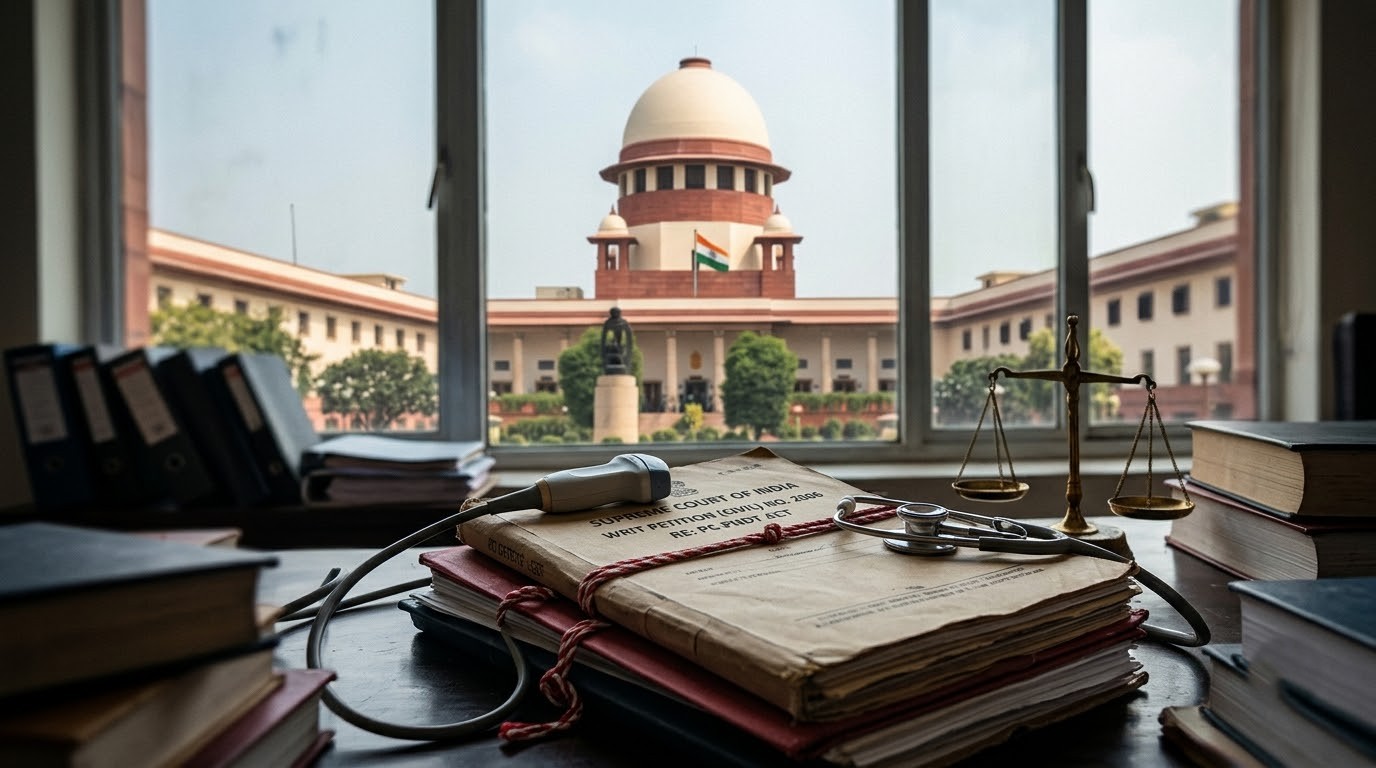
The Supreme Court has disposed of a writ petition filed in 2006 by the Voluntary Health Association of Punjab which sought wide-ranging directions for the implementation of the Pre-Conception and Pre-Natal Diagnostic Techniques (Prohibition of Sex-Selection) Act, 1994. A bench comprising Justice BV Nagarathna, Justice R Mahadevan and Justice Devendra Kumar Upadhyaya passed the order while granting liberty to the petitioner or any other party to file a fresh petition.
Background Of The Petition
The petition, pending for over eighteen years, was filed seeking structural and operational reforms in the enforcement machinery established under the 1994 Act. The petitioner, represented by a team of advocates including Mr. Khowaja Siddiqui and Mr. Arvind Gupta, prayed for the reconstitution of Appropriate Authorities (AAs) and advisory committees. It specifically sought the removal of private doctors from these bodies and their replacement with reputed NGOs and individuals committed to the full implementation of the statute.
The plea further demanded the strengthening and expansion of the team of Appropriate Authorities along with the allocation of a fixed budget for their functioning. It sought to make AAs accountable and directly liable for a worsening sex ratio in their respective jurisdictions, stipulating clear legal consequences for breach of duty.
Specific Reliefs Sought
The petition enumerated extensive directions relating to record-keeping and machine regulation. It prayed that statutory forms be maintained in duplicate and sent monthly to the AAs, with access granted to reputed NGOs for monitoring and prosecutions. Regarding ultrasound machines, the petitioner sought a direction that one operator be permitted to operate only one machine and that machines be sealed in the absence of a qualified operator. It also sought to ensure that seized machines and cancelled registrations are not returned or re-registered.
Further, the plea requested that manufacturers and sellers disclose the details of purchasers to the AAs on a monthly basis rather than quarterly. It sought the clubbing of the powers of AAs, including search and seizure under Sections 30(1) and 30(2) of the Act, under Section 17A.
Enforcement And Prosecution Reforms
On the prosecution side, the petitioner sought directions to the Medical Council of India to mandate doctors to report breaches of the Act and to act on complaints made by AAs. The prayer included the appointment of special legal officers to conduct prosecutions, the establishment of special courts for cases under the Act, time-bound trials and specialised training for presiding officers.
The petition also sought the constitution of a Commission comprising reputed NGOs, individuals and government servants to conduct surprise raids and report to the Supreme Court. Additionally, it prayed for monthly monitoring of the child sex ratio at birth at the district level, compulsory registration of births in all States, biennial audits of birth registers and a methodical analysis of birth and death registers.
Training And Curriculum Changes
Among the miscellaneous reliefs, the petitioner asked for an expert committee to review the 23 indications in Form F. It also sought separate registration for imaging techniques and gynaecological techniques such as Amniocentesis and Chorionic Villi Biopsy, and a direction that ultrasound not be offered without a referral. The plea further advocated for the training and sensitisation of doctors, inclusion of the subject in the medical curriculum, and the utilisation of registration fees for engaging lawyers and auditing Form F.
Court's Reasoning For Disposal
The bench disposed of the petition after observing that the legislative landscape had transformed significantly since the filing of the writ. During the pendency of this Writ Petition before this Court several amendments have been made to the Pre-Conception and Pre-Natal Diagnostic Techniques (Prohibition on Sex-Selection) Act, 1994 and the Rules, the bench noted in its order.
Consequently, the court concluded that the prayers made in 2006 required fresh consideration in light of the current statutory framework. The disposal was ordered without prejudice to the rights and contentions of the parties, explicitly granting liberty to file a fresh plea.
Why Was The 2006 PIL On PC&PNDT Act Disposed Of?
The Supreme Court disposed of the 2006 writ petition because several amendments have been made to the PC&PNDT Act and the Rules during its pendency. The bench held that the changed legislative framework necessitates a fresh assessment of the reliefs sought, granting the petitioner liberty to file a new petition.