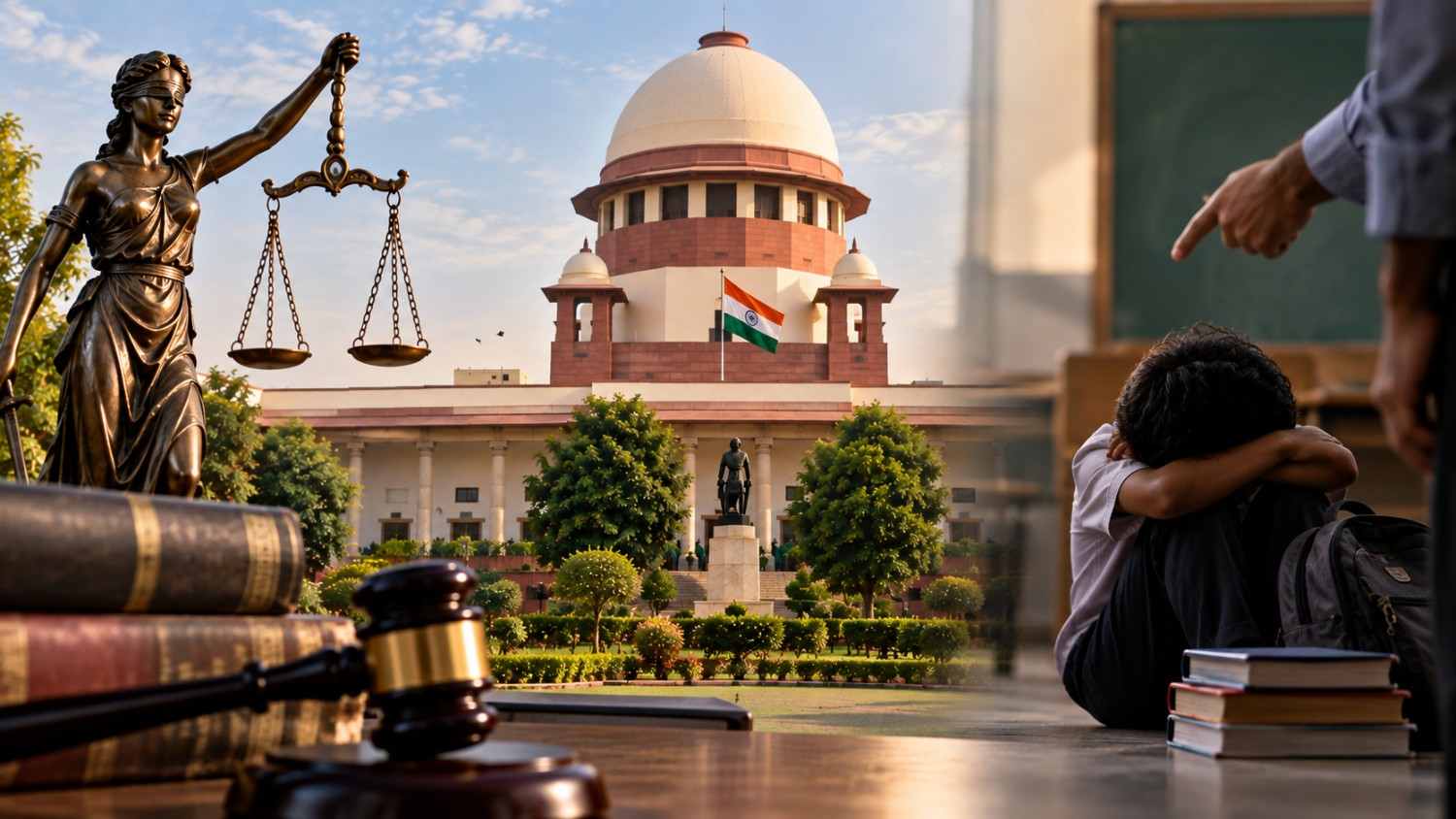
The Supreme Court has set aside the Calcutta High Court’s refusal to quash criminal proceedings under the Protection of Children from Sexual Offences Act, 2012 (POCSO Act) against a geography teacher, Bhaskar Paul, who was accused of hitting minor girl students on their back and waist during class. The Bench, comprising Justices Ujjal Bhuyan and Atul S Chandurkar, passed the order on September 8, 2026, in Bhaskar Paul v. State of West Bengal.
The Court examined the allegations arising from a District Child Protection Unit enquiry in Alipurduar, which recorded complaints that the teacher had rubbed students’ backs, pinched them on the waist, touched one student’s neck, and looked at three students inappropriately. Based on this report, an FIR was registered under Section 10 of the POCSO Act, which pertains to aggravated sexual assault.
The Bench clarified that under Section 7 of the POCSO Act, physical contact with a child constitutes sexual assault only when it is done with sexual intent. It emphasized that if such an offence is committed by a person entrusted with the care or supervision of a child, such as a teacher, it attracts the enhanced penalty under Section 9(f) and is punishable under Section 10.
After reviewing the statements of the two students recorded before a magistrate, the Court found that they described the teacher hitting them on the back and waist when they failed to learn their lessons, and one student mentioned that he had held her hand. The Court held that these accounts disclosed instances of corporal punishment but did not indicate any sexual intent on the part of the teacher.
The Bench acknowledged that the teacher’s use of corporal punishment was inappropriate and that he ought to have exercised greater sensitivity while dealing with girl students. However, it stressed that such conduct, without sexual intent, could not be prosecuted as sexual assault under the stringent provisions of the POCSO Act.
The Court further highlighted the profound and irreversible prejudice that a POCSO prosecution could inflict on a teacher, even if eventual acquittal followed. It observed that for a teacher in a girls’ or co-educational school, such an allegation or trial amounts to condemnation not only for their service career but for their life, affecting their family and reputation. The Bench stated that ultimate acquittal would not redress the pervasive damage caused by the criminal trial itself.
Noting the delay in registering the FIR and that the headmaster and women teachers who initiated the complaint had not witnessed the alleged incidents, the Court expressed doubts about the basis of the prosecution. It held that allowing the proceedings to continue would constitute an abuse of the process of law and cause extreme and irreversible prejudice to the teacher.
Accordingly, the Supreme Court set aside the Calcutta High Court’s order dated April 27, 2026, which had dismissed the teacher’s plea to quash the proceedings, and quashed the entire criminal case pending against Bhaskar Paul before the Special Court at Alipurduar.
The Court concluded that while the appellant needed to sensitize himself in dealing with students of tender age, particularly girl students, the absence of sexual intent rendered the prosecution untenable under the POCSO Act.