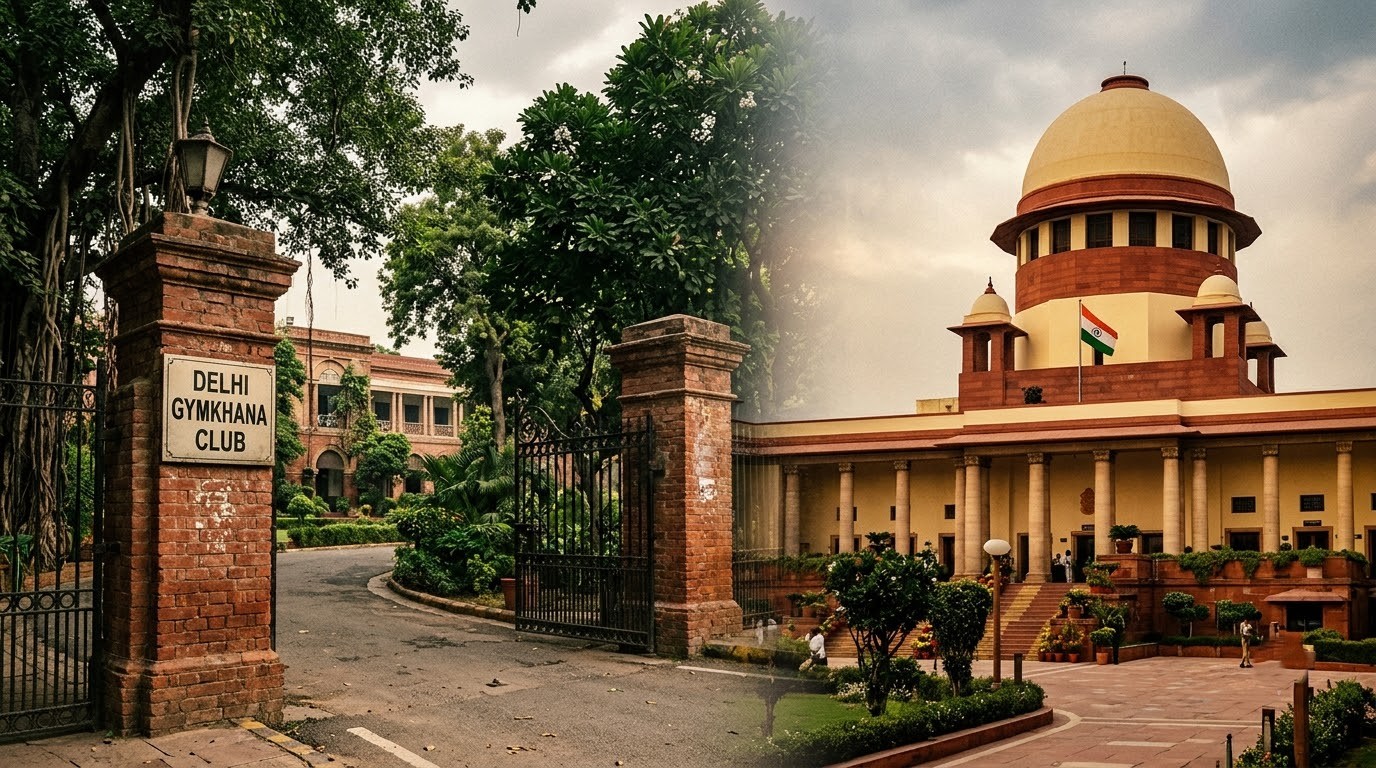
The Supreme Court on Monday clarified its September 15, 2026 order to permit members of the Delhi Gymkhana Club to independently pursue their legal challenge before the Delhi High Court against the Centre's decision to resume possession of the club's 27.3-acre premises at 2, Safdarjung Road, New Delhi, and initiate eviction proceedings.
A Bench Comprising Chief Justice Surya Kant and Justices Joymalya Bagchi and V. Mohana
The clarification was issued after Senior Advocate Vikas Singh, appearing for the petitioning members, submitted that their petitions were pending before the High Court but an objection had been raised regarding their locus standi to maintain the challenge independently. The objection contended that only the club as a corporate entity, and not its individual members, could institute proceedings against the government's decision.
Taking note of the submission, the Chief Justice clarified that the members would be at liberty to initiate independent proceedings before the High Court. The Bench, however, refrained from expressing any opinion on the merits of the underlying dispute, leaving all objections available to the parties to be adjudicated by the High Court.
What Prompted the Centre's Resumption of the Club's Property?
The Land and Development Office (L&DO), under the Union Ministry of Housing and Urban Affairs, issued a resumption notification on May 22, 2026, terminating the perpetual lease granted to the erstwhile Imperial Delhi Gymkhana Club Ltd. The government invoked Clause 4 of the lease deed, which permits resumption where the land is required for a public purpose. It maintained that the property, situated in a strategically sensitive area of the national capital, was required for strengthening defence infrastructure, governance-related facilities and other vital public security requirements.
Timeline of Government Action
Date | Action | Authority |
|---|---|---|
May 22, 2026 | Resumption notification issued terminating perpetual lease | Land and Development Office (L&DO) |
June 29, 2026 | Eviction notice issued under Public Premises (Eviction of Unauthorised Occupants) Act, 1971 | Centre |
September 15, 2026 | Supreme Court passes initial order | Supreme Court |
November 16, 2026 | Supreme Court clarifies order allowing independent member proceedings | Supreme Court |
Members' Contentions on Arbitrariness and Conflict of Interest
The members have questioned the legality of the government's action, contending that the stated public purpose behind the proposed takeover is neither adequately substantiated nor consistent with the terms governing the original perpetual lease. They have also raised constitutional concerns, alleging arbitrariness and violation of fundamental rights.
The dispute has acquired an additional dimension because the club is presently administered by a government-nominated management committee. The members argued that the existing management structure creates an inherent conflict of interest, as the club's administration is effectively controlled by the very government against whose decision it is required to litigate.
Background of Management Dispute
The management dispute stems from proceedings under Sections 241 and 242 of the Companies Act, 2013, following which the National Company Law Tribunal (NCLT) superseded the elected General Committee and permitted the Centre to nominate directors to administer the institution. The National Company Law Appellate Tribunal (NCLAT) subsequently upheld the arrangement while directing completion of remedial measures and restoration of an elected governing body.
The members have alleged that the failure to restore the elected management has enabled the government-appointed committee to continue exercising control beyond the stipulated timeline, raising concerns about the club's institutional autonomy. The Supreme Court's clarification now enables the members to pursue their challenge before the Delhi High Court, where the legality of the resumption notification, the subsequent eviction proceedings and the objection regarding their locus standi will be adjudicated on merits.