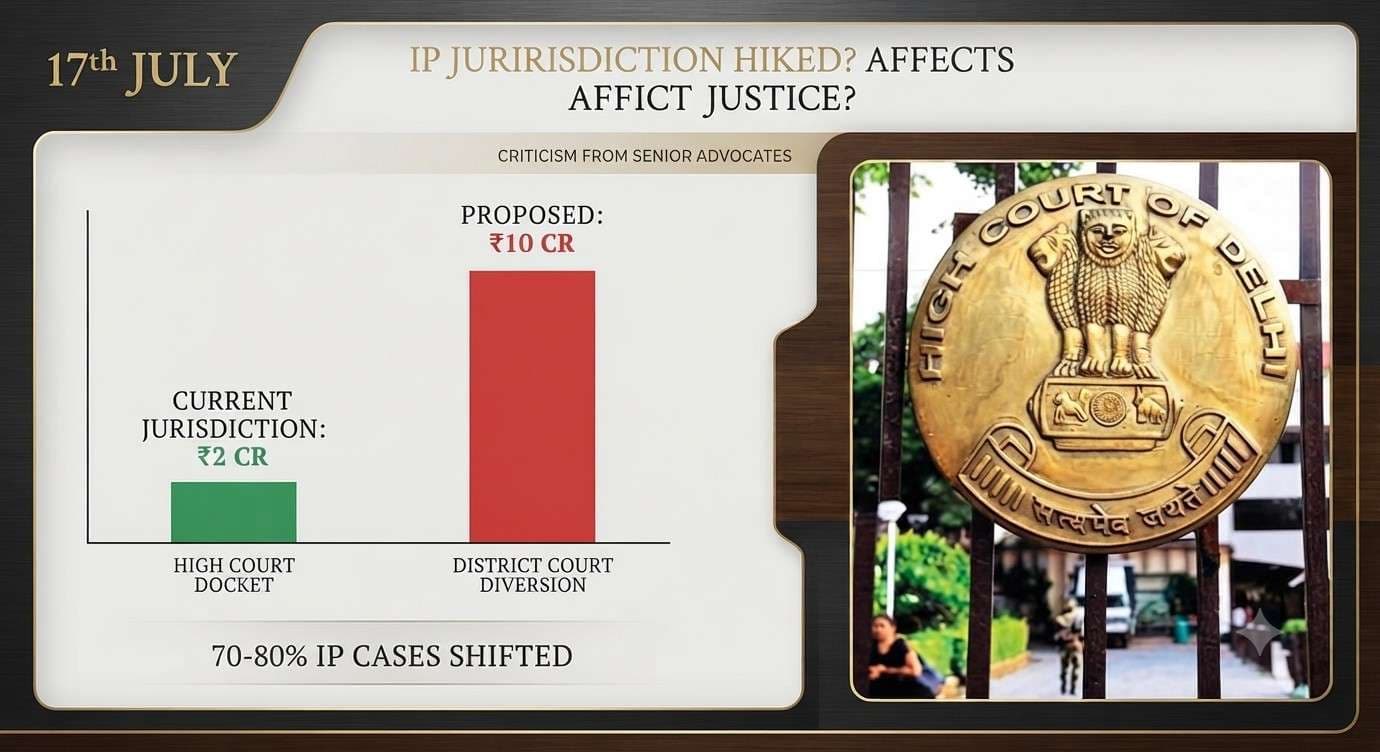
The Delhi High Court’s proposed amendment to raise its pecuniary jurisdiction from Rs 2 crore to Rs 10 crore has drawn sharp criticism from a group of senior advocates who contend that the change, if implemented without broader stakeholder input, will adversely affect access to justice and the development of intellectual property jurisprudence.
Senior Advocate Chander Lall highlighted that approximately seventy to eighty percent of the country’s intellectual property litigation is presently filed before the Delhi High Court because litigants regard it as their preferred forum. He warned that the Court is on the verge of becoming an elitist institution if the jurisdictional threshold is raised abruptly. Lall noted that the High Court has taken nearly thirty‑five years to cultivate the expertise, procedural mechanisms and specialised registries necessary for routinely adjudicating complex patent disputes. He pointed out that district courts currently lack reliable internet connectivity, dedicated online evidence handling systems and confidentiality clubs, which are essential for modern intellectual property proceedings.
Lall further argued that transferring a substantial volume of intellectual property matters to district courts cannot be effected as a knee‑jerk reaction. He stressed that district courts require time, targeted training and infrastructural upgrades before they can competently handle such technically sophisticated cases. He also questioned the opacity surrounding the underlying report that recommended the increase, noting that the absence of the document in the public domain has compelled lawyers to consider collective action.
Senior Advocate Pravin Anand echoed these concerns, estimating that around seventy percent of intellectual property matters would be redirected to district courts under the revised limit. He explained that counterfeiting and trademark suits, which are often instituted at an early stage before significant damages accrue, would be particularly affected. Anand clarified that his apprehension does not pertain to the competence of district judges but to the prevailing deficiencies in supporting infrastructure, specialised registries and the lack of authoritative law reporting from district courts. He observed that judgments from the Delhi High Court, Bombay High Court, Madras High Court and Calcutta High Court have earned international recognition, whereas district court decisions presently do not possess precedent‑setting authority.
Senior Advocate Rajshekhar Rao warned that many substantive questions of intellectual property law arise in disputes involving relatively modest monetary claims. He contended that shifting such matters away from the High Court would impede the Court’s ability to continue developing jurisprudence in emerging technological fields, including artificial intelligence. Rao noted that recent High Court judgments on novel aspects of technology and intellectual property have required nearly a decade to mature, and he expressed doubt that trial courts could replicate that depth of analysis without comparable resources and experience.
Rao proposed a staggered approach to the jurisdictional increase, suggesting an initial rise to Rs five crore, followed by incremental steps to Rs seven point five crore and finally Rs ten crore after periodic evaluations of district court readiness. He posed the rhetorical question whether a jump from Rs two crore to Rs ten crore could be effected instantaneously, implying that a measured progression would be more prudent.
Senior Advocate Shwetasree Majumder drew attention to another fiscal barrier: the uncapped ad valorem court fees prevailing in Delhi. Unlike Mumbai and Kolkata where court fees are subject to a ceiling, a suit valued at Rs twenty crore in Delhi could attract fees amounting to Rs twenty lakh. Majumder argued that this fee structure, combined with the proposed jurisdictional shift, would further deter litigants of moderate means from seeking redress. She reiterated that district courts presently lack the facilities required for sealed filings, confidentiality clubs and other procedural safeguards that are routine in the High Court’s intellectual property docket.
Collectively, the senior lawyers urged the Bench and the Bar to engage in dialogue before finalising any amendment. They advocated for a consultative process that includes litigants, practitioners and representatives from district courts to ensure that any enhancement of the High Court’s pecuniary limit is accompanied by commensurate investments in infrastructure, training and procedural reforms at the trial level.