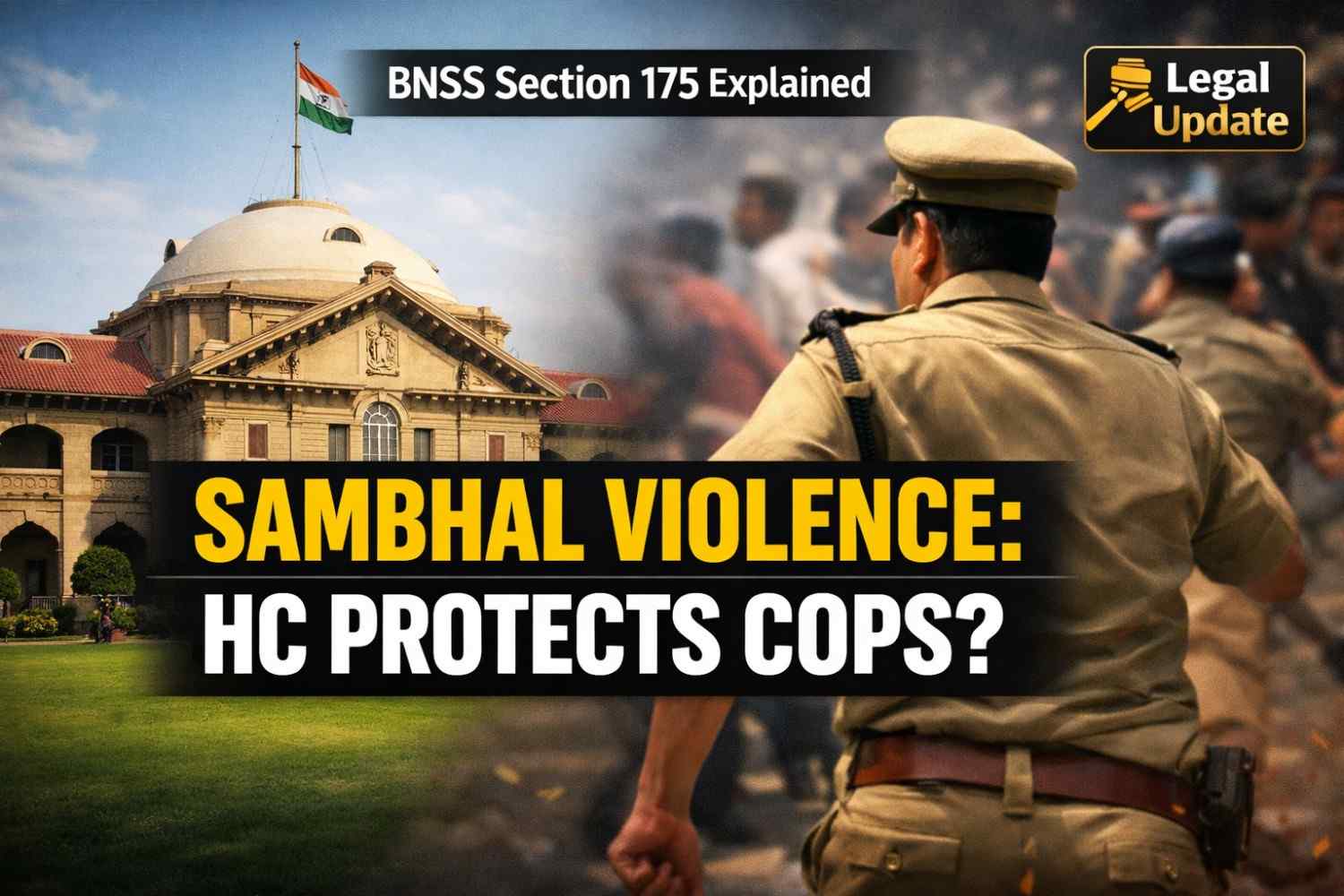
The Allahabad High Court has commenced hearing a high-stakes petition filed by the State of Uttar Pradesh and Additional Superintendent of Police (ASP) Anuj Chaudhary. The petitions challenge a controversial order by the Chief Judicial Magistrate (CJM) of Sambhal, which directed the registration of an FIR against several police officials for their alleged role in the violence that rocked the district in November 2024.
The case brings to the forefront the interpretation of the Bharatiya Nagarik Suraksha Sanhita (BNSS)—India’s new criminal procedural code—and the specific protections it offers to public servants acting in their official capacity.
The roots of the current legal battle lie in the tragic events of November 24, 2024. During a court-mandated survey of the Shahi Jama Masjid in Sambhal, massive stone-pelting and arson broke out. In the ensuing chaos and police action, five people lost their lives and several others were injured.
Following the incident, Yameen, the father of a youth who sustained bullet injuries during the clashes, moved an application before the CJM Court. He alleged that ASP Anuj Chaudhary and other police personnel had opened fire on his son with the intent to kill.
Last month, CJM Vibhanshu Sudheer passed an order directing the police to register an FIR against the officers under Section 175 of the BNSS. Interestingly, shortly after passing this order, the CJM was transferred to Sultanpur by the High Court.
Appearing before the Bench of Justice Samit Gopal, Additional Advocate General (AAG) Manish Goyal, representing the State and the police officer, raised serious questions about the legality of the CJM’s order.
The core of the argument is that the Magistrate failed to follow the mandatory "two-step" safeguard introduced in the BNSS to prevent the harassment of public servants through frivolous litigation.
The State contended that while the Magistrate invoked Section 175 of the BNSS to order the FIR, he completely ignored Section 175(4), which mandates that before an investigation can be ordered against a public servant:
- The Magistrate must receive a report from a superior officer (Clause A).
- The Magistrate must consider the assertions made by the public servant regarding the specific situation that led to the incident (Clause B).
AAG Goyal argued that while the Magistrate did call for a report from the superior police officers, he failed to apply his mind to the contents of that report or the defense of the officers involved.
"The report was delivered... but no consideration was given to the situation which led to the incident. Clause (b) is mandatory, not optional," the AAG submitted. He further pointed out that there was "not a whisper" in the CJM’s order about the police report, which stated that a formal investigation into the violence was already underway and that the police were acting to control a riotous situation.
The State’s counsel characterized the move by the complainant as "forum shopping," arguing that the complainant had not even followed the basic prerequisite of approaching the local police station before rushing to the Magistrate.
To bolster the State's position, the AAG relied on recent landmark rulings from the Supreme Court, including Om Prakash Ambadkar vs. State of Maharashtra (2025) and XXX vs. State of Kerala (2026).
These judgments emphasize that a Judicial Magistrate has the authority—and duty—to reject applications that are "manifestly absurd" or "inherently improbable." The AAG argued that the CJM did not examine the police officials in question and acted beyond the statutory boundaries established by the new law.
Under the old CrPC (Section 156(3)), Magistrates had broad powers to order an FIR. However, the BNSS has tightened these rules, particularly for cases involving government officials. The goal is to ensure that officers are not afraid to perform their duties during riots or emergencies due to the fear of immediate criminal prosecution by private individuals.
The State argues that the Sambhal violence was not a "standalone incident" of police high-handedness but a reaction to a massive commotion and life-threatening stone-pelting. By ignoring the context of the riot, the State claims the CJM's order sets a dangerous precedent for law enforcement.
The Allahabad High Court is currently reviewing the records. The outcome of this case will likely set a major precedent for how Section 175(4) of the BNSS is applied across the country.
Can a Magistrate order an FIR against a senior police officer without hearing their side of the story as mandated by the new code? This is the billion-dollar legal question the High Court is set to answer.
As the hearing continues, the eyes of both the legal fraternity and the public remain on Prayagraj. The decision will balance the rights of victims seeking justice for police violence against the legal safeguards meant to protect officers performing their duties in volatile situations.