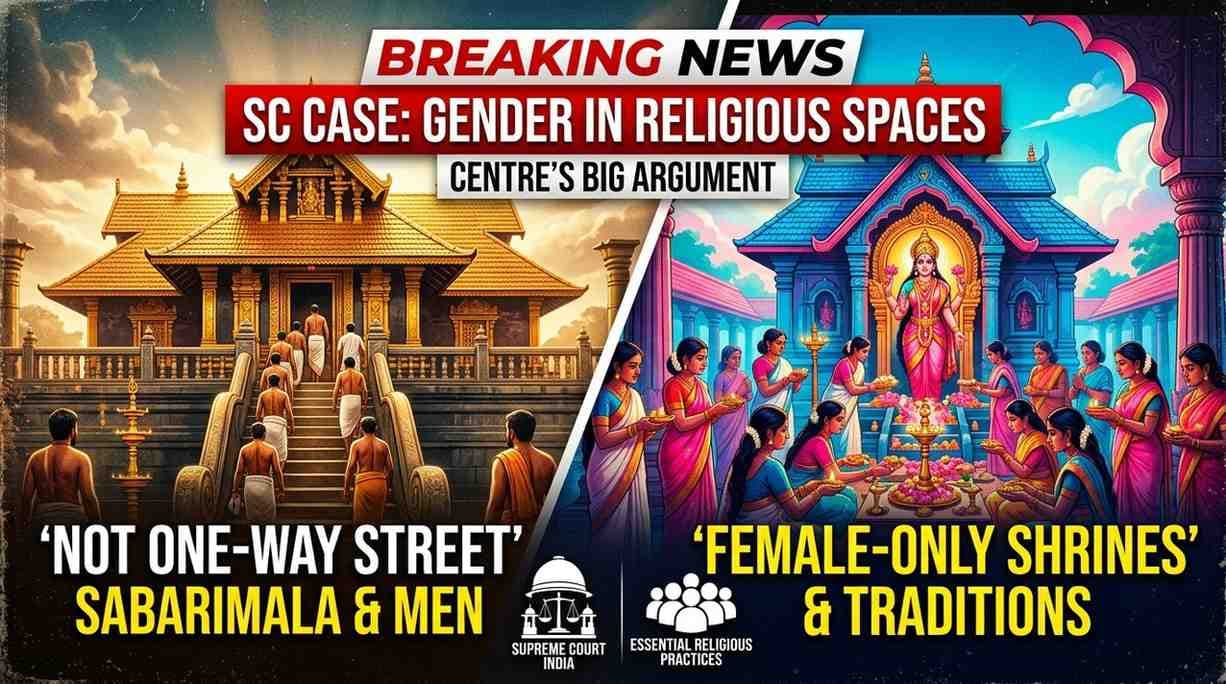
Continuing the complex deliberations in the Sabarimala reference case, the Central Government has pointed out to the Supreme Court that gender-based restrictions in religious spaces are not a one-way street. Solicitor General Tushar Mehta, representing the Centre, informed the nine-judge Constitution Bench that India possesses a diverse tapestry of traditions, including specific temples where only women are permitted to enter and perform rituals. This argument was presented to demonstrate that such exclusions are often intrinsic to the unique character of the deity and do not necessarily stem from a desire to discriminate or cast aspersions on any gender.
The Solicitor General’s submissions were aimed at contextualizing the "Essential Religious Practices" test, which is at the heart of the referral. By highlighting "women-only" shrines, the Centre sought to show that the exclusion of men in certain spaces and women in others (such as the Sabarimala temple) is a manifestation of the varied religious landscape of the country. The government argued that these practices are rooted in centuries-old customs and legends, suggesting that viewing every religious rule through the singular lens of modern secular equality might overlook the genuine denominational rights protected under the Constitution.
The Centre further contended that the judiciary should not apply a "one-size-fits-all" approach to religious practices. It was argued that if a practice is not a social scourge—like untouchability—but rather a specific disciplinary or traditional requirement of a sect, it should remain within the domain of the religious community. The government’s stance suggests that the "purity" or "character" of a deity, such as the celibate form of Lord Ayyappa, creates a specific set of rules that are essential to the identity of that particular pilgrimage, rather than being a generalized statement on the status of women in society.
A significant theme of the discussion involved the definition of "secularism" in the Indian context, which involves the state maintaining an equal distance from all religions while respecting their internal autonomy. The Centre warned that if the Court begins to strike down every custom that appears exclusionary by modern standards, it could lead to a cascading effect on various minority and majority religious institutions. The mention of temples where men are banned was a strategic move to show that the law of the land recognizes reciprocal exclusions based on the specific "faith-based" requirements of different deities.
The bench engaged with these arguments by questioning where the line should be drawn between a religious practice and a civil right. The judges explored whether the right to worship is an individual right that should be available to everyone regardless of biological factors, or if it is a collective right of a denomination to set its own boundaries. The Centre’s emphasis on the existence of female-centric temples was intended to neutralize the argument that the Sabarimala restriction is rooted in patriarchy, framing it instead as a matter of diverse denominational sovereignty.
This legal tug-of-war highlights the difficult task facing the Supreme Court in reconciling traditional religious freedoms with the transformative goals of the Indian Constitution. As the hearing progresses, the Court must decide if the presence of female-only spaces justifies the existence of male-only spaces, or if the "Basic Structure" of the Constitution demands a level of access that transcends traditional boundaries. The final verdict on this reference will provide a definitive framework for how India balances its commitment to gender equality with its deep-seated respect for the pluralistic and often paradoxical nature of its religious heritage.