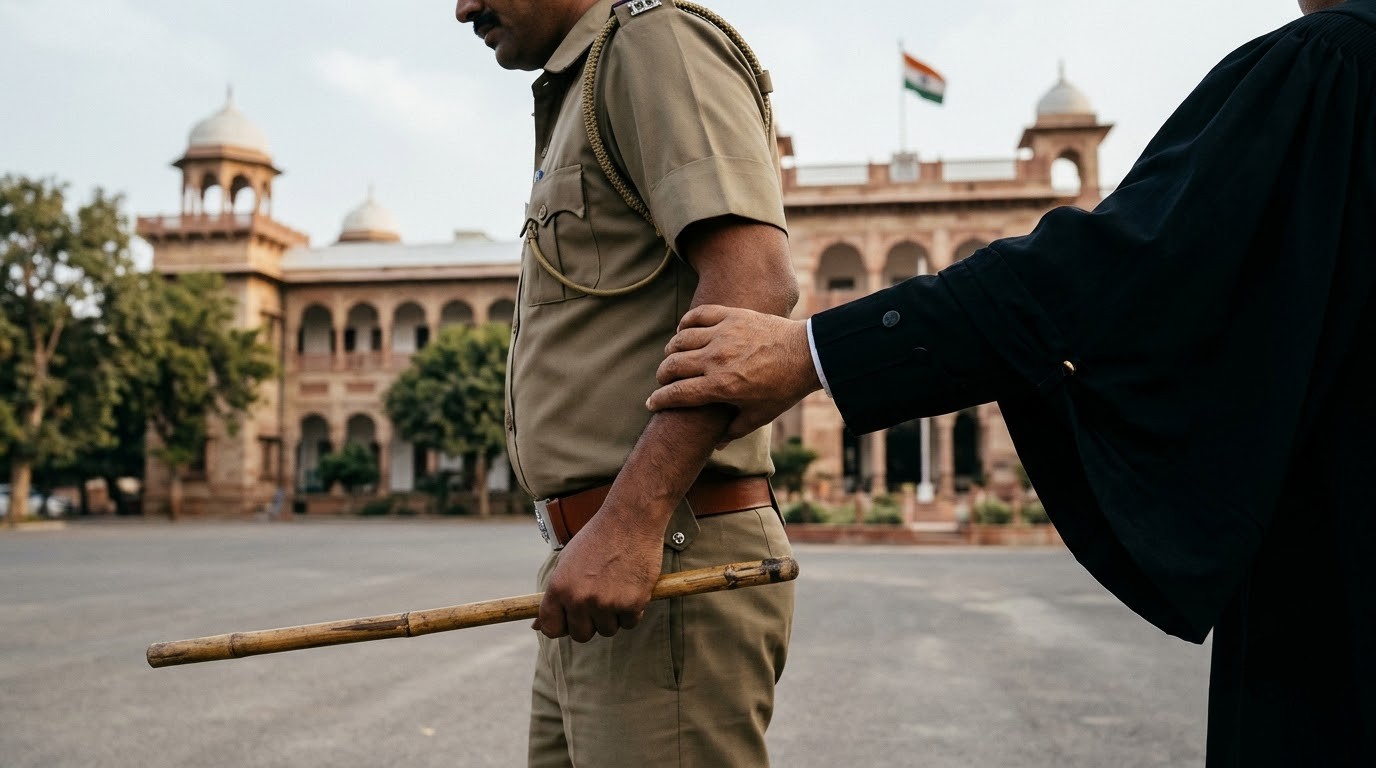
The Rajasthan High Court has reinstated cognizance taken against police officers accused of assaulting a petitioner and his mother during a residential visit to execute a warrant against the petitioner's brother. The bench of Justice Farjand Ali held that no police officer is vested with the authority to break the bones or teeth of a citizen under the pretext of performing official duty.
The court was hearing a petition challenging an order passed by the trial court discharging the respondents. The trial court had set aside the magistrate's order taking cognizance, ruling that since the alleged acts were performed during the discharge of official duty, prior sanction under Section 197 of the Code of Criminal Procedure (CrPC) was mandatory.
When Does Section 197 CrPC Protection Apply To Police Officers?
Section 197 CrPC protection applies only when the alleged offence has a direct and reasonable nexus with the discharge of official duty; it does not cover acts of gratuitous violence or abuse of authority committed during an official visit.
The High Court disagreed with the trial court's broad interpretation. Justice Farjand Ali observed that the authority to apprehend a person cannot be equated with the authority to assault family members or inflict injuries on persons intervening at the scene. The bench emphasised that such conduct, if established, would constitute an abuse of official position rather than an ordinary incident of the lawful execution of a warrant. Physical violence, unless justified by the lawful and reasonable necessities of the situation, cannot be elevated to the status of an official function.
The court drew a clear distinction between an act committed in the exercise of official authority and an act committed by abusing such authority. It held that the mere fact an incident occurred during an official assignment, or at a place visited by police in relation to an arrest, could not justify invoking the protection under Section 197 CrPC. The expression "while acting or purporting to act in the discharge of official duty" cannot be interpreted so broadly as to include acts completely disconnected with the lawful exercise of official authority.
Referencing the Supreme Court judgment in B. Saha v M.S. Kochar, the bench reiterated that the relevant consideration is not merely whether the public servant had an opportunity to commit the offence by virtue of his office, but whether the act complained of was reasonably connected with the performance of his official functions. The statutory protection is neither absolute nor automatically attracted merely due to the official status of the accused.
Factual Background And Allegations
According to the petitioner, the respondents arrived at his residence to inquire about his brother, who was not present. The conversation allegedly turned aggressive, resulting in the respondents assaulting the petitioner. When the petitioner's mother intervened, she was allegedly struck with a lathi on her face, resulting in broken teeth. The magistrate took cognizance of the complaint; however, the trial court discharged the respondents, holding that sanction under Section 197 CrPC was required.
The High Court clarified that even assuming the initial visit was lawful, it could not legitimise every subsequent act. The bench stated that the power to arrest, execute a warrant, or maintain law and order forms part of legitimate police functions, but such authority does not extend to inflicting punitive or retaliatory physical injuries. The alleged act of inflicting injuries on the petitioner's mother was held not to be automatically protected by Section 197.
Aspect | Trial Court View | High Court View |
|---|---|---|
Section 197 CrPC Applicability | Automatically attracted because acts occurred during official duty | Requires direct nexus with lawful discharge of duty; not a protective umbrella for gratuitous violence |
Scope of Police Authority | Implied immunity for acts during warrant execution | Authority to arrest does not extend to assaulting family members or inflicting punitive injuries |
Legal Test | Official status and timing of incident | Reasonable connection between act and official function (per B. Saha v M.S. Kochar) |
Accordingly, the High Court set aside the trial court's discharge order and reinstated the cognizance taken by the magistrate. The matter has been remitted for further proceedings in accordance with law.