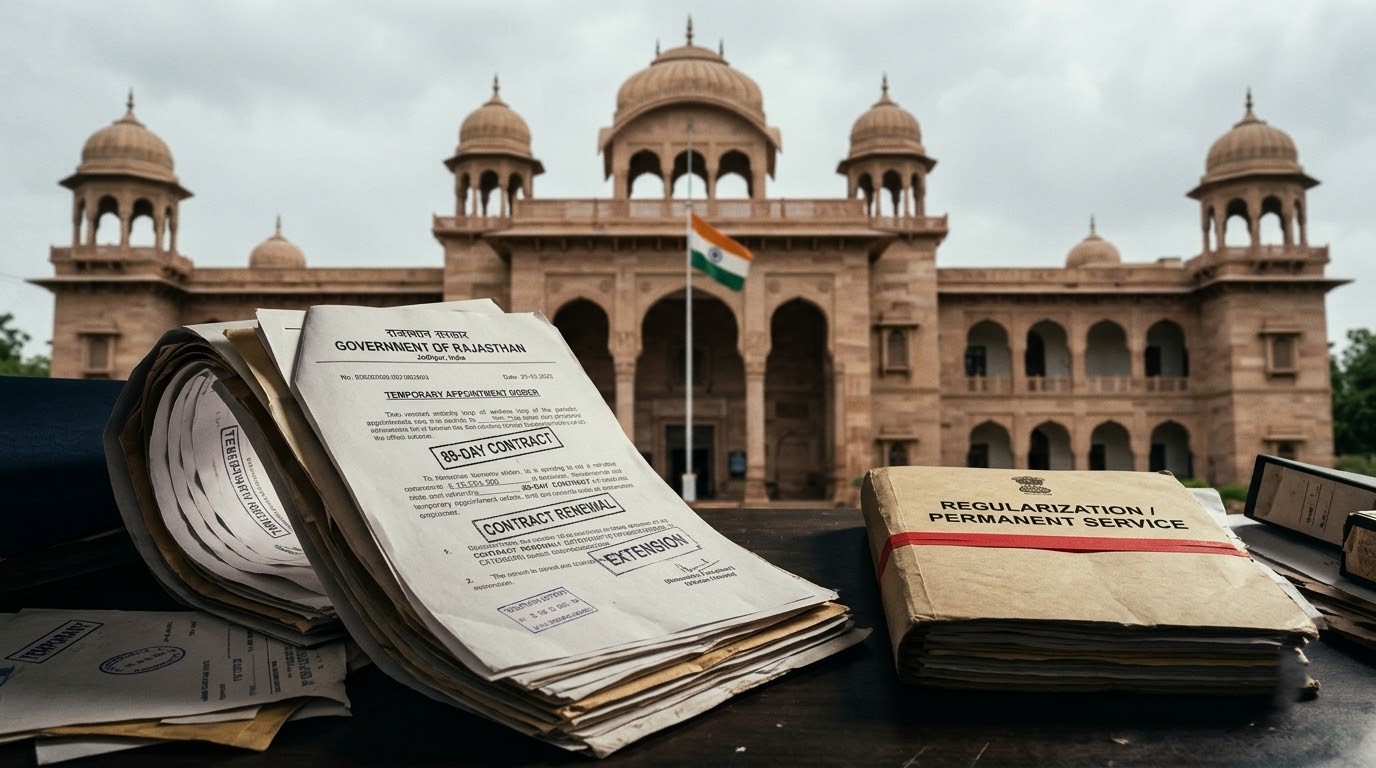
A Division Bench of the Rajasthan High Court comprising Justice Vinit Kumar Mathur and Justice Chandra Shekhar Sharma dismissed a special appeal filed by the State of Rajasthan, affirming a single judge directive that ordered the regularisation of veterinary officers. The High Court firmly held that an abrupt termination of services imposed by the department in the past cannot serve as a valid legal bar to prevent employees from securing regularisation after completing ten years of service.
Does an intervening termination and court-ordered service disqualify employees from regularisation after ten years?
No, an intervening termination and subsequent service rendered under court orders do not disqualify employees from regularisation. The Rajasthan High Court ruled that if employees complete ten years of continuous service despite departmental disruptions, periodic appointments designed to circumvent regularisation are legally impermissible, and such employees remain fully entitled to regularisation benefits under established jurisprudence.
The dispute arose when the respondents, originally appointed as veterinary officers in the year 2013, faced abrupt termination by the department. Challenging that administrative action, the veterinary officers approached the judicial forum and secured interim reinstatement orders. Operating under the strength of judicial protections, the respondents continued their employment uninterrupted for a span of nearly ten years. Upon completion of this decade-long tenure, they formally requested regularisation from the State authorities, which the department rejected.
Aggrieved by the refusal, the respondents instituted a writ petition before a single judge, who allowed the plea and directed the State to grant regularisation. Challenging this outcome, the appellant State argued before the Division Bench that the initial engagements were irregular and made on an urgent temporary basis, thereby disqualifying the incumbents from regular status. Furthermore, the State contended that because a portion of the service period was protected by judicial interim orders, it could not be legally counted as continuous or uninterrupted service for the threshold requirement of ten years.
The Division Bench evaluated the rival submissions and rejected the stance adopted by the State administration. Referencing the binding precedent of the Supreme Court in the matter of Jaggo versus Union of India, the High Court noted that the Apex Court had previously addressed situations where departments terminated employees to deliberately block them from fulfilling continuous service criteria. The Bench emphasized that such termination orders cannot by themselves disentitle an employee from being considered for regularisation, provided the individual satisfies the overarching requirements specified in the Constitution Bench judgment of State of Karnataka versus Uma Devi.
Appellant Contentions | Respondent Position | Court Observations |
|---|---|---|
Appointments were irregular and temporary | Continuous service exceeded ten years | State adopted periodic appointments to avoid regularisation |
Interim court orders invalidate continuous service calculation | Intervening terminations were deliberate blockades | Abrupt terminations cannot deprive employees of regular service fruits |
The High Court observed that the systematic practice of making periodical engagements despite the permanent availability of perennial work constitutes a deliberate administrative mechanism intended to bypass statutory obligations. The judiciary characterized this governmental approach as an active attempt to withhold regular emoluments and service benefits from deserving personnel who effectively discharge duties for prolonged periods.
Consequently, the Division Bench upheld the findings of the single judge and dismissed the special appeal filed by the State. The Court reiterated that completing ten years of service, even when sustained through judicial intervention following an unlawful or abrupt termination, fulfills the necessary benchmark for regularisation. The operative outcome mandates that the appellant department must proceed with granting regularised status to the respondents in accordance with the law.