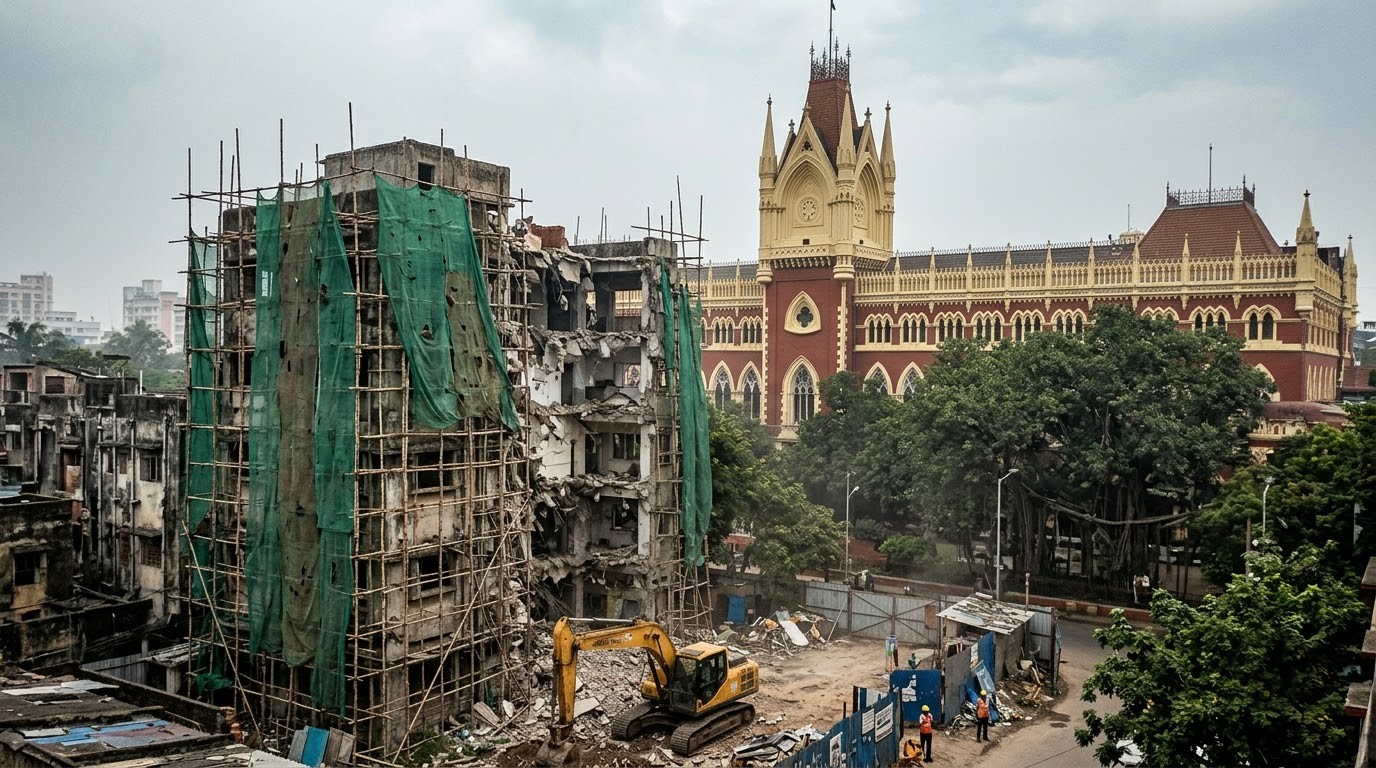
The Calcutta High Court has dismissed a writ petition challenging a Sub-Divisional Officer direction to demolish a building declared illegal, ruling that the mere pendency of an appeal against a demolition order does not operate as an automatic stay of that order. Justice Rishad Medora held that the Sub-Divisional Officer of Baruipur committed no legal error in directing the petitioner to pull down the unauthorized construction by October 28, 2026, because the earlier High Court ruling declaring the structure unlawful remained active and unstayed.
Does a pending appeal automatically stay a judicial order of demolition?
No, the mere filing or pendency of an appeal does not grant an automatic stay of operation against a demolition order. A party must secure a specific interim protection or stay order from the appellate forum to halt enforcement, and failure to pursue such relief leaves executing authorities legally free to implement the original directives.
The litigation traces back to a 2018 writ petition filed by a private respondent seeking the removal of a building erected by the petitioner, alleging it violated statutory norms. Although that initial petition was disposed of in April 2025 without a direct demolition command, the private respondent contested that outcome in an intra-court appeal. On August 25, 2025, a Division Bench instructed the Sub-Divisional Officer of Baruipur to inspect records, conduct a hearing, and take lawful action. The Division Bench expressed a clear prima facie view that the structure contravened the West Bengal Panchayat Act, 1973, and the West Bengal Land Reforms Act, 1955, noting that the Panchayat Act lacked provisions for regularising such unauthorized structures.
Following those directions, the Sub-Divisional Officer initially passed an order in November 2025 affirming the legality of the construction. This favorable finding was challenged in turn, culminating in a High Court order on September 23, 2026, which quashed the Sub-Divisional Officer decision. The High Court declared the building entirely unauthorized and directed the local administration to execute demolition within ten days. The aggrieved property owner challenged this September ruling by instituting an appeal registered as MAT 1714 of 2026. When that appeal was listed on October 5, 2026, the appellant sought an adjournment, and the court scheduled further proceedings for a later date.
Judicial Stage | Authority or Court | Core Outcome or Ruling |
|---|---|---|
Initial Writ | Calcutta High Court (2018 Petition) | Disposed of without demolition order; subsequently challenged in appeal. |
Division Bench Order | Calcutta High Court (August 2025) | Remanded matter to Sub-Divisional Officer, noting construction was prima facie illegal. |
Sub-Divisional Officer Order | SDO Baruipur (November 2025) | Initially held the construction to be lawful and authorized. |
High Court Quashing Order | Calcutta High Court (September 2026) | Quashed SDO order, declared construction illegal, and ordered demolition. |
Final Writ Dismissal | Calcutta High Court (Justice Rishad Medora) | Dismissed fresh challenge, ruling pending appeal does not stay demolition. |
Seizing upon the pending status of the appeal, the Sub-Divisional Officer issued a fresh hearing notice for October 13, 2026, and subsequently ordered the petitioner to clear the site by October 28, 2026, explicitly noting the absence of any protective stay. The petitioner then filed a fresh writ petition before the High Court, contending that the administrative authority acted improperly by proceeding with enforcement while the validity of the underlying demolition directive was still sub judice.
The respondents defended the administrative action, asserting that the Sub-Divisional Officer acted strictly in accordance with the law and in compliance with unstayed judicial mandates. Evaluating the rival submissions, the High Court observed that the administrative authority was merely executing the directions issued in the September ruling. The court reiterated that writ proceedings are strictly confined to reviewing the decision-making process rather than sitting in appeal over merits, and the petitioner failed to demonstrate any procedural illegality or impropriety.
The bench underscored that the petitioner had ample opportunity to seek interim protection within the pending appeal but neglected to take active steps after the adjournment on October 5, 2026. Because no appellate court had intervened to suspend the operation of the September 23 order, the administrative authorities were fully empowered to enforce the demolition timeline. Consequently, the High Court dismissed the fresh writ petition without imposing any costs, reaffirming that administrative compliance cannot be stalled by the mere existence of an un-adjudicated challenge.