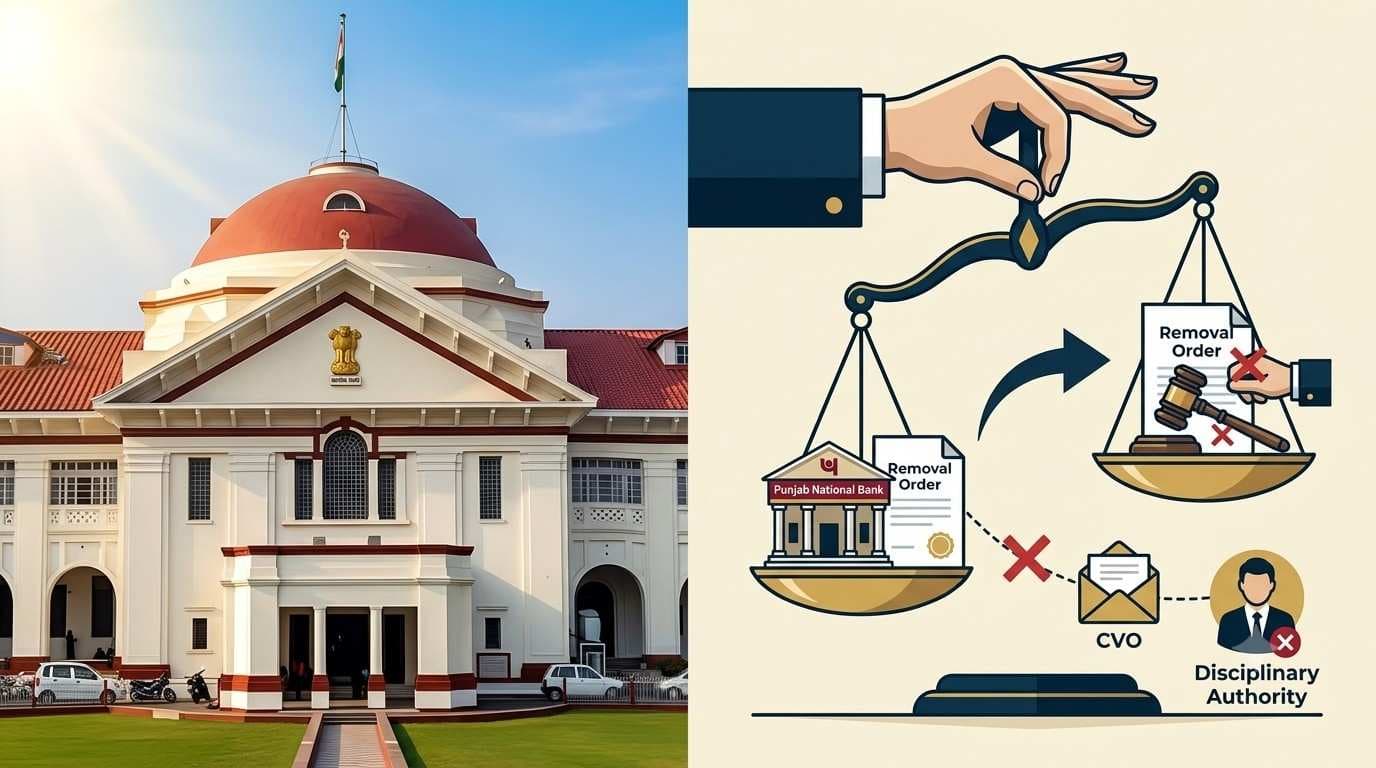
Patna High Court Upholds Independent Judgment Requirement for Disciplinary Authority
The Patna High Court, sitting as a Division Bench comprising Justice Sudhir Singh and Justice Ranjan Kumar Jha, dismissed a Letters Patent Appeal filed by Punjab National Bank and affirmed the order that set aside the removal of a bank employee from service. The appeal arose from a writ petition filed by the employee, Sanjay Kumar Srivastava, challenging the punishment of removal from service imposed after a departmental enquiry.
The employee was appointed as a Clerk‑cum‑Cashier in April 1994. In October 1997 a charge‑sheet containing several allegations was served on him, following which a departmental enquiry was initiated. Upon conclusion of the enquiry, the Inquiry Officer submitted a report on 15 January 2000. The disciplinary authority thereafter issued a second show‑cause notice proposing removal from service and, after considering the employee’s reply, passed an order removing him from service on 6 November 2000. The employee’s departmental appeal was dismissed by the appellate authority, prompting him to approach the High Court by way of a writ petition.
The learned Single Judge allowed the writ petition, setting aside both the order of punishment and the appellate order. Punjab National Bank appealed that decision intra‑court, contending that the findings recorded by the Inquiry Officer were based on documentary evidence, management exhibits and oral testimony adduced during the departmental enquiry. The Bank argued that the Single Judge had erred in treating those findings as perverse.
The Division Bench framed the principal issue as whether the findings recorded in the departmental proceedings were supported by legally admissible material and whether the disciplinary authority had exercised its discretion independently while imposing punishment. After examining the record, the Bench noted that the Single Judge had found that no material conclusively established the charges against the employee and that most of the charges had not been proved. The Bench further observed that even the disciplinary authority had remarked that the Inquiry Officer appeared to be biased to some extent.
The Court held that the Bank had failed to demonstrate that the findings recorded by the Single Judge were unsupported by the record. It agreed with the Single Judge’s conclusion that the disciplinary authority had failed to exercise independent judgment. In reaching this conclusion, the Bench referred to correspondence exchanged with the Chief Vigilance Officer, which showed that the disciplinary authority had itself considered that a lesser punishment would be appropriate. Despite this consideration, the employee was ultimately removed from service.
The Bench observed that the record lent credence to the conclusion that the disciplinary authority had been influenced by considerations extraneous to its own independent assessment. Emphasising the scope of a disciplinary authority’s powers, the Court quoted the settled principle: “The law is equally settled that where discretion is vested in a statutory or disciplinary authority, the same must be exercised independently and not under the dictates of another authority.”
The Court clarified that the Single Judge had not re‑appreciated the evidence as an appellate court. Instead, the interference was confined to examining the perversity of the enquiry findings and the failure of the disciplinary authority to independently exercise its statutory discretion, both of which went to the root of the decision‑making process and fell within the permissible limits of judicial review.
Finding no patent illegality or jurisdictional error in the judgment under appeal, the Division Bench dismissed the Letters Patent Appeal and affirmed the order setting aside the respondent’s removal from service. The case is cited as Punjab National Bank v. Sanjay Kumar Srivastava, Letters Patent Appeal No. 911 of 2018 in Civil Writ Jurisdiction Case No. 10392 of 2003. Appearances were Mr. Amit Kumar Anand for the appellant and Mr. Ajay Kumar Prasad for the respondent.