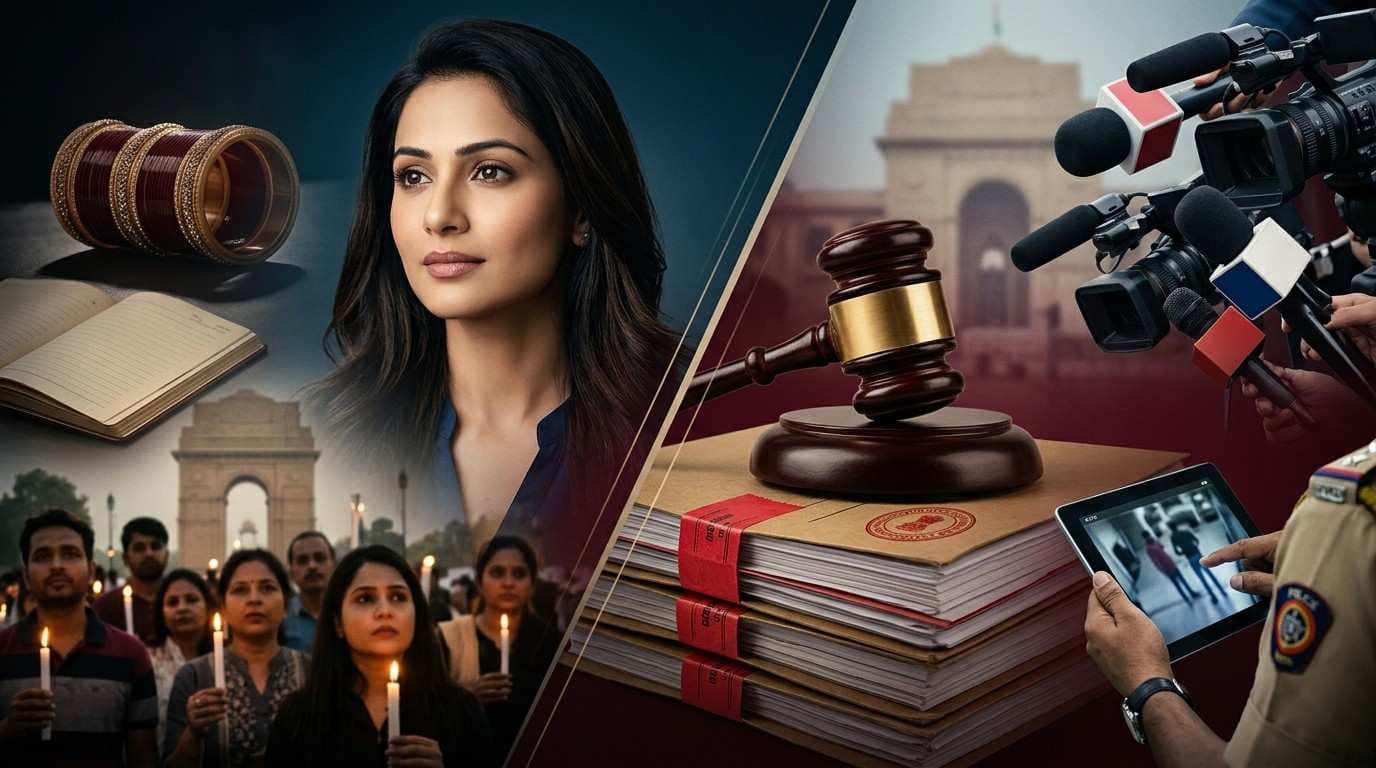
The tragic death of 33-year-old former actor and corporate manager Twisha Sharma, just five months after her high-profile wedding, has transformed into a high-stakes legal battle and a national media sensation. Found dead at her matrimonial home in Bhopal's Katara Hills, Twisha’s passing has triggered a highly aggressive public relations war between her grieving family and her influential in-laws. With a six-member Special Investigation Team (SIT) aggressively parsing through digital evidence and a state government proposing a CBI probe, the case stands as a chilling example of how quickly an intimate domestic tragedy can mutate into a deeply polarized public spectacle.
From the moment the news broke, Twisha’s family launched an uncompromising public campaign, flatly rejecting the initial narrative surrounding her death. Her father and brother staged intense protests outside the Madhya Pradesh Chief Minister's residence, demanding an independent, external investigation and a secondary autopsy at AIIMS Delhi to rule out a covered-up homicide. The family alleges a sustained pattern of physical and emotional abuse stemming from severe dowry harassment. They point out that Twisha was in active, cheerful contact with them until 10 PM on the night of her death, expressing an urgent desire to pack her bags and escape back to her parental home in Noida.
The narrative took an even more dramatic turn when exclusive CCTV footage from the residence was broadcast nationally, adding fuel to the ongoing media firestorm. The visuals capture Twisha walking steadily toward the rooftop terrace, followed by a harrowing sequence an hour later showing her husband and two other men frantically carrying her unresponsive body back down the stairs. While her family views the footage as highly suspicious circumstantial evidence of a staged crime scene, local police officials have clarified that medical and forensic evaluations from AIIMS Bhopal explicitly state the primary cause of death as hanging, leading the department to officially treat the case under the statutory framework of a driven suicide.
In a sharp counter-offensive, the accused family has deployed a highly complex defensive narrative through legal bail applications and public statements. Led by Twisha’s mother-in-law, a retired district judge, the defense has levied intense, highly personal counter-accusations against the deceased, claiming she struggled with severe psychiatric instability and substance dependency. The defense alleges that Twisha was undergoing treatment for heavy withdrawal symptoms that manifested as physical tremors, and that her mental health had deteriorated rapidly following a recent, highly stressful medical termination of pregnancy just days prior to the incident.
Compounding the intense public scrutiny is the vast disparity in institutional influence between the two factions, which has turned the investigation into a political lightning rod. Twisha’s family has openly accused the in-laws of leveraging their extensive network within the regional legal fraternity to actively delay the registration of the primary FIR and shield the key accused. This narrative gained massive traction as the mother-in-law successfully secured anticipatory bail almost immediately, while Twisha’s husband, an established Bhopal-based advocate, managed to completely evade law enforcement, remaining entirely absconding despite a cash reward and multi-state police raids tracking his digital footprint.
The absolute polarization of this case highlights the powerful, often toxic role that modern media plays in shaping the public perception of high-profile crimes. On one side, digital advocacy groups and student organizations have rallied at historic protest sites like Jantar Mantar, framing Twisha as a defenseless victim of systemic domestic greed and institutional corruption. On the opposite side, the legal defense aggressively files transaction histories and private medical records to the sub-judice court, attempting to construct a corporate portrait of an unstable lifestyle completely incompatible with traditional domestic realities.
Ultimately, the chaotic media circus surrounding Twisha Sharma’s death leaves a trail of profound devastation that text-heavy legal briefs fail to fully capture. As the state administration transitions the files toward central investigative authorities to ensure a transparent, unbiased probe, the core human tragedy remains trapped beneath layers of strategic character assassination and legal maneuvering. Whether the final judicial verdict uncovers a calculated act of violence or a desperate, isolated moment of mental collapse, the case stands as a grim reminder of how modern domestic battlefield lines are drawn, where the search absolute truth is routinely obscured by the roar of public opinion.