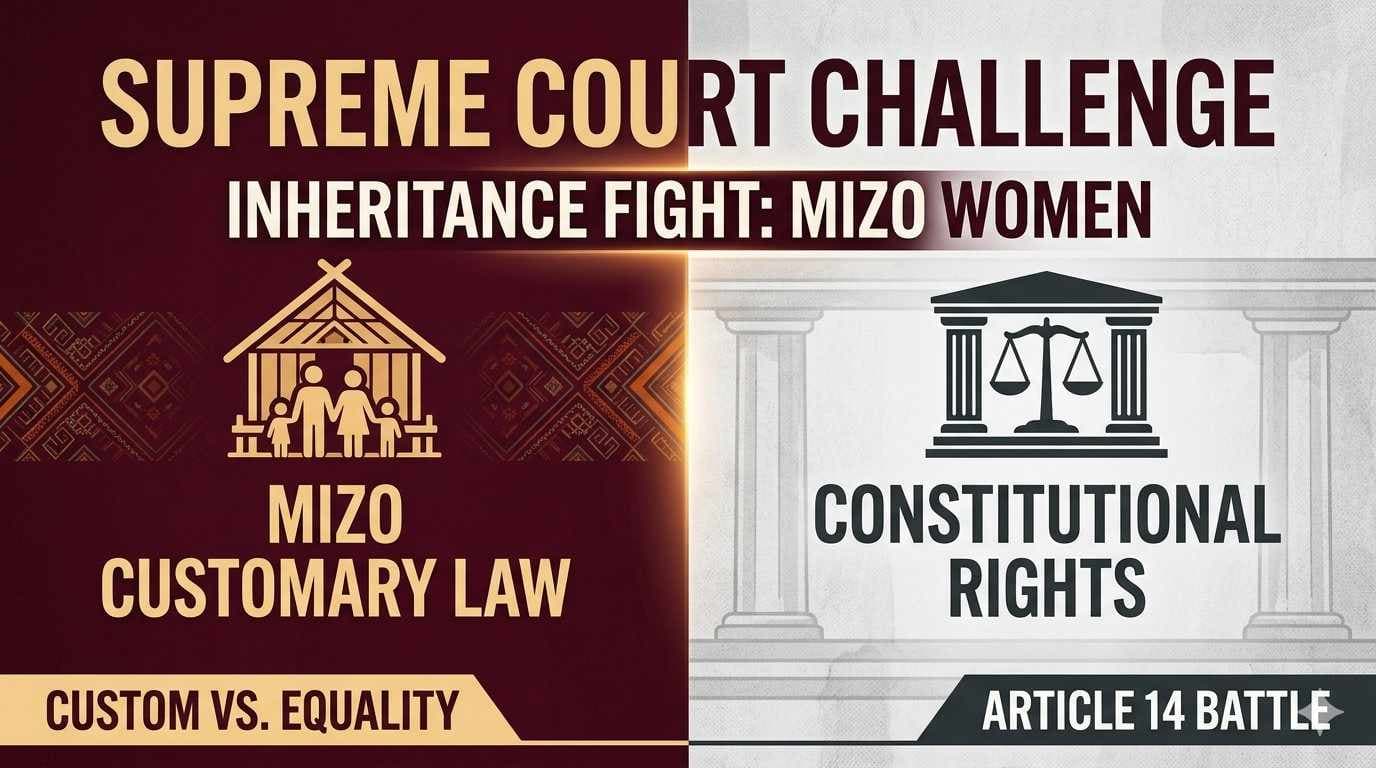
The Supreme Court of India is currently seized of a significant legal challenge directed at the "Mizo Customary Law," specifically regarding its discriminatory stance on the inheritance rights of Mizo women. The petition highlights a contentious provision: a Mizo woman loses her right to inherit ancestral property if she chooses to marry a non-Mizo man. This legal battle brings to the forefront the delicate intersection of protected tribal customs and the constitutional mandate of gender equality under Article 14.
At the heart of the dispute is the "Mizo Marriage, Divorce and Inheritance of Property Act, 2014." While the Act was intended to codify and modernize traditional practices, the petitioners argue that it persists in perpetuating archaic patriarchal norms. By penalizing women for their marital choices, the law effectively treats them as lesser citizens compared to their male counterparts, who face no such property forfeiture regardless of whom they marry.
The petitioners contend that these provisions are not merely traditional nuances but are direct violations of fundamental rights. They argue that the right to equality and the right to live with dignity are being compromised. In a modern legal framework, the "purity of lineage" argument often used to justify such laws is increasingly viewed as a pretext for systemic gender discrimination, stripping women of economic security and autonomy.
Furthermore, the plea emphasizes that while Article 371G of the Constitution provides special protections for the religious and social practices of Mizos, these protections cannot be used as a shield to bypass the "Golden Triangle" of the Constitution (Articles 14, 19, and 21). The judiciary is being asked to determine if a custom that disenfranchises women solely based on gender and marital status can be deemed "essential" to the Mizo identity.
The social implications of this case are profound. For decades, Mizo women have been the backbone of the state’s agrarian and domestic economy, yet they remain legally tethered to a system that denies them land ownership. This lack of property rights often leaves women vulnerable to poverty and displacement in the event of divorce or the death of a spouse, particularly when the marriage involves a non-Mizo.
Legal experts suggest that this case could mirror the landmark decisions seen in other tribal regions of India where the courts have slowly intervened to ensure that personal laws evolve with contemporary human rights standards. The Supreme Court’s intervention is seen as a necessary step in reconciling the autonomy of indigenous communities with the non-negotiable principle of non-discrimination.
As the proceedings continue, the outcome will likely set a major precedent for tribal jurisprudence across Northeast India. It challenges the Mizo society to introspect on whether its cultural preservation must come at the cost of its women's rights. A ruling in favor of the petitioners would signify a massive shift toward gender justice, ensuring that inheritance is a right of birth and blood, not a privilege contingent upon marital obedience.
Ultimately, the case is about more than just property; it is about the recognition of Mizo women as equal stakeholders in their heritage. By bringing this to the apex court, the petitioners are demanding a legal evolution that aligns customary practices with the democratic values of modern India, ensuring that "tradition" is no longer synonymous with "exclusion."