The Madras High Court recently dismissed a public interest litigation that sought an independent enquiry into the accreditation, affiliation and autonomous status of Sri Venkateswara College of Engineering and Technology situated in Tiruvallur. The bench comprising Chief Justice S A Dharmadhikari and Justice Arul and Justice Arul Murugan delivered the order on 30 June 2026 in the matter styled Radha Krishnan versus Union of India.
The petitioner D Radhakrishnan approached the court praying for directions to the Union government the University Grants Commission the National Assessment and Accreditation Council the State of Tamil Nadu Anna University and the Directorate of Technical Education to constitute an independent enquiry committee. The committee was to examine the records submitted by the college for obtaining and continuing its accreditation autonomous status affiliation and other regulatory approvals.
In support of the plea the petitioner relied on newspaper clippings YouTube material a First Information Report registered by the Directorate of Vigilance and Anti Corruption and the pendency of a DVAC investigation. The court observed that before filing the writ petition the petitioner had submitted a representation on 29 April 2026 seeking withdrawal of the autonomous status and accreditation granted to the college. However the relief sought in the writ petition was materially different as it asked for an investigative mechanism rather than a punitive remedy.
The bench noted that a petitioner cannot first seek one extreme punitive remedy before the statutory authorities and subsequently approach this court asking for an investigative mechanism under a completely transformed pretext. This inconsistency was regarded as a fundamental defect in the petition.
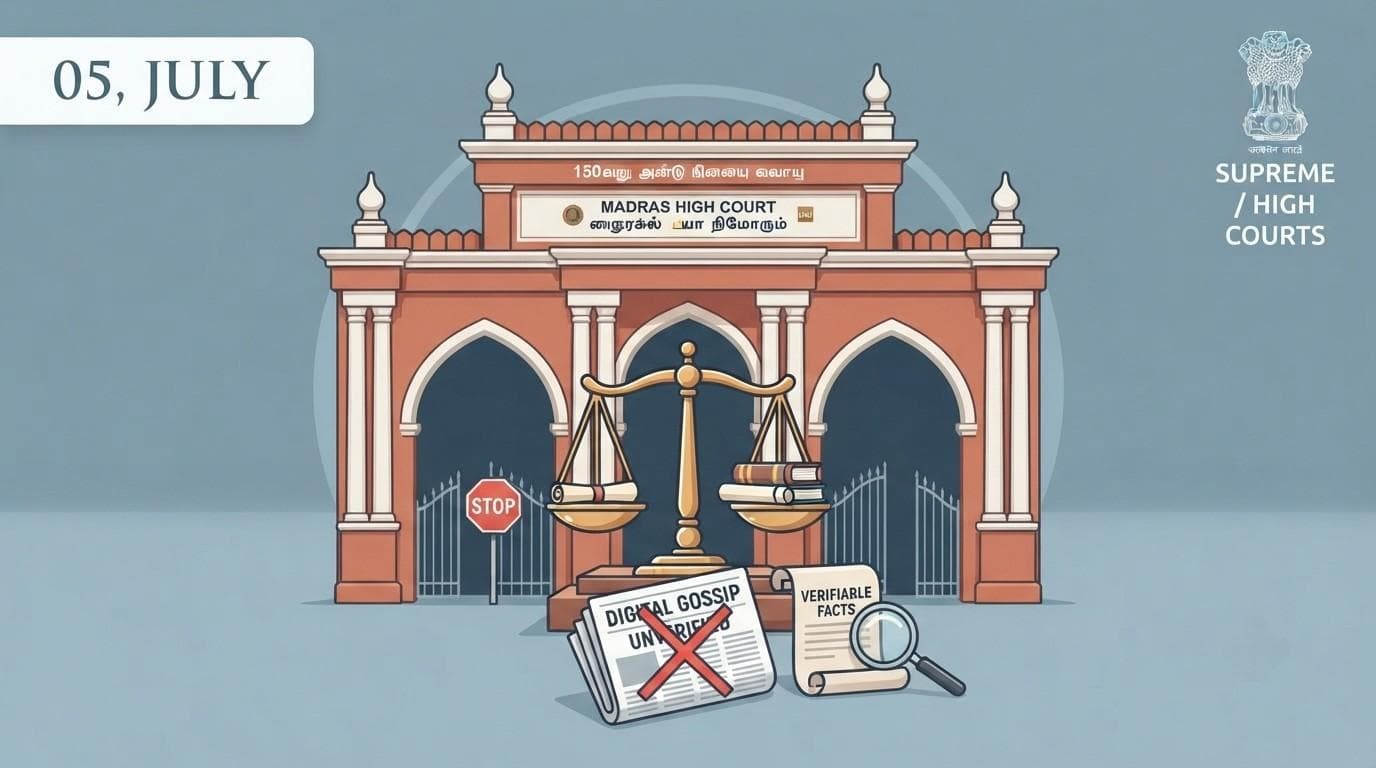
On the substantive requirements for maintaining a public interest litigation the court reiterated that the petitioner must demonstrate sufficient research and independent verification before approaching the judiciary. It held that reliance purely on a pending DVAC investigation or on digital gossip does not satisfy the stringent threshold of sufficient research mandated for filing a PIL.
The order quoted the observation that when a public interest litigation is filed without a shred of independent research it must be throttled at the threshold. The bench found that the petitioner had merely bundled newspaper clippings YouTube references and an FIR to build a narrative of widespread malpractice against the college without conducting any independent verification prior to rushing to the court.
Furthermore the court pointed out that a writ of mandamus requires a prior demand for justice before the concerned authorities and a subsequent refusal. Since no such demand and refusal were shown the petition failed to meet the procedural prerequisite for mandamus relief.
The bench also held that the matter was sub judice because a criminal investigation by the DVAC was already underway. Filing a PIL without verifying foundational facts under such circumstances was characterised as an attempt to sensationalise a pending legal process.
Consequently the court dismissed the petition. The petitioner was represented by Senior Advocate R Shunmugasundaram and Advocate A Gopinath. Senior Advocate K S Jeyaganeshan appeared for the Union government Advocate V Sudha for the University Grants Commission Government Pleader Mohammed Fayaz Ali for the State of Tamil Nadu Standing Counsel U Baranidharan for Anna University.
The decision underscores the Madras High Court’s insistence that public interest litigation must be grounded in verifiable facts and independent research rather than on unverified media reports or pending investigations.