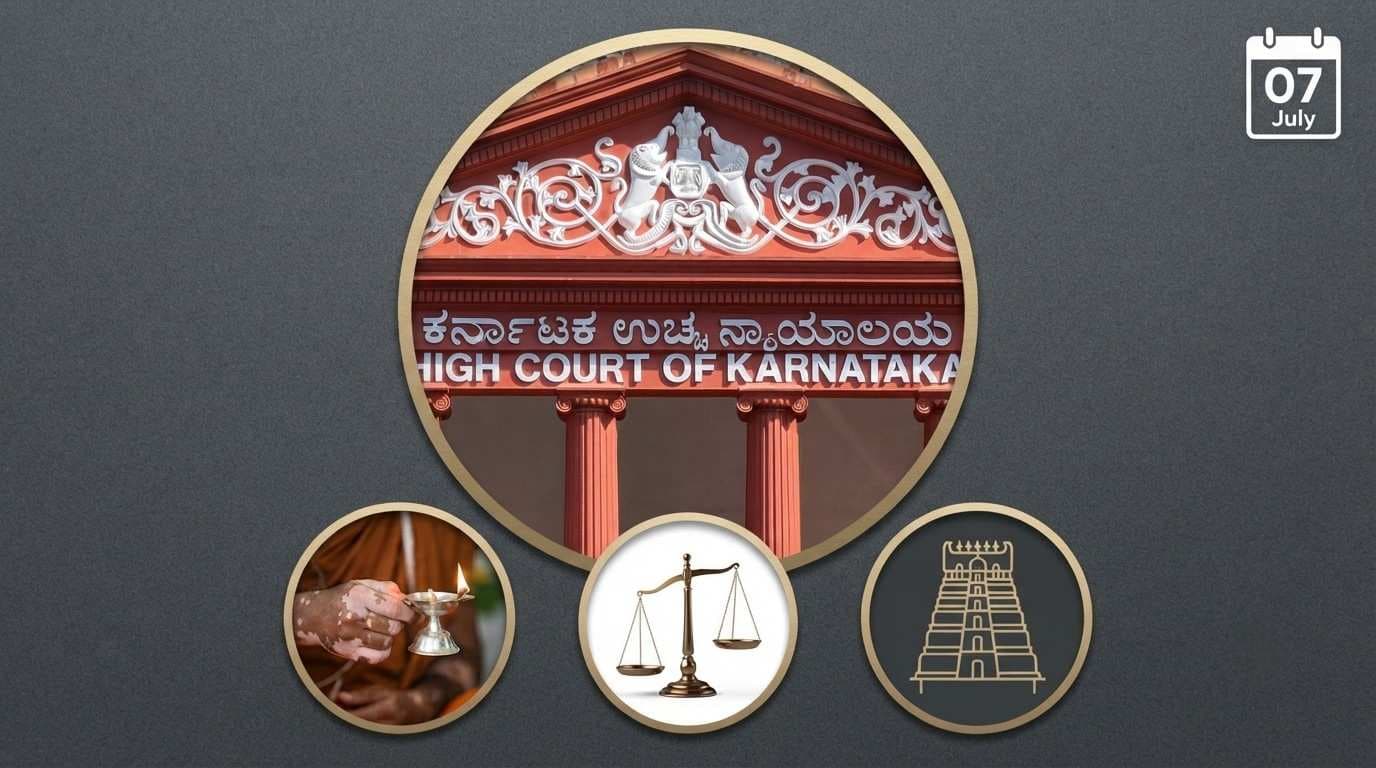
The Karnataka High Court, sitting as a single judge bench presided over by Justice Suraj Govindaraj, issued a direction to the authorities of the Chamundeshwari Temple in Mysuru to allow a hereditary priest who lives with vitiligo to continue performing the prescribed rituals. The bench observed that the temple’s refusal to let the priest discharge his duties was grounded solely in the visible manifestation of his skin condition, which the court characterised as a non‑contagious medical disorder.
In its order, the court emphasised that any form of stigmatisation attached to a disease that does not pose a risk of transmission constitutes discrimination. It held that such treatment offends the guarantee of equality before the law and equal protection of the laws enshrined in Article 14 of the Constitution of India. The bench reasoned that the classification effected by the temple authorities—distinguishing the priest on the basis of his vitiligo—lacks a rational nexus with any legitimate objective and therefore fails the test of reasonable classification.
The petition before the court was filed by the priest himself, who asserted that his family has performed the temple’s pujas for generations and that his medical condition does not impede his ability to chant mantras, offer flowers, or carry out any other liturgical function. The temple management, on the other hand, contended that the priest’s appearance might disturb devotees and affect the sanctity of the rituals. The court rejected this contention, noting that the apprehension of disturbance is speculative and not substantiated by any empirical evidence. It further pointed out that the temple’s stance effectively penalises the priest for a characteristic over which he has no control and which bears no relevance to his sacerdotal competence.
Justice Govindaraj referred to the principle that the State, and by extension institutions exercising public functions, must not perpetuate prejudice against individuals on account of health conditions that are neither infectious nor incapacitating. The bench held that the exclusionary practice amounted to an arbitrary state action, violating the equal protection clause. Consequently, the court directed the temple authorities to forthwith permit the priest to resume his hereditary duties and to refrain from any further discrimination based on his vitiligo.
The ruling underscores the judiciary’s role in safeguarding constitutional rights against social biases that masquerade as tradition or custom. By linking the protection afforded under Article 14 to the non‑contagious nature of vitiligo, the court signalled that medical conditions devoid of public health risk cannot serve as a basis for denying access to religious offices or public services. The decision also reinforces the broader jurisprudential trend that disfavours discrimination rooted in physical appearance, aligning with the constitutional vision of an inclusive society where every individual, irrespective of dermatological attributes, enjoys equal opportunity to participate in cultural and religious life.
In practical terms, the order obliges the Chamundeshwari Temple administration to adjust any internal guidelines that condition priestly eligibility on physical appearance and to ensure that the hereditary priest is allowed to perform all rituals without hindrance. The bench made it clear that any continuation of the discriminatory practice would attract judicial scrutiny and potential contempt proceedings. The judgment thus serves as a precedent for similar claims where individuals seek to assert their right to serve in religious or public capacities despite facing prejudice owing to harmless medical conditions.