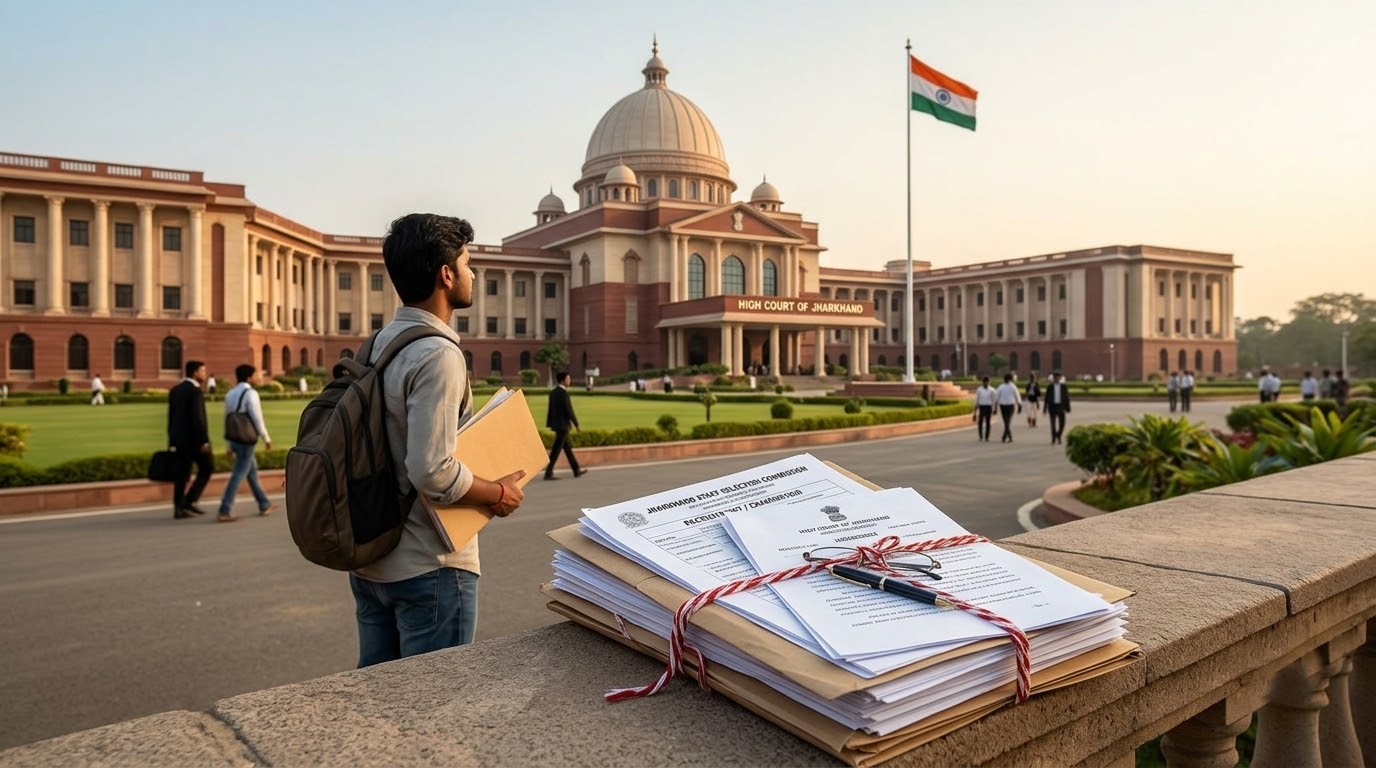
The Jharkhand High Court has quashed a State Government notification dated August 18, 2026 that cancelled the recruitment conducted by the Jharkhand Staff Selection Commission (JSSC) under Advertisement No. 10 of 2023. A Single Judge Bench of Justice Deepak Roshan held that the executive decision was contrary to prior orders passed by a Division Bench of the High Court and the Supreme Court concerning the same selection process. The Court directed that the petitioners be deemed to have continued in service without any break and that they should not be denied monetary or other service benefits on account of the impugned notification. However, the Bench clarified that the appointments would remain subject to the final outcome of pending criminal prosecutions relating to alleged examination malpractices.
Background of the Recruitment and Litigation
The dispute arose from the Jharkhand General Graduate Level Combined Competitive Examination (JGGLCCE)-2023, conducted for posts including Assistant Section Officer, Junior Secretariat Assistant, Labour Enforcement Officer, Planning Assistant, Block Welfare Officer, Block Supply Officer and Circle Inspector-cum-Kanoongo. The examination was initially scheduled for January 28 and February 4, 2024, but was cancelled following reports of a paper leak. It was subsequently reconducted on September 21 and 22, 2024.
Allegations of malpractice in the reconducted examination led to the filing of two writ petitions, including a Public Interest Litigation and a petition instituted by 1,011 unsuccessful candidates. On December 17, 2024, a Division Bench directed the registration of an FIR, following which two cases were registered by the CID, Ranchi, in January 2025. By its judgment dated December 3, 2025, the Division Bench declined to cancel the examination and directed an investigation by a Special Investigation Team (SIT) to be completed within six months. The JSSC published the final results on December 8, 2025.
Subsequently, on January 5, 2026, the Supreme Court declined to interfere with the Division Bench judgment. The apex court expressly directed that appointment letters already issued or to be issued would remain subject to the final outcome of all criminal prosecutions. The petitioners received appointment letters between December 2025 and January 2026 and joined their respective posts.
State's Cancellation Notification and Challenge
Following protests in Ranchi in July 2026, the State Government issued the notification dated August 18, 2026, cancelling 22 examinations, including the recruitment under Advertisement No. 10 of 2023. The State defended the cancellation by alleging systemic fraud involving manipulation of examination records, tampering with OMR sheets, digital irregularities and destruction of evidence. It argued that separating genuine candidates from beneficiaries of the alleged malpractice was not reliably possible and that wholesale cancellation did not require proof beyond reasonable doubt or individual hearings.
The petitioners challenged the notification, submitting that the issue of cancellation had already been considered by the High Court and the Supreme Court. They contended that the State could not reopen the same controversy through executive action while the investigation remained pending. They further argued that they were already appointed public servants and that cancellation of the recruitment effectively terminated their services without compliance with applicable service rules and constitutional protections.
Court's Reasoning on Executive Action versus Judicial Orders
Examining the matter, the High Court noted that the earlier Division Bench had already declined to cancel the examination on allegations substantially similar to those relied upon by the State. The Supreme Court had also permitted the appointments to continue subject to the outcome of criminal proceedings.
The Court held that the State could not undo the decisions of constitutional courts merely by claiming that further material had been collected or additional arrests had been made. It observed that an act of the executive cannot be contrary to a judicial order. Judicial decisions are aimed to give quietus to a dispute and bring about certainty, and legal certainty is a facet of the Rule of Law. Post-final determination by the highest court, the executive lacked the authority to nullify the recruitment process through a notification.
Comparison of Judicial and Executive Stances
Authority | Decision | Key Rationale |
|---|---|---|
Division Bench, Jharkhand High Court (Dec 3, 2025) | Declined to cancel JGGLCCE-2023; ordered SIT probe within six months | Allegations did not warrant wholesale cancellation at that stage |
Supreme Court of India (Jan 5, 2026) | Refused to interfere; appointments subject to final outcome of criminal cases | Balanced interest of candidates with integrity of investigation |
State Government (Aug 18, 2026) | Cancelled recruitment via notification | Claimed systemic fraud, OMR tampering, digital irregularities |
Single Judge, Jharkhand High Court (Present) | Quashed State notification; deemed petitioners in continuous service | Executive action contrary to prior judicial orders; violates legal certainty |
What Is the Effect of the High Court's Order on the Appointees?
The petitioners are deemed to have continued in service without any break since their initial joining. They are entitled to all monetary and service benefits accruing during the period of the cancelled notification, subject to the final outcome of the pending criminal prosecutions regarding alleged examination malpractices.
Final Disposition
The High Court set aside the notification dated August 18, 2026 to the extent it cancelled the recruitment under Advertisement No. 10 of 2023. The petitioners shall be treated as having continued in service without interruption. The State is restrained from denying them any monetary or other service benefits on the basis of the quashed notification. The appointments, however, remain subject to the final outcome of the criminal cases registered by the CID, Ranchi, and any other proceedings arising therefrom.