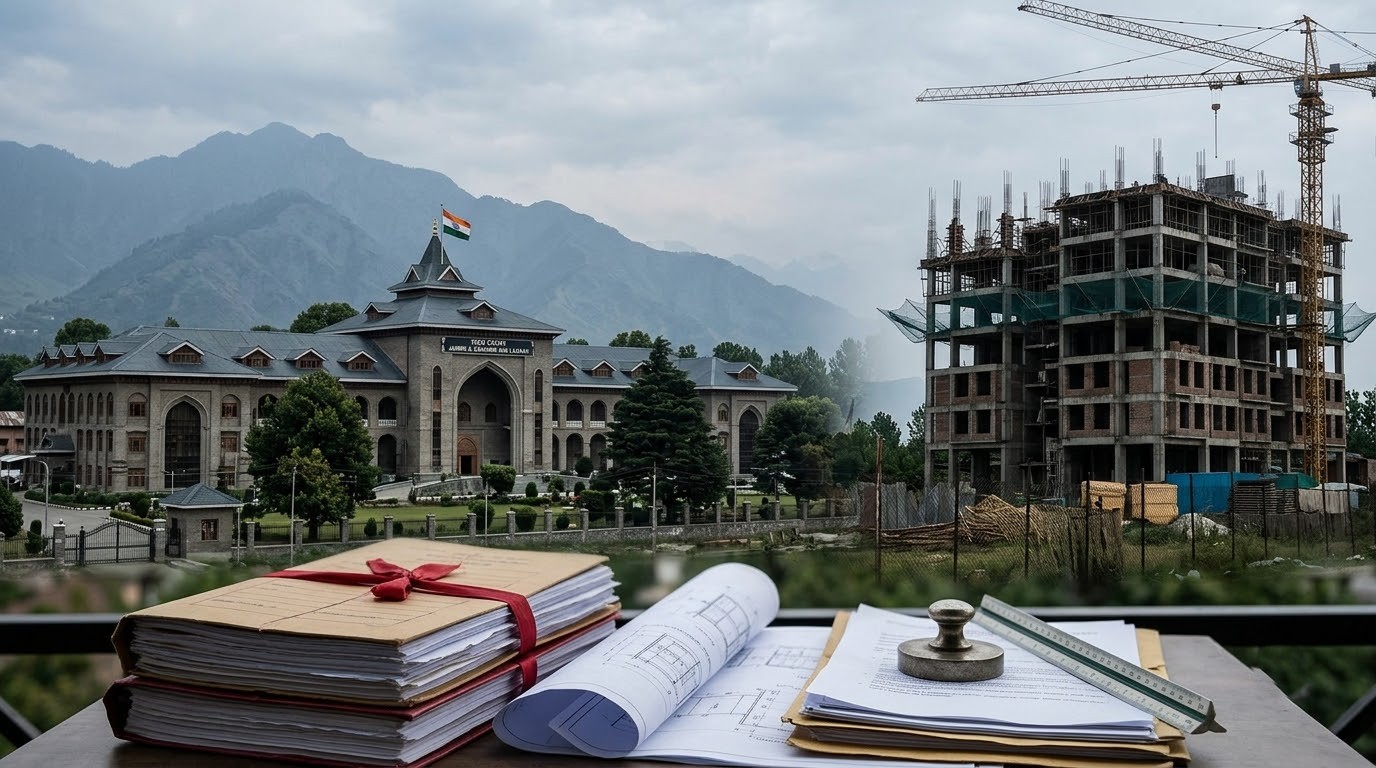
The High Court of Jammu & Kashmir and Ladakh at Srinagar has modified an order passed by the Jammu & Kashmir Special Tribunal which provided that a failure by Municipal Authorities to adjudicate objections against a building permission within thirty days would result in the automatic cancellation of the abeyance order and the deemed restoration of the permission.
Justice Sanjay Dhar, hearing a writ petition filed by the inhabitants of Syedabad Kupwara, upheld the Tribunal's direction to the Municipal Authorities to decide the pending objections within a fixed timeline. However, the Court struck down the consequential direction that the order keeping the permission in abeyance would stand cancelled by default, allowing the private respondent to proceed with construction.
Background of the Dispute
The litigation originated from a long-standing dispute concerning proposed construction on land belonging to a Masjid at Kupwara. Municipal authorities had granted building permission in favour of Respondent No. 6 for a commercial building. The petitioners challenged this grant by way of a revision petition before the Special Tribunal, which was dismissed by an order dated October 20, 2022.
Subsequently, the Municipal authorities passed an order dated October 8, 2022, keeping the building permission granted to Respondent No. 6 in abeyance. This order was passed to enable the authorities to decide complaints and representations received from the petitioners and other objectors regarding the construction. Respondent No. 6 challenged this abeyance order before the Special Tribunal, which disposed of the revision by directing the Municipal Authorities to take a final decision within thirty days. Crucially, the Tribunal ordered that in the event of default, the abeyance order would be deemed cancelled and Respondent No. 6 would be at liberty to proceed with construction as per the original permission.
Court's Reasoning on the Nature of the Abeyance Order
The High Court observed that it was undisputed that the order dated October 8, 2022, keeping the building permission in abeyance was a temporary measure. The Court held that such an order could not remain in force in perpetuity. Its validity, the Court reasoned, extended only until the Municipal Authorities arrived at a decision on the objections received concerning the grant of building permission.
Consequently, the Court affirmed the Tribunal's direction to the Municipal Authorities to decide the issue within thirty days, finding it a correct exercise of jurisdiction to prevent the indefinite suspension of the permission.
Why did the High Court modify the Tribunal's direction on deemed permission?
The High Court modified the Tribunal's order because the direction for deemed permission upon default by the Municipal Authorities would effectively decide the merits of the objections without adjudication, prejudicing the petitioners' right to have their grievances heard and decided on merits.
The petitioners specifically assailed the Tribunal's direction providing for deemed permission in favour of Respondent No. 6 upon the failure of the Municipal Authorities to act within the stipulated period. Justice Dhar noted that the petitioner was particularly aggrieved by this consequence, which would allow construction to proceed automatically without a decision on the pending objections. The Court held that the impugned order deserved modification to this limited extent to address the petitioners' concerns.
The Court clarified that while the Municipal Authorities were bound to decide the matter expeditiously, the failure to do so could not operate as a statutory fiction cancelling the abeyance order and reviving the building permission. The modification ensures that the abeyance continues until a positive decision is rendered on the objections, safeguarding the petitioners' right to a reasoned order.
Operative Disposition
The High Court modified the Tribunal's order dated September 8, 2025, to the extent that default on the part of the Municipal Authorities to decide the fate of the order dated October 8, 2022, shall not lead to the automatic cancellation of the said order. The direction requiring the authorities to decide the objections within thirty days was upheld. The writ petition was disposed of accordingly.