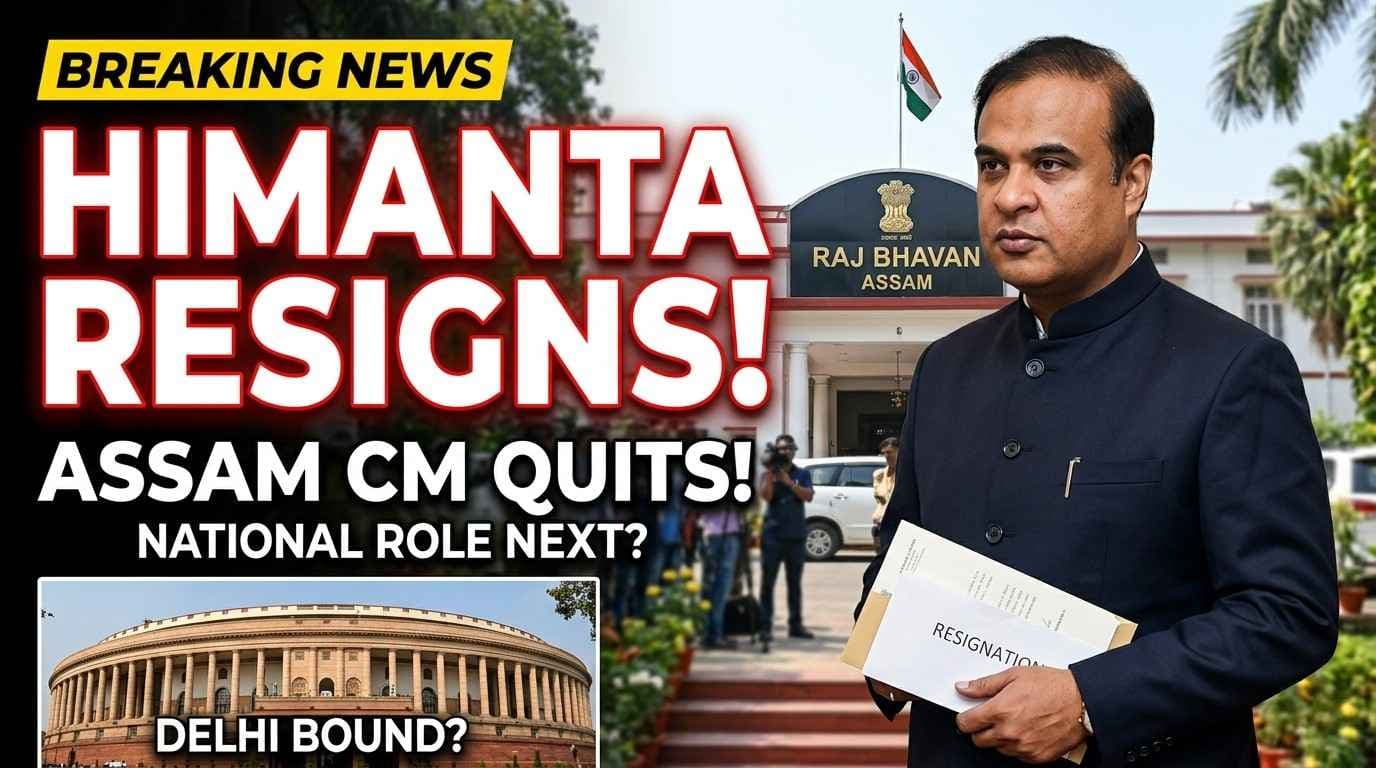
In a move that has sent shockwaves through the political corridors of the Northeast, Himanta Biswa Sarma has officially tendered his resignation as the Chief Minister of Assam. After a tenure marked by high-octane governance, significant infrastructure development, and controversial legislative reforms, Sarma met with Governor Lakshman Prasad Acharya at Raj Bhavan to submit his formal resignation.
While the resignation comes in the wake of the 2026 Assembly election cycle, the timing has sparked intense speculation. Political analysts are debating whether this move is a tactical stepping stone toward a larger role in the Union Cabinet in New Delhi or a result of internal party realignments following the recent polls. Under Sarma’s leadership, the BJP had consolidated its position as the dominant force in the state, making his departure a pivotal moment for the party’s future trajectory in the region.
Under the Indian Constitution, the resignation of a Chief Minister entails the resignation of the entire Council of Ministers. The Governor has requested Sarma to continue as the "Caretaker Chief Minister" until a new government is sworn in. This ensures that the state’s administration does not face a vacuum during the transition period.
The legacy left behind by the outgoing CM is substantial. His administration was defined by the "Mission Basundhara" land reforms, the push for the Uniform Civil Code (UCC) at the state level, and an aggressive stance on internal security and border disputes. However, his tenure was also a lightning rod for criticism from opposition parties, who often raised concerns regarding civil liberties and the "majoritarian" tone of specific policies.
The focus now shifts to the BJP Legislative Party meeting, where the next leader will be chosen. Names currently circulating in the high-stakes "succession race" include senior cabinet ministers and prominent MPs from the state. The central leadership in New Delhi is expected to send observers to Guwahati to oversee the selection process and ensure a smooth transition that maintains the NDA’s coalition stability with partners like the AGP and UPPL.
As the news of the resignation spreads, supporters and critics alike are reflecting on the "Himanta Era"—a period where Assam’s political gravity shifted significantly. The upcoming days will be crucial in determining whether the next administration will continue with the same aggressive development-and-identity model or pivot toward a different governance style.
In conclusion, the resignation of Himanta Biswa Sarma marks the end of a highly consequential chapter in Assam’s history. Whether he is moving toward the national stage or preparing for a new political role, his exit from the Chief Minister's office reshapes the power dynamics of the entire Northeast. For the people of Assam, the immediate priority remains the formation of a stable government that can build upon the state’s recent growth while addressing unresolved social and economic challenges