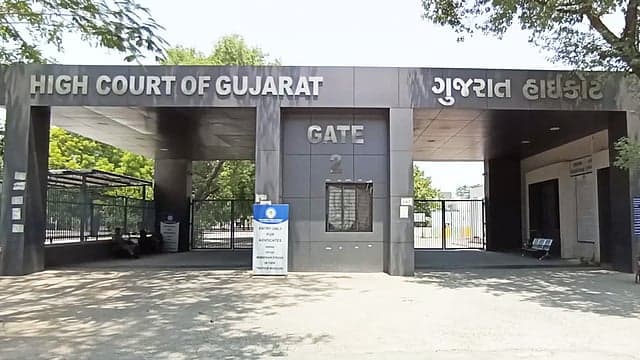
The Gujarat High Court, presided over by Justice Hasmukh D Suthar, has granted regular bail to Vishal @Kano Hemantbhai Kansagara, who was charged with extortion allegedly committed by threatening the complainant with artificial intelligence‑generated defamatory videos. The matter arose from a first information report that accused the applicant and his co‑accused of entering into a criminal conspiracy, gathering confidential information pertaining to the complainant and a witness, and thereafter using AI technology to produce fabricated videos intended to intimidate the victims into paying a sum of Rs.23,00,000.
The court noted that the investigation had been completed and a charge‑sheet had already been filed. Consequently, there remained no material to be recovered or discovered from the applicant. Justice Suthar observed that the applicant had been in custody since January 2026, a period of approximately six months at the time of the bail hearing.
In assessing the bail application, the High Court placed significant weight on the principle of parity. It pointed out that the co‑accused, who occupied a similarly situated role in the alleged conspiracy, had already been enlarged on regular bail. The court held that denying bail to the applicant while his co‑accused enjoyed liberty would be inconsistent and unjustified absent any distinguishing circumstances.
Further, the applicant furnished an undertaking to the court, promising to remain available whenever required by the investigating agency for a voice spectrograph test and to cooperate fully with any further investigative steps. This undertaking was taken into account as a safeguard against potential tampering with evidence or obstruction of justice.
Justice Suthar emphasised that, although the allegations are serious and involve the misuse of emerging technology, the court must not delve into the merits of the evidence at the bail stage. Without conducting a detailed examination of the prosecution’s material, the bench formed a prima facie view that the case was suitable for the exercise of discretion in favour of bail. The order expressly stated: “In the facts and circumstances of the case and considering the nature of the allegations made against the applicant in the FIR, without discussing the evidence in detail, prima facie, this Court is of the opinion that this is a fit case to exercise the discretion and enlarge the applicant on regular bail.”
Accordingly, the Gujarat High Court allowed the bail application. The applicant was directed to furnish a personal bond of Rs.25,000 along with one surety of an equivalent amount, to the satisfaction of the trial court. The bail was made subject to standard conditions, including the requirement to appear before the court as and when summoned, to refrain from inducing or influencing any witness, and to comply with the undertaking regarding the voice spectrograph test.
The decision underscores the High Court’s approach to bail applications where the investigative phase has concluded, the accused has undergone a period of incarceration, and co‑accused similarly situated have already been granted bail. It also highlights the judiciary’s willingness to consider undertakings and assurances of cooperation as mitigating factors, even in cases involving allegations of AI‑facilitated extortion and defamation. The order leaves the substantive trial to proceed on its own schedule, with the applicant now at liberty subject to the imposed conditions.